
Employer Defense Lawyers Near Gardena
Strategy | Tenacity | Results
Gardena companies build, ship, cook and deal cards around the clock. When a worker claims wrongful termination, discrimination, sexual harassment or retaliation, our employment defense lawyers represent the business, starting from the shop-floor records that usually decide those cases: the injury report, the quota sheet, the heat log, the work permit.
Company Counsel
We step in for Gardena owners, plant and floor managers and HR teams when an employee claim lands on the business.
A Small Team
Gardena employer matters are handled by the three employment litigators named further down this page.
Cost Up Front
We size the claim before you commit to a strategy, so the cost of defending it is weighed against what it could cost to lose it.
Quick answer
Novian & Novian's Gardena employment lawyers act for the business when a current or former employee sues it or files an agency complaint. In plants, warehouses and card rooms the claim usually grows out of an injury, a heat complaint, a production quota or a work permit, and some of the clocks are short: 15 working days to appeal a Cal/OSHA citation, and discipline handed out in the 90 days after a quota complaint is presumed retaliatory. We start from the shop-floor records and defend the case in court, in arbitration or before the agency.
Employer defense services
Gardena Employment Lawyers on the Company's Side of Wrongful Termination, Discrimination and Sexual Harassment Claims
Written by Nikku Khalifian. Reviewed by Farhad Novian, managing partner. Last reviewed November 11, 2026.
Our Gardena employment lawyers work for the company. When an employee claims wrongful termination, discrimination or harassment, Novian & Novian defends the business. Here is how we approach the claims Gardena employers bring to us most.
A claim form, a Cal/OSHA citation or a lawyer's letter on your desk this week?
Some of these papers run on working days, not months. Call before a supervisor replies or anyone is disciplined, and keep the envelope.
Call (310) 553-1222Use the contact formWrongful termination
A Gardena firing case usually turns on a document: the last write-up, a light-duty offer, a quota description, a permit notice. We gather those papers before we respond, because the story they tell, and the dates on them, carry more weight with a judge or arbitrator than anyone's memory of the conversation. We defend termination claims in court, in arbitration and before state agencies.
Discrimination: age, disability, race and national origin
Disability claims in a hands-on workforce usually begin with an injury, so they have their own section below. Age claims deserve a specific warning for plants and warehouses facing cutbacks: in Government Code section 12941, the Legislature declared that using salary to choose who is let go can be age discrimination when it falls harder on older workers as a group, and that disparate-impact proof may be used in age cases. A layoff list built on "highest-paid first" needs a business reason that stands on its own.
Sexual harassment and assault allegations
Some harassment complaints go further and allege a sexual assault. When the allegation is assault, the employer usually faces two tracks at once: a police matter it does not control and a civil claim it must answer. We keep the company's internal steps (separating the people involved, preserving video and messages, documenting what management knew and when) consistent with what will later be said in the civil case.
Retaliation and whistleblower claims
On a shop floor, the protected activity behind a retaliation claim is often a safety complaint, an injury report or a question about a production quota. Each has its own statute and, for quotas, its own presumption, covered in the sections below and in the FAQ.
Wage and hour disputes
Unpaid overtime, missed breaks and waiting-time penalties are part of most Gardena claims, even ones that begin as a termination. Two wage issues specific to this city, heat-recovery breaks and Los Angeles wage rates for work across the city line, get their own sections.
When a claim arrives
Hand the First Week to a Gardena Employer Defense Lawyer
Supervisors, HR and owners all want to respond to a claim right away, and that first week is when the most avoidable mistakes happen. Send us what arrived; we will tell you who should and should not talk to the employee, what to keep, and what the deadline is.
Contact usWhat goes wrong, and what we change
Exhibits That Decide Gardena Injury and Firing Cases
A Gardena employment case is rarely decided by testimony alone. It is decided by a handful of documents that someone on the floor wrote in a hurry, long before anyone expected a lawsuit. We start with the six below, each paired with the change we help clients make.
The incident report from the shift
What we usually find
A two-line note written days later, with no witness names and no record of whether the worker left for a clinic. Without the time care went beyond first aid, nobody can show the claim form went out on time.
What we put in place
A one-page report completed before the end of the shift: who, where, which machine or load, witnesses, and whether the worker was sent for treatment. A copy goes to HR the same day.
The doctor's restriction note
What we usually find
A note saying "no lifting over 20 pounds" filed in a drawer, followed by a schedule that puts the worker back on the same pallet line.
What we put in place
A written reply to every restriction note: what the job requires, which tasks fit the restriction, and an invitation to meet. That reply is the start of the interactive process, on paper.
The modified-duty offer letter
What we usually find
An offer for "light duty, details to follow," with no hours, pay or end date, which the worker declines and the company treats as a resignation.
What we put in place
An offer that names the tasks, the schedule, the rate of pay and how long it lasts, written in the language the worker reads most easily, with a date to respond and a contact person.
The heat log for the week of the complaint
What we usually find
No temperature readings at all, or readings taken only at the office thermostat, far from the ovens or the loading dock where the complaint came from.
What we put in place
Readings taken where the work is done, at the times the rule requires, with the date, time and location written down, and kept with the shift schedule for that day.
The termination text message
What we usually find
A supervisor's late-night text: "Don't come back tomorrow." No reason, no final pay plan, sent a week after an injury report or a quota question.
What we put in place
A termination decision reviewed by someone outside the supervisor's chain, a dated letter stating the reason, and a check of whether any protected activity happened in the prior 90 days.
The tip-out sheet from the card room cage
What we usually find
A handwritten tally showing a share of the dealers' tokes going to a shift manager who schedules and disciplines the dealers, with card tips paid net of processing fees.
What we put in place
A written tip-pool policy that names who participates, excludes anyone acting for the employer, pays card tips in full, and keeps each shift's count signed by two people.
Recognize one of these exhibits in your own files?
Send us the document as it stands today, before anyone rewrites it. We tell you what it proves, what it leaves open and what to change from here on.
Send us the documentOur attorneys
The Defense Team on a Gardena Plant, Warehouse or Card-Room Claim
Three lawyers in our Century City office handle employer defense for Gardena companies.

Farhad Novian
Managing Partner
Farhad has been a member of the California bar since 1985 and is admitted in all four federal district courts in the state and the Ninth Circuit. He leads the firm's litigation practice for privately held companies, including labor and employment cases, and takes disputes to trial when they cannot be resolved on the client's terms.
Farhad Novian: profile and bar admissions
Nikku Khalifian
Attorney, author of this page
Nikku defends employers in individual cases and in class and representative actions, including claims under the Private Attorneys General Act, and appears for employers before state and federal agencies. She counsels employers on day-to-day compliance with an eye to stopping problems before they become lawsuits. Before law school she completed a bachelor's degree at Cal State Long Beach in 2016.
Nikku Khalifian: profile and bar admissions
Yasmin Khalifian
Attorney
Yasmin investigates whistleblower retaliation, harassment and misconduct complaints and gives employers objective findings they can act on. She has worked at both a small firm and a national firm, and her litigation practice covers wage, discrimination, retaliation and wrongful termination claims. B.A., University of California, San Diego.
Yasmin Khalifian: profile and bar admissionsThe first week
Short Clocks in a Gardena Plant's First Week: Claim Forms and Cal/OSHA Citations
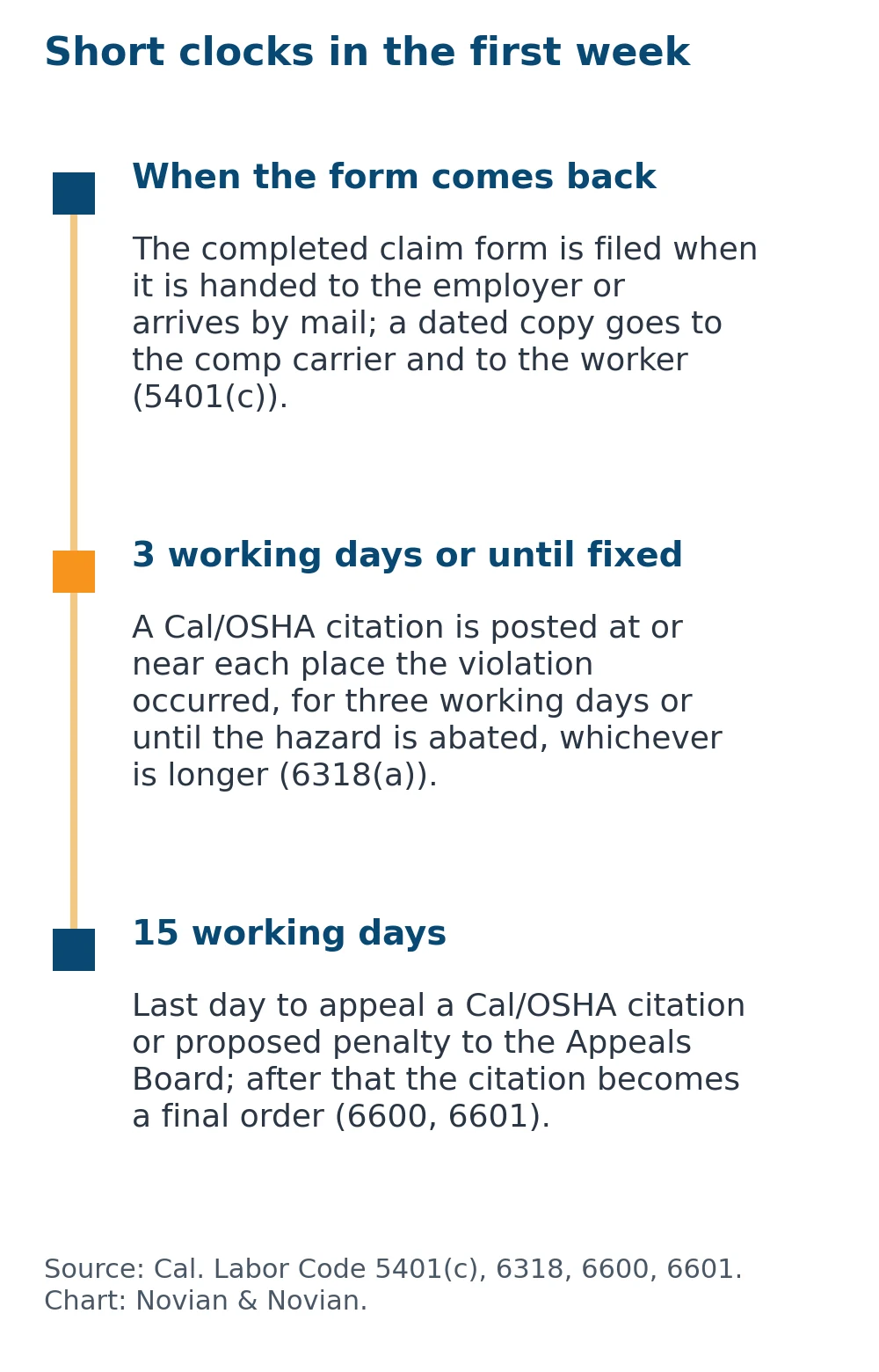
Most deadlines in an employment case run for months. A few run in working days, and in a Gardena plant or warehouse they tend to start before anyone has called a lawyer: the day an injured worker hands back a completed claim form, and the day a Cal/OSHA inspector leaves a citation. What the company does in those days becomes the record a later retaliation or disability claim is measured against.
The date the completed form comes back
Under Labor Code section 5401(c), the claim is filed when the worker personally delivers the completed form to the employer, or when the employer receives it by first-class or certified mail. The employer then gives a dated copy to its comp carrier and to the worker. That date is the one later disputes turn on, so whoever opens the mail at the front office should stamp the form the day it arrives and log who received it.
A Cal/OSHA citation goes on the wall
Labor Code section 6318(a) requires each citation, or a copy, to be posted prominently at or near each place a cited violation occurred, for three working days or until the unsafe condition is abated, whichever is longer. After an accident investigation that finds no violation, the employer posts the notice Cal/OSHA prepares for three working days. Crews read these postings, and a missing one is a fact a worker can raise if a safety complaint later turns into a retaliation claim.
Fifteen working days to appeal
An employer may appeal a citation, the abatement period or a proposed penalty to the Occupational Safety and Health Appeals Board within 15 working days of receiving it (section 6600). If nobody appeals in time, the citation becomes a final order of the Appeals Board that no court or agency can review, although the Board may extend the period for good cause (section 6601). The citation describes the same machine, heat condition or line speed an employee may sue over later, so the decision whether to appeal belongs with the employment exposure in view, not with the safety coordinator alone.
A citation arrived with this week's mail?
Count the working days from the date you received it, then call us with the citation and the inspector's notes. We look at the appeal and the employment side together.
Call about a citationWork injuries
When a Gardena Shop-Floor Injury Turns Into a Disability Claim
Under the Labor Code, workers' compensation is the exclusive remedy for the injury itself, and most of the time it stays that way. The employment claims come from what happens next: how the employer handles the claim form, the doctor's restrictions, the return to work and, sometimes, the termination. For a plant or warehouse employer, each step in that sequence is a point where an injury claim can turn into a lawsuit.
A supervisor's knowledge is the company's knowledge
Under Labor Code section 5402(a), the employer is on notice when a foreman, superintendent, managing agent or anyone else in authority knows of the injury, from any source. A line lead who saw the fall and said nothing to HR has still given the company notice. Training leads to report the same shift is the cheapest protection a Gardena plant can buy.
The benefits notice has to be readable in Spanish
The claim form the employer hands over comes with a notice of potential eligibility for benefits, and Labor Code section 5401(b) requires it to be easy to understand and available in both English and Spanish. A third of Gardena residents age 5 and older speak Spanish at home (33.5%, and 16.7% are Spanish speakers who speak English less than "very well", per the Census Bureau's 2020-2024 survey, table C16001), so a Gardena employer should keep both versions on hand at every site, not only at the main office. The notice has to explain, among other things:
- how to start proceedings to collect compensation;
- the different types of workers' compensation benefits;
- what happens to the claim form after it is filed;
- from whom the worker can get medical care for the injury;
- the role of the primary treating physician.
A worker who later says no one explained the process in a language they read will point to this notice first; a signed acknowledgment of the Spanish version closes that argument.
Posters and new-hire notices in Spanish
Labor Code section 3550 requires a posted notice naming the current workers' compensation carrier and who adjusts claims, in English and Spanish where there are Spanish-speaking employees, in a place employees see during the workday. If the poster is missing, an employee hurt during that time may be treated by their own physician. Section 3551 adds a written notice to every new employee at hire or by the end of the first pay period, also in English and Spanish.
The pay notice at hire, in the language you use with the crew
Labor Code section 2810.5 requires a written notice to every new non-exempt hire, in the language the employer normally uses to communicate employment information to that employee. For a Gardena crew supervised in Spanish, that means a Spanish notice. It must state:
- the rate or rates of pay and how they are paid (hour, shift, piece, commission), including overtime rates;
- any meal or lodging allowance claimed toward the minimum wage;
- the regular payday;
- the employer's legal name and any "doing business as" names, its main office address and phone number;
- the name, address and phone number of the workers' compensation carrier;
- the employee's paid sick leave rights, and any federal or state emergency declaration for the county issued within 30 days before the start date.
Changes to any of that information must be given in writing within seven calendar days, unless they already appear on the next wage statement. A notice that still names last year's comp carrier is a small error that tends to surface right after an injury.
When comp leave runs out: the interactive process
Under the FEHA regulations, Cal. Code Regs., tit. 2, § 11069(b), the employer must start a timely, good-faith interactive process when an employee with a disability has exhausted workers' compensation leave (or CFRA, FMLA or other leave) and the employee or doctor says more accommodation is needed. Failing to engage is a separate violation under Government Code section 12940(n), and failing to accommodate is another under section 12940(m), unless the accommodation would impose an undue hardship. "Your leave is used up, so your job is gone" is the sentence that most often converts a comp claim into a FEHA lawsuit.
What the employer may ask for
Section 11069(c) sets the ground rules for the conversation. The employer may require reasonable medical documentation when the disability or the need for accommodation is not obvious, but once it has that documentation it may not ask about the underlying medical cause. If the documentation needs clarification, the employer must say what is missing and allow reasonable time to supply it. Where it helps, the employer analyzes the job's essential functions and may consult experts. For a machine operator with a lifting restriction, that analysis is usually what decides whether modified duty exists.
Someone on your line is out on comp or on restricted duty?
Send us the incident report, the restrictions note and your carrier's claim number. We look at the employment side (accommodation, leave, return to work) while the comp claim runs.
Send the injury filePlants and warehouses
Heat, Quotas and Line Speed in Gardena Plants and Warehouses
Two California rules written for the kind of work Gardena does have produced a new set of employee claims: the indoor heat standard, operative since July 23, 2024, and the warehouse quota law, in force since 2022. Both create records an employer either has or does not have when a complaint arrives.
When the indoor heat rule applies
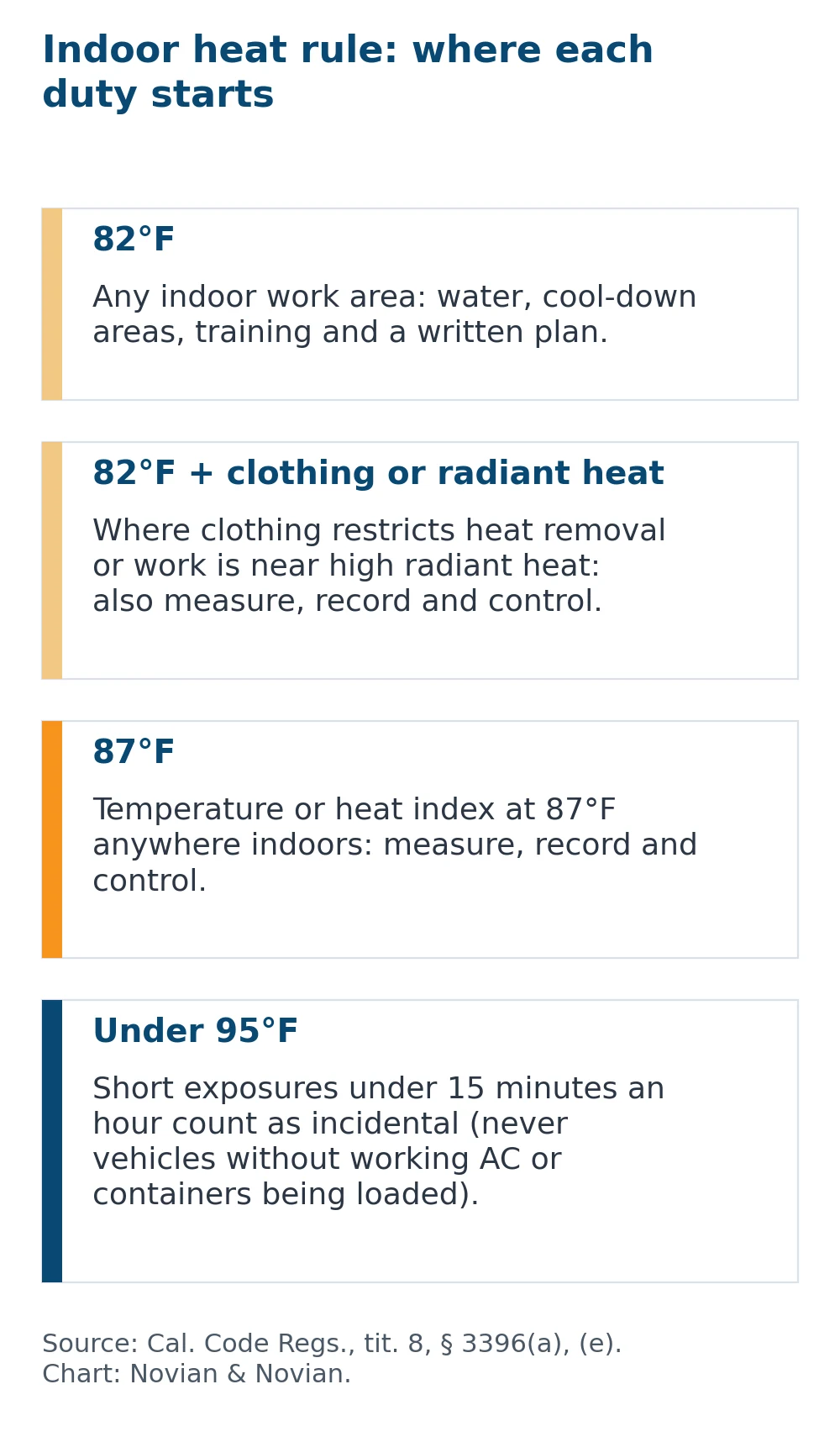
Cal. Code Regs., tit. 8, § 3396 applies to every indoor work area where the temperature reaches 82°F while employees are present. At that level the employer must provide water, cool-down areas, training and a written prevention plan. Exposures under 15 minutes an hour, below 95°F, count as incidental and fall outside the rule, but that exception never covers vehicles without working air conditioning or shipping containers during loading and unloading.
The 87-degree trigger and the measurement log
The fuller duties in section 3396(e) start when the temperature or the heat index reaches 87°F, or at 82°F where workers wear clothing that restricts heat removal or work near high radiant heat, such as ovens, fryers or furnaces. The employer must measure the temperature and heat index, record the higher of the two with the date, time and exact location, and use engineering or administrative controls to bring exposure down. A Gardena food plant or print shop that cannot produce those records starts any heat-related claim at a disadvantage.
Cool-down rest is paid like a recovery period
Section 3396 gives a preventative cool-down rest the same meaning as a "recovery period" under Labor Code section 226.7(a). In practice, a worker who needs to cool down and is told to keep working can claim the same premium pay as a missed rest break. Cool-down time belongs in timekeeping and in the supervisor's training, not only in the safety binder.
Did a worker stop work in a hot area, or ask to cool down?
Call before any discipline is decided. What a supervisor says that afternoon is what a retaliation claim will quote later.
Call about a heat complaintTraining before the first hot shift
Section 3396(h) requires training before an employee starts work that can reasonably be expected to bring heat exposure, and separate training for the supervisors who will oversee that work. The employee session has to cover, among other topics:
- the environmental and personal risk factors, including the extra heat load from exertion, clothing and protective gear;
- the employer's own procedures for water, cool-down areas and rests, and the right to use them without retaliation;
- drinking small amounts often, up to four cups an hour, when the work is hot;
- acclimatization, and the signs and first aid for each type of heat illness;
- reporting symptoms right away, in yourself or a coworker, and how emergency services will be called and directed to the site.
The regulation allows these measures to live inside the written Injury and Illness Prevention Program or in a separate document. For a Gardena plant, the sign-in sheet from that training, kept with the Spanish version of the materials, is often the record that ends a heat-retaliation claim early. The regulation's own note points out that firing or disciplining a worker for using these protections violates Labor Code sections 6310 to 6312.
Which Gardena warehouses the quota law reaches
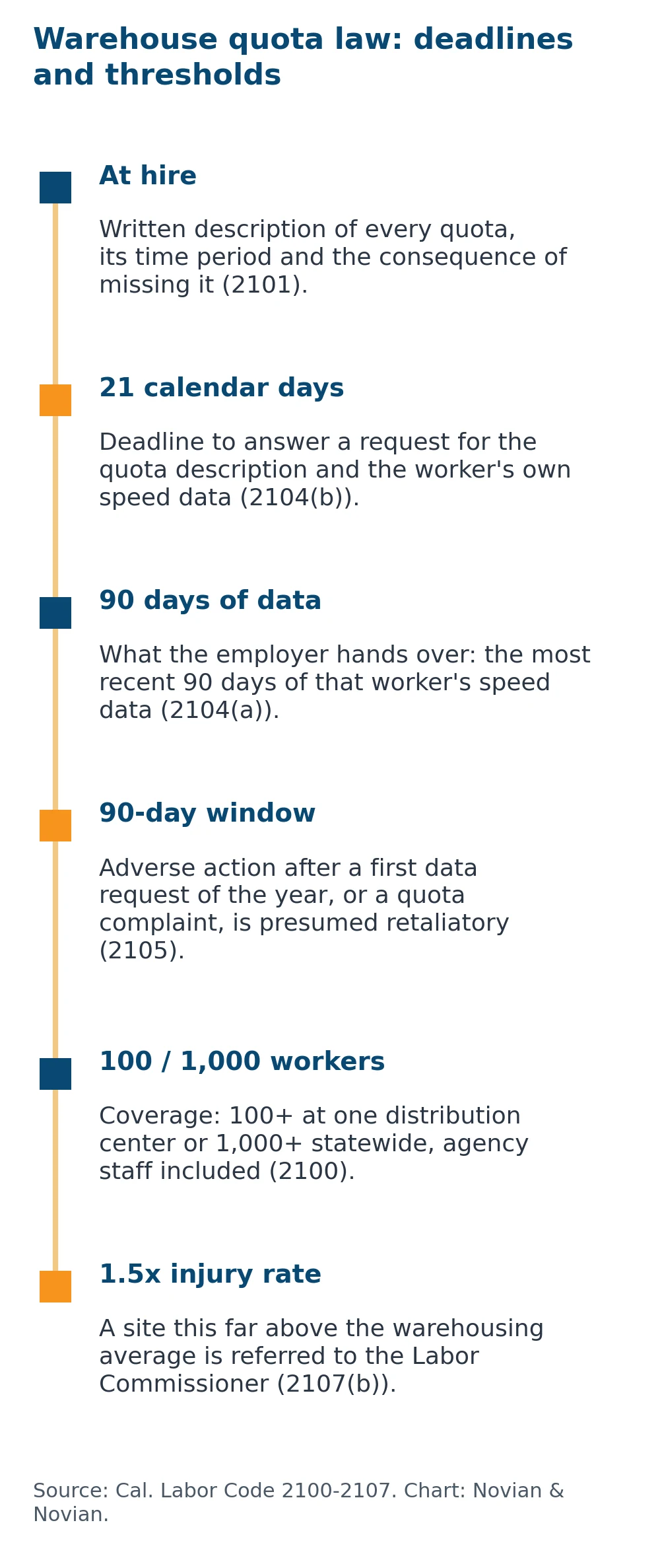
The warehouse quota law, Labor Code sections 2100 to 2112, applies to an employer with 100 or more employees at a single warehouse distribution center, or 1,000 or more at centers across the state, counting workers supplied by staffing agencies. "Warehouse distribution center" covers general warehousing (NAICS 493110), durable and nondurable merchant wholesalers (NAICS 423 and 424) and e-commerce fulfillment (NAICS 454110). A smaller wholesale site stays outside the law, but a busy distribution site with temp staff can cross the line without anyone noticing.
The written quota and what it may not do
A covered employer must give each worker, at hire, a written description of every quota: the tasks or volume, the time period, and the possible consequences of missing it (section 2101). No quota may stop a worker from taking meal or rest breaks, using the bathroom (including walking time to and from it) or complying with safety rules, and no one may be disciplined for missing a quota that did (section 2102). Time spent following safety rules counts as time on task (section 2103).
Requests for speed data, and the 90-day presumption
A current or former worker who believes a quota cost them a break or forced a safety violation may ask for the quota description and their own last 90 days of work-speed data; the employer must answer within 21 calendar days, and a former worker gets one request (section 2104). Any adverse action within 90 days after a worker's first data request of the year, or after a quota complaint, is presumed retaliatory (section 2105). When a worksite's injury rate reaches 1.5 times the warehousing industry average, Cal/OSHA or the Division of Workers' Compensation must tell the Labor Commissioner, who decides whether to investigate (section 2107(b)).
Four-tens and other alternative schedules on the line
Labor Code section 511 allows a regularly scheduled alternative workweek of up to 10 hours a day within 40 hours without daily overtime, but only if the employer proposes it and at least two-thirds of the affected employees in a readily identifiable work unit approve it by secret ballot. Work beyond the scheduled hours is still overtime, and work past 12 hours is double time. The employer may not cut hourly rates because a schedule is adopted or repealed, must make a reasonable effort to find an eight-hour schedule for a voter who cannot work the new hours, and must report the election results to the Labor Commissioner within 30 days. A four-tens schedule that was never put to a vote, or whose results were never reported, is one of the first things a wage claim against a Gardena plant tests.
Running a distribution floor with temp staff?
Count everyone at the site, agency workers included. If you are near 100, send us your quota sheet and your break schedule and we will check them against sections 2101 and 2102.
Send the quota sheetGaming employers
Card Room Payrolls, Tips and State Work Permits
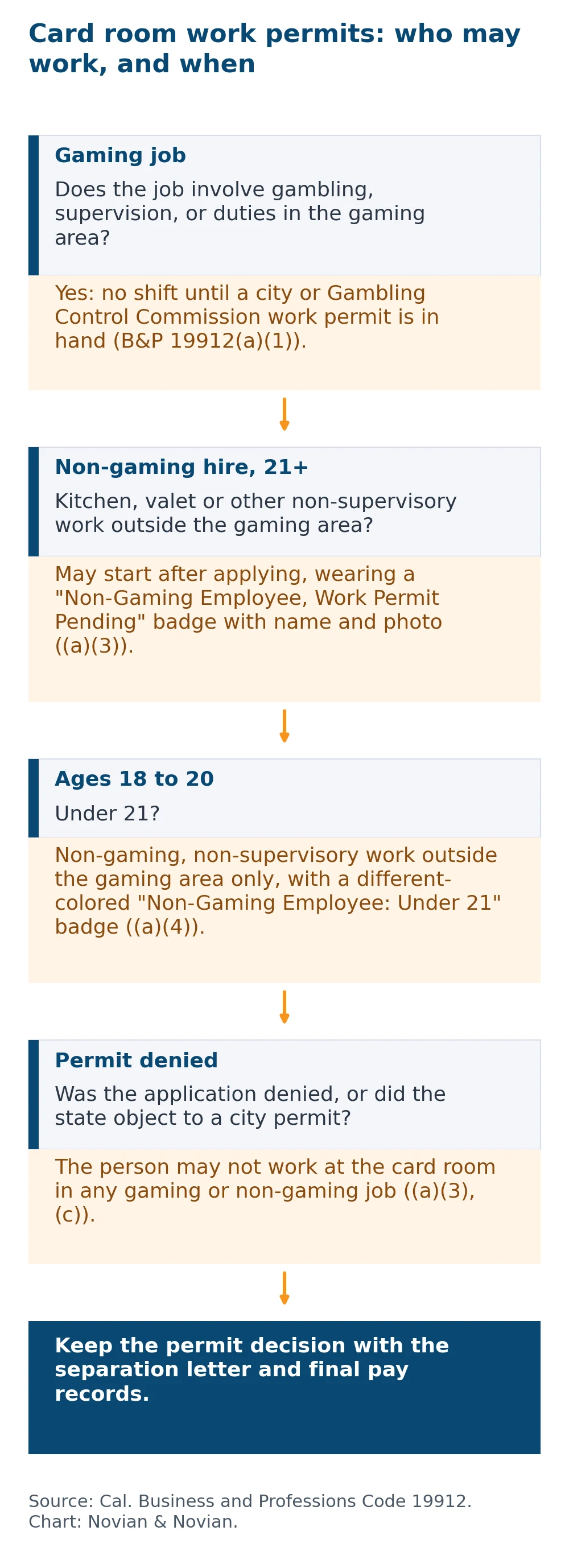
Gardena is one of the California cities with licensed card rooms inside its limits, and gaming payrolls bring rules no other Gardena employer deals with. The chart sets out who may work the floor, and when, under the state's work-permit statute; the paragraphs after it take each step in turn.
No work permit, no shift on the floor
Under Business and Professions Code section 19912, a gambling enterprise employee needs a valid work permit, issued either under the city's ordinance or by the California Gambling Control Commission. A Commission permit lasts two years and lets the holder work at any gambling enterprise for which the Commission issues permits, after notice to the state Department of Justice. A permit is denied to anyone disqualified from holding a state gambling license under section 19859.
Who can start before the permit arrives
Section 19912(a)(3) lets a non-supervisory employee whose job is not related to gambling, and who works outside the gaming area, start after applying, wearing a badge reading "Non-Gaming Employee, Work Permit Pending" with name and photo. Workers aged 18 to 20 may hold only non-gaming, non-supervisory jobs outside the gaming area, wearing a "Non-Gaming Employee: Under 21" badge in a different color (section 19912(a)(4)). A kitchen or valet hire who drifts onto the gaming floor before the permit issues is a regulatory problem first and an employment problem later.
A denied or revoked permit
When the state objects to a city-issued permit, or a permit is denied, the person may not keep working for the card room in any gaming or non-gaming job (section 19912(a)(3) and (c)). If that employee later claims the real reason for the separation was a complaint or a protected trait, the permit file is the company's strongest evidence. We make sure the termination letter cites the permit decision, attaches it, and was sent promptly after the decision, not weeks later after an unrelated dispute.
Dealers' tips
Labor Code section 351 makes every gratuity the sole property of the employees it was given to. The employer and its agents may not take any part of it, deduct from wages because of it, or count it toward wages. Tips paid by card must reach employees in full, without any deduction for card processing fees. Under section 351(b), as amended effective January 1, 2026, the Labor Commissioner may investigate and issue citations for tips taken or withheld. In a card room, the risk sits in the toke box: who counts it, who shares in it and whether a floor supervisor with authority over the dealers takes a cut.
Third-party proposition player firms
Many California card rooms contract with outside companies that supply players for player-dealer games. Business and Professions Code section 19984 requires the contract to be approved in advance by the state, requires those firms' owners, supervisors and players to be licensed or registered, and requires their staff to wear a badge identifying them. Two companies' employees then share one floor. When a proposition player complains about a casino supervisor, or the reverse, the approved contract and each company's harassment policy decide who investigates and who answers the claim, so both should say so in writing.
A permit was denied for someone already on your floor?
Call before you act on it. The order of steps (taking the person off the schedule, documenting the permit decision, final pay) matters if the separation is challenged.
Call about a permit issueOn the ground
Payroll Across the Harbor Gateway Line
Gardena shares long borders with the City of Los Angeles, whose Harbor Gateway neighborhood is a narrow strip running down the city's east side. For a Gardena employer whose staff drive, deliver, install or repair, that boundary changes the wage rate.
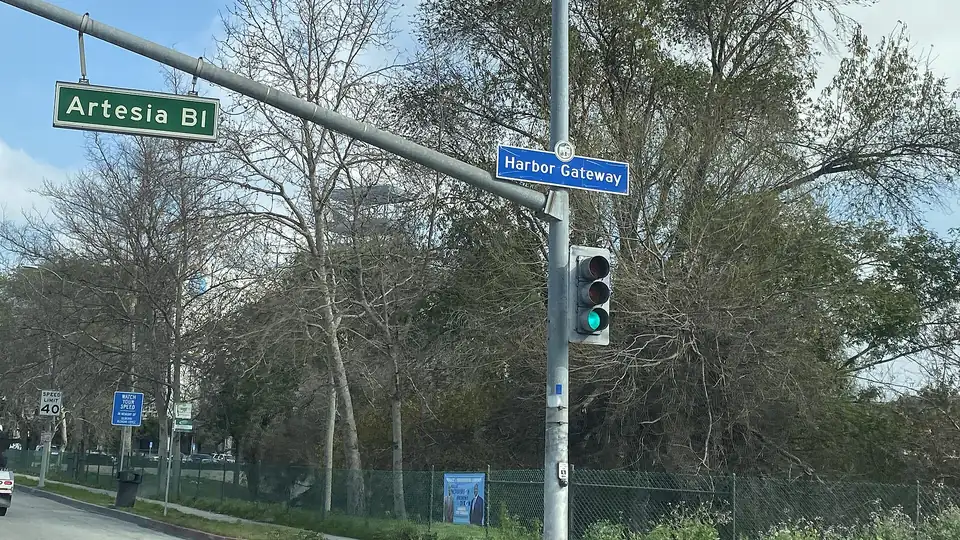
Two hours in Los Angeles changes the rate
The Los Angeles Minimum Wage Ordinance covers any employee who performs at least two hours of work in a particular week within the City of Los Angeles, for any employer. Since July 1, 2026, the city rate has been $18.42 an hour. The employer must pay that rate, and provide the city's paid sick leave, for the hours worked inside city limits.
Routes, service calls and timekeeping
A Gardena company with route drivers or field technicians needs timekeeping that shows where hours were worked, not only how many. Without it, a wage claim can argue that every hour should have been paid at the higher city rate. GPS logs, job tickets with addresses and dispatch records are the evidence that separates Gardena hours from Los Angeles hours.
Los Angeles sick leave for the same workers
The city ordinance also gives paid sick leave to employees who work at least two hours in a week in Los Angeles for the same employer on 30 or more days within a year. Unused city sick time carries over, and the employer may cap the carryover at no less than 72 hours. A Gardena business whose drivers qualify should track that balance separately from the state sick leave policy, because the two rules count and cap the hours differently.
Hotel work across the line
Los Angeles also has a separate Citywide Hotel Worker Minimum Wage Ordinance, amended on May 26, 2026, with its own rates published by the city's Office of Wage Standards. A Gardena staffing or cleaning contractor that sends workers into Los Angeles hotels should price those assignments from the city's current wage chart rather than the general minimum.
Reviews From Clients Who Hired Farhad Novian’s Team

“I have been a client of Novian & Novian for over 10 years and consider Farhad Novian as a highly experienced business and corporate litigator. His extensive legal experience and considerable success allows him to apply the most effective legal strategy, resulting in a successful outcome on a wide spectrum of litigation matters.”
“Thank you, Farhad, Sharon and your team of excellent lawyers. I highly recommend Novian and Novian LLP for all of your legal issues, this team is superior in their drive and commitment to protecting small business owners. There should be six stars available for firms like this one.”
“I cannot offer a more resounding recommendation for Novian & Novian or be more grateful to Farhad Novian & his staff for their exemplary work on my behalf. I am forever grateful and unequivocally recommend this exceptional firm.”
Quoted word for word from client reviews published on novianlaw.com (Rick, Grant M. and Tim B.). A client review is not a guarantee, warranty or prediction of the outcome of your matter.
Questions
What Gardena Plant, Warehouse and Card-Room Managers Ask Us
Questions Gardena owners, plant managers and HR staff raise about the claims and rules on this page. Each answer covers something the sections above do not.
Are you an employment lawyer in Gardena for workers or for employers?
For employers. On this page, Novian & Novian represents Gardena businesses that receive an employee claim. A worker looking for a lawyer can find a State Bar certified lawyer referral service through the State Bar of California.
Who handles the workers' compensation claim itself?
The comp claim runs through the employer's insurance carrier, its claims administrator and, if disputed, the Workers' Compensation Appeals Board. What comes to us are the employment claims that travel with it, filed in court or with the Civil Rights Department: disability discrimination, failure to accommodate, failure to engage in the interactive process, and wrongful termination.
Can a sexual harassment settlement be kept confidential?
Only partly. Code of Civil Procedure section 1001 voids settlement terms signed since January 1, 2019 that prevent disclosure of the facts of a filed claim of sexual assault, sexual harassment, workplace harassment or discrimination, or retaliation for reporting them. The amount paid can still be kept confidential, and at the claimant's request the agreement can shield the claimant's identity. Settlement drafts that copy older confidentiality clauses need to be rewritten.
Is an employee protected after reporting a safety problem to Cal/OSHA?
Yes. Labor Code section 6310 bars discharge or discrimination because an employee complained about safety or health to Cal/OSHA, another agency or the employer, took part in a safety committee, reported a work-related injury or illness, or asked for injury records. When a firing follows a safety complaint in a plant or warehouse, it is the first statute to check.
Can we fire a worker who refuses to run an unsafe machine?
Not if the refusal fits Labor Code section 6311: an employee may not be laid off or discharged for refusing work that would violate a safety law, standard or order where the violation would create a real and apparent hazard to the employee or coworkers. The practical step is to investigate the complaint about the machine before deciding anything about the person. The same goes for heat: the indoor heat rule is a Cal/OSHA standard, so a worker who stops working in a hot area with no cool-down access may claim this protection.
Your question is about a notice you are holding?
Read us the agency name, the date and the case number over the phone. Those three details tell us which deadline is running.
Call (310) 553-1222Our notice says DFEH. Is that still the agency?
The Department of Fair Employment and Housing was renamed the Civil Rights Department in 2022, and older templates and some employees' lawyers still use the old name. The law it enforces, the Fair Employment and Housing Act, kept its name, so a letter that cites "DFEH" or "FEHA" is about the same agency and the same statute. What matters for a Gardena business is the date on the notice and whether it is an investigation or an immediate right-to-sue; send it to us with the envelope, because the response deadlines run from what is in it, not from the name at the top.
If the claim says sexual assault, not harassment, is the deadline different?
Yes, and it is much longer. For conduct against an adult, Code of Civil Procedure section 340.16 allows a damages suit until the later of 10 years after the last act or three years after the person discovers, or should have discovered, the injury it caused. No criminal charge or conviction is needed, and the section does not limit claims against people or companies other than the person accused, which is how an employer ends up named. Under an amendment in force since January 1, 2026, section 340.16(e) also revives expired adult sexual assault claims, which can be filed until December 31, 2027, against a company accused of covering up an earlier assault or allegation involving the same alleged perpetrator, together with related wrongful termination and sexual harassment claims.
Does Gardena have its own minimum wage?
No. Gardena has not passed a city minimum wage (it is not on the UC Berkeley Labor Center inventory of local ordinances), so work inside city limits is paid at least the state minimum, $16.90 an hour in 2026. The Los Angeles County ordinance covers only unincorporated county areas, where the rate went from $17.81 to $18.47 on July 1, 2026. Work done across the Los Angeles city line follows the city rule described above.
Does outdoor work in the yard have its own heat rule?
Yes. Outdoor work falls under Cal. Code Regs., tit. 8, § 3395, not the indoor standard. Shade must be available when the outdoor temperature exceeds 80°F, enough for everyone on a recovery or rest period, and water must be fresh, placed as close as practicable to the work, and supplied in enough quantity for each employee to drink a quart an hour. A loading yard or truck lot can be under both rules on the same shift: section 3395 outside, section 3396 inside the building.
Does the warehouse quota law cover a parcel sorting hub?
It depends on how the site is classified. Courier and delivery operations, which federal industry codes place under NAICS 492, are not among the four codes in section 2100(i) listed in the coverage subsection above, while an online fulfillment center is. A Gardena employer that runs both kinds of work at one address should look at how the establishment itself is classified before assuming the law does or does not apply.
What happens after a worker complains about a quota to the Labor Commissioner?
The Labor Commissioner enforces the quota law with the same procedures it uses for wage claims and retaliation complaints, under Labor Code sections 98, 98.3, 98.7, 98.74 and 1197.1, as section 2107(d) directs. If the Commissioner sues and wins, the court may order changes to the quota and must award the Commissioner costs and reasonable attorney's fees (section 2107(e)). The employer's first task is to produce the written quota description and the worker's speed data, because the 21-day deadline for a data request often runs alongside the complaint.
Can we ask about a card room applicant's background before hiring?
The state does that through the permit. Section 19912 ties work-permit eligibility to the disqualifications for a state gambling license in Business and Professions Code section 19859, and the state Department of Justice may object to a city-issued permit. Card rooms should let the permit process carry that review and keep their own hiring questions to what the job and the law allow, so the permit file, not a separate inquiry, is the record of the background check.
Gardena Employment Lawyer for Employers: Send Us the Papers
These are general rules; the facts of a specific claim can change the answer. If an employee claim has reached your Gardena business, use the form to tell us what arrived, when it was served and how many people you employ, and an attorney will contact you.
1801 Century Park East, Suite 1201 Los Angeles, CA 90067
Employer Defense in Hawthorne, Compton, Inglewood, Carson and Torrance
Neighboring cities we also serve, by distance between city centers in the Census Gazetteer, plus our employment law practice overview.