
An employee claiming a hostile work environment in California must prove they belong to a protected class, experienced unwelcome harassment because of that characteristic, and endured conduct severe enough to alter working conditions. They must also establish a basis for holding the employer responsible, including when management knew about the harassment but failed to act. Courts evaluate the conduct’s frequency, severity, and impact on the employee’s ability to work, not merely whether the employee felt uncomfortable. Unlike federal anti-discrimination laws, California’s FEHA applies a more employee-protective standard, allowing claims based on conduct that may not meet the federal threshold.
At Novian & Novian, we represent injured clients on a contingency fee basis, so you pay no attorney fees unless we recover compensation for you. Our attorneys have more than 35 years of experience handling workplace discrimination and sexual harassment claims. Our firm highlights more than $1 million recovered in settlements to date. If you are being accused of harassment, contact us today for a free consultation.
This guide sets out each element, what actually defeats it, and where California employers carry more exposure than they expect.
Table Of Contents
- What Must an Employee Prove to Establish a Hostile Work Environment?
- What Counts as Harassment Based on a Protected Characteristic?
- Does the Conduct Have to Be Severe or Pervasive?
- How Does California’s Standard Differ From Federal Law?
- When Is an Employer Legally Responsible for the Harassment?
- What Evidence Supports a Hostile Work Environment Claim?
- How Can Employers Assess Hostile Work Environment Exposure?
- How Long Does an Employee Have to Bring a Claim?
- How Should an Employer Reduce Its Exposure Before a Claim Arrives?
- Step 1 – Publish and Distribute a Policy That Meets the Regulatory Requirements.
- Step 2 – Meet the Training Legal Requirements.
- Step 3 – Take Every Complaint Seriously, Including Anonymous Ones.
- Step 4 – Investigate Promptly and Document Each Step as It Happens.
- Step 5 – Take Corrective Action.
- Step 6 – Protect the Complainant and Every Witness From Retaliation.
- What Should Employers and Employees Understand About These Claims?
- Need Help Facing a Harassment Claim?
- Frequently Asked Questions
What Must an Employee Prove to Establish a Hostile Work Environment?

The employee carries the burden on every element, and the elements are cumulative. A claim fails if any one of them is missing. The employee must establish membership in a protected class and unwelcome conduct directed at them because of that protected characteristic.
They must then show the harassing conduct was severe or pervasive enough to alter the conditions of employment and create an abusive working environment. Finally, they must establish a basis for employer liability, which differs depending on who did the harassing.
In our experience, the standard is severe or pervasive, not both, so a claim does not fail merely because conduct happened once. And the environment must be objectively hostile to a reasonable person and subjectively hostile to the employee who experienced it. An employee who was genuinely untroubled at the time has a harder claim. An environment no reasonable person would find abusive does not become a hostile environment because one employee found it so.
What Counts as Harassment Based on a Protected Characteristic?
The conduct must be tied to a protected characteristic. This is the element that disposes of most claims, and it is where the distinction between a hostile work environment and an unpleasant workplace actually lives. Conduct qualifies when it is unwelcome, meaning uninvited and unwanted, and when it occurs because of the employee’s protected status.
Offensive jokes, slurs, derogatory comments, offensive remarks about a person’s race, humiliating remarks, physical threats, unwanted physical advances, and negative comments about religion or national origin can all qualify. Conduct of a sexual nature is covered, and so is offensive language that carries no sexual element at all. Racial slurs are the clearest example of offensive behavior that qualifies. The conduct does not have to be motivated by sexual desire to constitute sexual harassment.
Which Characteristics Does California Protect?
California protects a broader list than federal law. Under the Fair Employment and Housing Act, the protected characteristics include race, religious creed, color, national origin, ancestry, and physical or mental disability. The list continues with medical condition, genetic information, marital status, sex, gender, gender identity, and gender expression. It also covers age, sexual orientation, reproductive health decision-making, and veteran or military status.
The practical consequence is that conduct which would not support a federal claim may still support a California one. An employer applying the federal list is working from an incomplete picture of its own exposure. The same breadth applies across claim types, so a company defending an age discrimination matter faces the same expanded definitions.
What Does Not Qualify as a Hostile Work Environment?
General workplace unfairness does not qualify. Neither does a demanding manager, an isolated rude remark untethered to any protected characteristic, personality conflict, unfavorable scheduling, or criticism of job performance. Workplace bullying and isolated incidents of ordinary rudeness are not actionable in California as a hostile workplace claim unless tied to a protected characteristic.
Stress and effects on mental health, standing alone, do not establish the claim either, although they may support damages once liability is shown. That distinction is genuine, and it is the employer’s strongest ground. A difficult boss who treats everyone badly is behaving poorly, not unlawfully. The claim turns on whether the treatment was because of who the employee is.
Does the Conduct Have to Be Severe or Pervasive?
It has to be one or the other, and California has legislated specific instructions on how courts should assess that question. Those instructions are in Government Code section 12923, added by Senate Bill 1300 and effective January 2019. The statute is a declaration of legislative intent, and it is unusually direct.
It affirms the standard set out by Justice Ruth Bader Ginsburg in her concurrence in Harris v. Forklift Systems, quoting her statement that a plaintiff need not prove that his or her tangible productivity has declined as a result of the harassment. It is enough to show that a reasonable person would find the harassment so altered working conditions that it made the job more difficult. The stated purpose is to secure a workplace free of discrimination.
Section 12923 also states that the totality of the circumstances governs, and that a discriminatory remark may be relevant circumstantial evidence even if not made directly in the context of an employment decision or uttered by a nondecisionmaker. It rejects the stray remarks doctrine.
Courts weigh all the surrounding circumstances rather than examining each comment in isolation. It provides that the legal standard for sexual harassment does not vary by type of workplace, which forecloses the argument that coarse talk is normal in a particular industry. And it states plainly that harassment cases are rarely appropriate for disposition on summary judgment.
Can a Single Incident Be Enough in California?
Yes. Section 12923 says a single incident of harassing conduct is enough to create a triable issue regarding the existence of a hostile work environment if the conduct interfered with the plaintiff’s work performance or created an intimidating, hostile, or offensive working environment. The California Supreme Court reached the same conclusion in Bailey v. San Francisco District Attorney’s Office, decided unanimously in July 2024.
The Court held that an isolated act of harassment may be actionable if it is sufficiently severe in light of the totality of the circumstances, and that a coworker’s use of an unambiguous racial epithet, such as the N-word, may suffice. The harasser in Bailey was a coworker rather than a supervisor, so the case ran on the negligence standard rather than strict liability.
Also, the Court expressly declined to rest its decision on section 12923, noting only that its holding appears consistent with the statute. The single-incident rule in California therefore does not depend on one provision surviving a challenge. It has independent support from the state’s highest court.
A single incident creates a triable issue, which means the claim survives to a jury. It does not mean the employer loses. The practical significance is that the case does not go away on paper, which is precisely what section 12923(e) was written to accomplish.
What Does a California Hostile Work Environment Case Look Like?
Consider a hypothetical example involving a California employee who is repeatedly subjected to racial slurs by a coworker. The employee reports the conduct to human resources, identifies witnesses, and provides copies of messages containing offensive remarks. The employer acknowledges the complaint but takes no meaningful investigative or corrective action.
The employee may have a viable hostile work environment claim if the conduct was sufficiently severe or pervasive and the employer failed to respond reasonably after receiving notice. The coworker’s conduct alone does not automatically establish employer liability; the employer’s knowledge and response are also important.
The outcome would depend on the evidence, the severity and frequency of the conduct, and the steps the employer took after learning about it. This example shows why a prompt response to a complaint can materially affect the strength of a harassment defense.
How Does California’s Standard Differ From Federal Law?
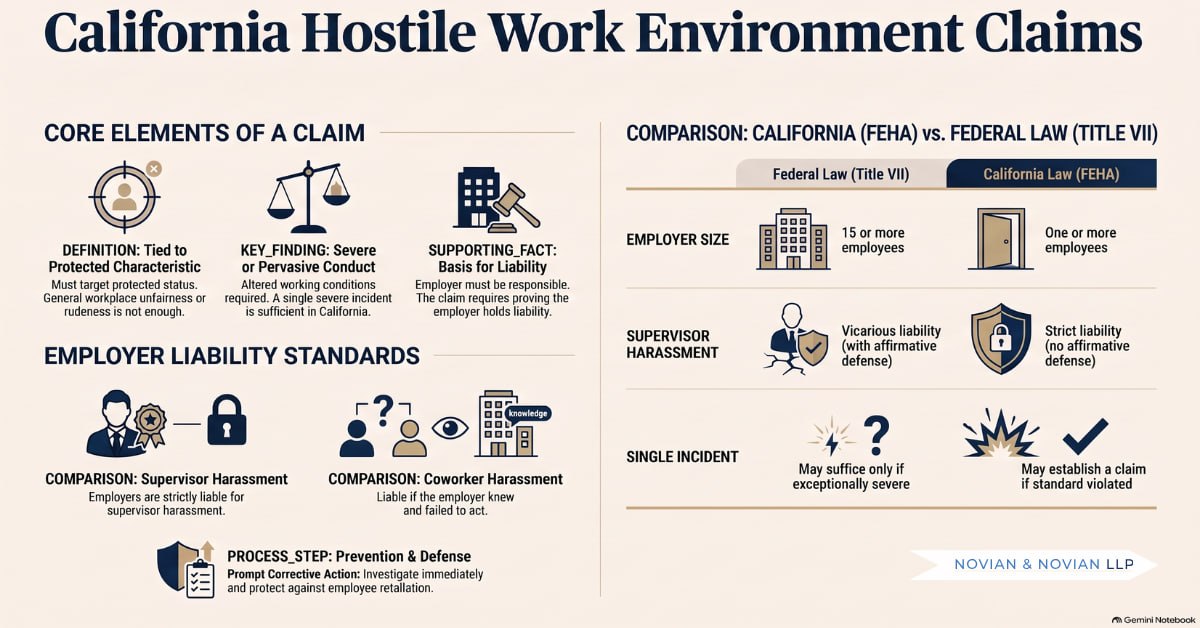
California and federal law start with the same elements, then diverge on almost every question that decides cases. The comparison below shows where the two differ.
| Question | Federal law, Title VII | California, FEHA |
|---|---|---|
| Employer size for harassment liability | Generally, 15 or more employees. | One or more employees. |
| Single incident | May suffice only if the conduct is sufficiently severe. | A single incident may establish a claim if it violates the statutory standard. |
| Stray remarks by a non-decisionmaker | May be discounted depending on their relevance and context. | Relevant circumstantial evidence; California rejects the strict stray-remarks doctrine. |
| Industry norms as context | Workplace context and industry norms may be considered. | The standard does not vary by type of workplace. |
| Supervisor harassment | Employers may be vicariously liable, subject to an affirmative defense in certain circumstances. | Employers are generally strictly liable for supervisor harassment. |
| Employee’s failure to report | May support the employer’s affirmative defense. | Not a defense to liability, although it may reduce damages. |
| Summary judgment | May be granted when no genuine dispute of material fact exists. | Rarely appropriate in harassment cases under California law. |
The single line in that table doing the most work is the first. For that subdivision alone, California’s harassment provisions define an employer as any person regularly employing one or more persons. The five-employee threshold that employers cite applies to discrimination claims, not harassment. A California business with one employee is exposed, and most small employers do not know it.
When Is an Employer Legally Responsible for the Harassment?
In our experience, the employer is strictly liable if the harasser is a supervisor. California does not adopt the federal affirmative defense that allows an employer to escape liability by showing it exercised reasonable care and the employee unreasonably failed to use the complaint process. Under California law, that showing goes to damages rather than to liability, through the narrower avoidable consequences doctrine.
When a supervisor is the harasser, a prompt and thorough investigation does not get the employer out of the case. It limits the period of compensable harm. Employers who assume the federal framework protects them are relying on a defense California does not recognize. Knowing about workplace discrimination defense in California means starting from that premise rather than the federal one.
A negligence standard applies if the harasser is a coworker or a third party. Under Government Code section 12940, harassment by an employee other than a supervisor is unlawful where the employer knows or should have known of this conduct and fails to take immediate and appropriate corrective action.
The same standard reaches harassment by non-employees such as clients, vendors, and contractors, where the employer knew or should have known and failed to act. In each case, the employer is held liable only if it failed to take appropriate action once on notice.
This is where employer conduct genuinely decides outcomes. The employer that learns of coworker harassment and acts promptly has a real defense. The employer that receives a complaint and lets it sit does not, and the delay itself becomes the evidence. How a company handles a disgruntled employee, and documents what it did, is frequently the whole case. Employers that protect employees promptly after a report are in a materially different position from those that wait.
What Evidence Supports a Hostile Work Environment Claim?
Contemporaneous records matter, and employers should understand what a plaintiff will assemble because the same material can support or undermine the defense. The evidence that carries weight includes dated incident logs, emails and text messages, and witness statements from colleagues who observed the conduct. It also includes human resources complaints and the employer’s response, plus performance reviews showing a change in the employee’s work performance.
Physical and digital evidence both count, as does the pattern of how and when the employee tried to file complaints internally. The company’s own file is usually the most important evidence, and it is built long before anyone files anything. Knowing how to document employee issues contemporaneously is what makes a defense possible.
A California employee handbook setting out a real complaint process is the first thing a plaintiff’s lawyer will ask for. We have found that this exposure is not theoretical. The Equal Employment Opportunity Commission (EEOC) received 37,397 charges alleging harassment in fiscal year 2025 and obtained $261.9 million in monetary benefits for charging parties through its administrative process, before any litigation.
How Can Employers Assess Hostile Work Environment Exposure?
Assessing hostile work environment exposure requires more than reviewing the alleged misconduct. Employers must examine the protected characteristic involved, the nature and severity of the conduct, who was responsible, and how the company responded. The following five-part framework provides a practical starting point for identifying potential liability and evaluating the strength of an employer’s defense.
Protected characteristic: Was the alleged conduct connected to race, sex, religion, disability, or another legally protected characteristic?
Conduct: What exactly was said or done, and was the behavior unwelcome?
Severity and frequency: Was the conduct isolated, repeated, threatening, humiliating, or otherwise sufficiently serious?
Notice and responsibility: Who committed the conduct, and when did the employer know or have reason to know?
Response and records: What did the employer investigate, document, and do to prevent the conduct from continuing?
This five-part review helps separate an unpleasant workplace from a potentially actionable hostile work environment. It also identifies where an employer’s evidence may be incomplete. The framework is a practical assessment tool, not a substitute for the legal elements that a court must apply.
How Long Does an Employee Have to Bring a Claim?

An employee in California may file with the state Civil Rights Department within three years of the alleged unlawful practice. The federal counterpart, Title VII of the Civil Rights Act, follows its own schedule. After receiving a right-to-sue notice, the employee generally has one year to file a civil action.
In California, an employee must generally file a charge with the Equal Employment Opportunity Commission within 300 days because the state has its own enforcement agency. An employee who relies only on the state deadline can still lose federal claims.
A hostile work environment claim is treated differently from a discrete act such as a termination, because the environment is created by a course of conduct over time rather than at a single moment. That affects how the filing period is calculated and is another reason employers should not assume older conduct has become irrelevant.
How Should an Employer Reduce Its Exposure Before a Claim Arrives?
Almost everything that decides these cases happens before a complaint is filed. The sequence below reflects where employers actually gain or lose ground.
Step 1 – Publish and Distribute a Policy That Meets the Regulatory Requirements.
California requires a written harassment, discrimination, and retaliation prevention policy with a complaint process, and the policy the company adopts becomes the benchmark it is measured against.
Step 2 – Meet the Training Legal Requirements.
Provide the required harassment prevention training under California employment law. Employers with five or more employees must train supervisory and nonsupervisory staff on a recurring schedule, and the training records are part of the defense file.
Step 3 – Take Every Complaint Seriously, Including Anonymous Ones.
The obligation is triggered by notice, not by the form the complaint takes. An employer who should have known is in the same position as one formally told.
Step 4 – Investigate Promptly and Document Each Step as It Happens.
For coworker harassment, this is the defense. For supervisor harassment, it limits damages rather than defeating liability, which makes speed more valuable, not less.
Step 5 – Take Corrective Action.
We advise that the action should be proportionate to what the investigation found and should confirm that the conduct has stopped. A finding with no action attached is worse than no finding, because it establishes that the employer knew.
Step 6 – Protect the Complainant and Every Witness From Retaliation.
Reporting harassment is protected activity, and adverse actions taken afterward create retaliation claims that frequently outlive the underlying harassment claim. Those claims arise from how the employer behaved after the complaint, not before it, and they often travel alongside a wrongful termination allegation. If an employee threatens a lawsuit, the response in the following days often matters more than the original incident.

What Should Employers and Employees Understand About These Claims?
A harassment allegation deserves serious attention, but an allegation is not the same as a proven violation. Employees may experience genuine distress without the conduct satisfying every legal element of a hostile work environment claim. Conversely, an employer may have a strong workplace policy yet still face liability if it did not implement the policy properly or respond adequately.
Employers should avoid dismissing complaints simply because the conduct appears isolated or because the accused denies the allegations. Employees should also understand that a difficult workplace, without harassment tied to a protected characteristic, may not meet the legal definition of a hostile work environment.
In our experience, a fair process protects everyone involved. The goal is to establish what happened, determine whether the conduct violated applicable law or workplace policy, and take an appropriate response based on the evidence.
Need Help Facing a Harassment Claim?
The value of employment counsel is not limited to defending a lawsuit after it is filed. Our employment practice addresses both preventive employment counseling and litigation defense. That combination allows employers to consider immediate workplace needs alongside the legal and evidentiary consequences of their decisions. Early advice cannot eliminate every risk, but it can help an employer make more informed decisions while the facts are still developing.
At Novian & Novian, our team of employment attorneys is dedicated to delivering results through strategic advocacy that protects your interests. We also provide personalized attention to each case and strive to build a relationship based on trust and transparency with all clients. Schedule a free consultation with us today!
Frequently Asked Questions
These are the questions employers and employees raise most often about what a hostile work environment claim actually requires.
What Evidence Is Needed to Prove a Hostile Work Environment?
Dated incident records, emails and text messages, witness statements, human resources complaints and the employer’s response to them all carry weight. Performance reviews from the relevant period can also show the effect on the employee’s work performance.
Can a Single Incident Create a Hostile Work Environment?
Yes, in California. Government Code section 12923 states that a single incident of harassing conduct is sufficient to create a triable issue, and the California Supreme Court confirmed in 2024 that an isolated act may be actionable if it is sufficiently severe.
Is Workplace Bullying a Hostile Work Environment?
Not on its own. Bullying becomes actionable harassment only when it is tied to a protected characteristic, which is why general workplace unfairness and a difficult manager do not support a claim.
Is an Employer Liable if It Did Not Know About the Harassment?
It depends on who the harasser was. For supervisor harassment, the employer is strictly liable in California, while for coworker or third-party harassment, the question is whether the employer knew or should have known and failed to take immediate and appropriate corrective action.
How Can Employers Prevent a Hostile Work Environment?
Publish and distribute a compliant policy, provide the required training, investigate every complaint promptly and impartially, and document what was done at the time. Protecting complainants and witnesses from retaliation afterward is equally important.
Reviewed by Farhad Novian, Esq., Novian & Novian, LLP \- Los Angeles, California
Legal Disclaimer: This article is provided for general informational purposes only and does not constitute legal advice. Reading it does not create an attorney-client relationship with Novian & Novian, LLP. Whether particular conduct gives rise to a hostile work environment claim depends on the specific facts, the employment relationship involved, and the federal, state, and local laws that apply; those laws and the decisions interpreting them change over time. Filing deadlines are strict and vary by forum. Employers and employees should consult a licensed attorney about their own circumstances before acting on any information in this article.
Attorney Advertising. The information on this website is provided for general informational purposes only and is not legal advice. Past results do not guarantee future outcomes. Viewing this website does not create an attorney-client relationship. The best way to get guidance on your specific legal issue is to contact a lawyer. To schedule a meeting with an attorney, please call (323) 747-8097.
 CALL:
CALL: