Quick answer
An employer wins an EEOC charge by showing, with records dated before the complaint, that the decision rested on a legitimate reason unrelated to any protected trait or activity. Organize the defense around five steps: Preserve, Pinpoint, Prove, Present and Prevent. Then test timing, because an employee usually has 180 days to file, or 300 in some states.
Winning an EEOC complaint starts with responding promptly, preserving evidence, and submitting a detailed position statement supported by employment records, policies, and witness statements. Demonstrate that every employment decision was based on legitimate, non-discriminatory business reasons and avoid any actions that could be viewed as retaliation. Hiring an experienced employment attorney improves your chances of success by helping you develop a strong legal strategy, protect your rights, and respond effectively to the EEOC. Legal representation also provides emotional support during the process, helping employers navigate a stressful investigation with greater confidence.
At Novian & Novian, we help employers evaluate EEOC charges, investigate the underlying facts, and assess whether mediation or another resolution strategy makes sense. Our attorneys have more than 35 years of experience handling employment law, and have secured fair settlements for employers. Our firm highlights more than $1 million recovered in settlements to date. If you have an EEOC charge, contact us today for a free consultation.
This post will provide a clear overview of an EEOC complaint and a step-by-step strategy for handling, responding to, and resolving one.
Table Of Contents
- What Is an EEOC Complaint Process and Why Does It Matter?
- What Makes Successful EEOC Complaints, and What Does It Mean for Your Defense?
- The 5-P Framework for Defending an EEOC Charge
- How Do You Respond to an EEOC Charge Through the EEOC Portal?
- What Should You Do After Receiving an EEOC Complaint?
- What Are the Most Common Reasons Employees File EEOC Complaints?
- What Are the Odds of Winning an EEOC Complaint?
- How Can an EEOC Complaint Affect Your Business?
- Is EEOC Mediation Worth It?
- What Are the Most Common Employer Mistakes in EEOC Cases?
- Need Help With Your EEOC Charge?
- Frequently Asked Questions
What Is an EEOC Complaint Process and Why Does It Matter?

The Equal Employment Opportunity Commission (EEOC) is the federal agency responsible for enforcing anti-discrimination laws in the workplace. An EEOC complaint, formally known as a charge of discrimination, is a legal claim filed by an employee or job applicant who believes they have experienced unlawful discrimination at work. This can involve being treated differently based on race, sex, age, disability, national origin, religion, genetic information, or other protected characteristics under federal employment law.
The complaint process typically begins when an individual files an initial complaint with the EEOC’s office. From there, the agency may pursue mediation, launch a formal investigation, request witness statements and relevant documents, and ultimately determine whether discrimination likely occurred. If the EEOC determines there is reasonable cause, the employer may face serious consequences, including lawsuits, mandatory corrective action, and costly settlements in federal court.
For employers, the stakes are high. An EEOC case can damage company morale, attract negative public attention, and create financial burdens that extend far beyond legal fees. Failing to respond properly to an EEOC complaint can also result in the loss of credibility before federal operations and civil rights agencies.
What Can Employers Be Sued For?
Under the laws enforced by the EEOC, employers can be sued for several types of alleged discrimination and employment violations. One of the most common EEOC complaint categories is discrimination claims. For example, age discrimination claims often arise when older workers feel they’ve been passed over for promotions or unfairly terminated due to their age.
Another frequent basis for EEOC complaints is retaliation. If an employee files a complaint, participates in an investigation, or supports a co-worker’s claim and then suffers a demotion, termination, or other adverse job action, they may claim retaliation. This type of EEOC case is particularly dangerous for employers because retaliation can be easier to prove than the original allegation of discrimination.
Harassment is also a major issue under the EEOC. Harassment, including sexual harassment in the workplace and other forms of hostile work environment, can lead to significant legal exposure. When employers fail to take prompt corrective action or ignore complaints from workers and co-workers, they open the door to liability.
In addition, failure to provide reasonable accommodations for disabilities or religious practices is another area where employers face EEOC scrutiny. Under federal employment law, workers have the right to request accommodations for physical or mental disabilities and religious beliefs. Denying or ignoring those requests without proper justification may lead to an EEOC complaint and legal action.
Unequal pay is yet another reason employers may face lawsuits. Under the Equal Pay Act, employees are entitled to receive equal compensation for equal work, regardless of gender. If women in your organization are paid less than men in similar positions with the same responsibilities, that wage disparity can become the basis for an EEOC complaint and even escalate into class-action litigation.
What Makes Successful EEOC Complaints, and What Does It Mean for Your Defense?

In our experience, knowing what makes successful EEOC complaints is essential for evaluating risk and building an effective defense. Strong employment discrimination claims typically share three characteristics: credible evidence, thorough documentation, and compliance with strict deadlines throughout the EEOC process.
The first is evidence. A claim tied to a specific decision, a named decision-maker, and a documented adverse employment action carries far more weight than a general workplace grievance. The EEOC investigates allegations of unlawful employment discrimination under federal laws, including Title VII, which prohibits discrimination based on race, color, religion, sex, and national origin.
Other federal laws, including the Americans with Disabilities Act, the Age Discrimination in Employment Act, and the Genetic Information Nondiscrimination Act, protect additional classes. Gathering evidence immediately after the discriminatory act strengthens your position, while solid evidence can also refute employer exaggerations during mediation.
Maintaining meticulous documentation is equally important in navigating an EEOC complaint. Contemporaneous performance reviews, disciplinary records, emails, and other business records are generally more persuasive than documents created after a complaint is filed. Consistent records showing legitimate performance concerns before any protected activity help establish a lawful, non-discriminatory reason for an employment decision.
Conversely, documentation that appears only after a complaint or accommodation request may undermine an employer’s credibility. Timeliness is another critical factor. A charge generally must be filed within 180 days of the discriminatory act, although the deadline may extend to 300 days if a state or local fair employment agency also enforces a similar law.
Federal sector workers follow different rules and have 45 days to contact an EEO counselor after the discriminatory act before filing a formal complaint. These deadlines apply only to federal employees. In addition, some state laws, such as California’s Fair Employment and Housing Act, provide longer filing periods, making it important to evaluate both federal and state deadlines before relying on a timeliness defense.
Finally, don’t overlook witness testimony. A signed statement from someone who directly observed the events is usually far more persuasive than multiple accounts based on workplace impressions. Identify the individuals involved early, preserve their recollections while they are fresh, and document their statements carefully. Those statements often become valuable evidence when preparing a position statement or defending against a claim.
While the EEOC aims for administrative judges to issue decisions within 180 days of a hearing request whenever practicable, actual timelines often vary based on the case’s complexity. For practical guidance on organizing evidence and preparing your response, see our walkthrough: Example Response to EEOC Charge of Discrimination.
The 5-P Framework for Defending an EEOC Charge
Employers can approach an EEOC charge using a simple five-part framework. These are Preserve, Pinpoint, Prove, Present, and Prevent.
Preserve: Immediately protect relevant emails, personnel records, performance reviews, disciplinary documents, policies, text messages, and other potentially relevant evidence. Do not delete, modify, or selectively preserve records after learning about the charge.
Pinpoint: Identify exactly what the employee alleges, which protected characteristic or protected activity is involved, who made the challenged decision, when the relevant events occurred, and what employment action is being challenged.
Prove: Match each important factual assertion to contemporaneous evidence. If the employer says an employee was terminated for poor performance, for example, the personnel file should contain credible evidence showing that performance concerns existed before the employee engaged in protected activity.
Present: Build the position statement around the actual evidence rather than conclusions. Address each allegation directly, explain the employer’s legitimate business reasons, identify applicable legal defenses, and organize supporting documents so the EEOC can understand the employer’s position without having to reconstruct the facts.
Prevent: Use the charge as an opportunity to identify weaknesses in workplace policies, documentation, manager training, accommodation procedures, or complaint-handling practices. A successful defense should not only resolve the current charge but also reduce the risk of similar claims later.
In our experience, this framework helps employers avoid a common mistake: treating the EEOC charge as a standalone dispute rather than examining the employment decision, the evidence supporting it, and the company’s broader practices.
When Documentation Can Change an EEOC Defense

Consider an employee who files an EEOC charge alleging that the employer terminated them because of their age. The employer maintains that the termination resulted from repeated performance problems.
The strength of the employer’s defense may depend less on the employer’s current explanation than on what the records showed before the termination. If performance reviews from the preceding year identify the same deficiencies, supervisors previously discussed those deficiencies with the employee, and similarly situated employees were disciplined under the same policy, the employer has contemporaneous evidence supporting its stated reason.
Now consider the opposite situation. Suppose the employer has no documented performance concerns until shortly after the employee complains about discrimination, and the manager’s explanation changes several times during the investigation. Even if poor performance was the employer’s actual reason, the lack of contemporaneous documentation can make that explanation more difficult to defend.
The lesson is not that documentation automatically wins or loses an EEOC charge. Rather, employers should be able to connect their stated reason for an employment decision to credible evidence that existed when the decision was made.
How Do You Respond to an EEOC Charge Through the EEOC Portal?
The EEOC runs the entire charge process digitally, and employers have their own access. Employees file through the EEOC public portal, which lets them submit an inquiry, complete an interview, and file a charge online, by mail, by telephone, or in person. Employers respond through the separate Respondent Portal, where your defense is built.
Step 1: Access the Charge.
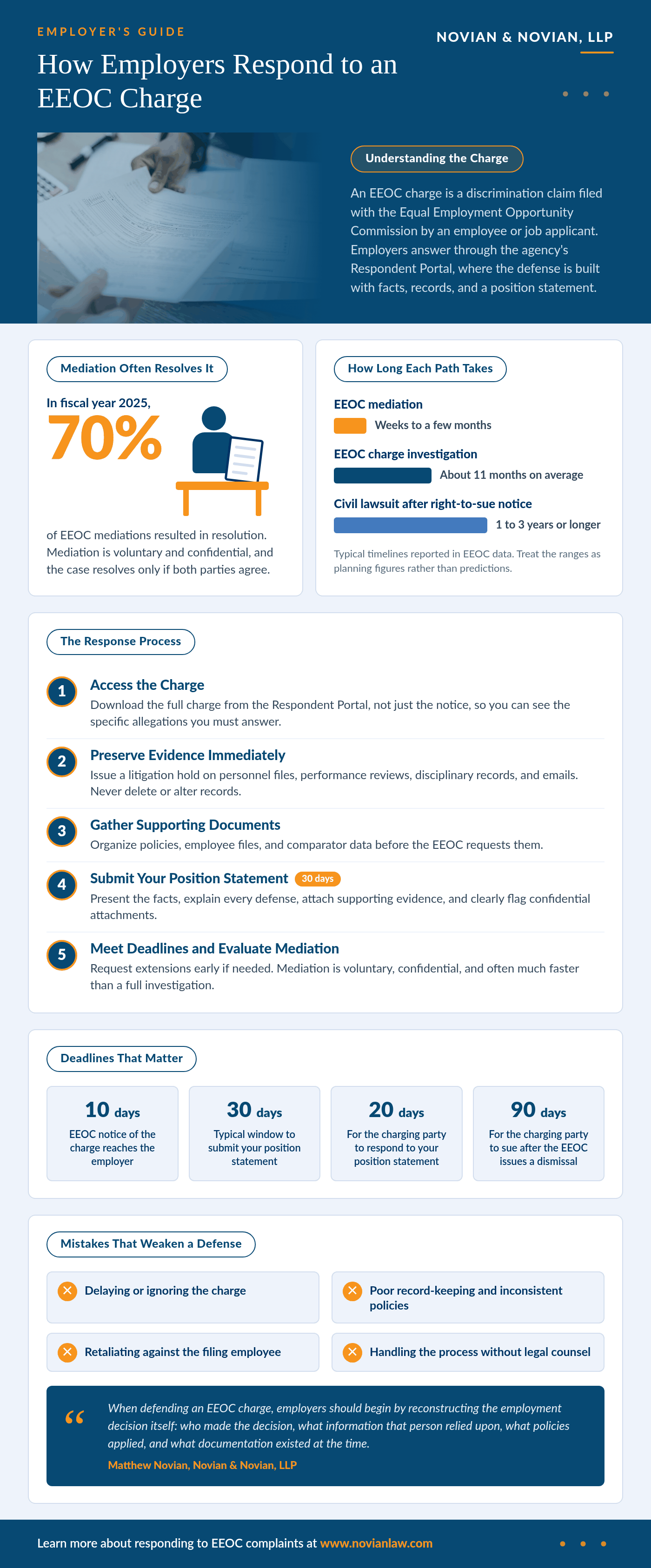
The EEOC sends employers a notice within 10 days with a link to the Respondent Portal. Download the actual charge, not just the notice, because it identifies the protected category and specific allegations you must answer. Employees can file an EEOC complaint through the EEOC Public Portal, by mail, by telephone, or in person. Utilizing the EEOC Public Portal also makes it easier to track a case and submit documents.
Step 2: Preserve Evidence Immediately.
Issue a litigation hold for personnel files, performance reviews, disciplinary records, emails, and other relevant communications. Destroying or altering records after receiving notice can create serious spoliation issues during the EEOC investigation.
Step 3: Gather Supporting Documents.
Organize personnel policies, employee files, comparator data, and other records before the EEOC requests them. Being prepared helps you respond faster and keeps the EEOC investigation moving efficiently.
Step 4: Submit your Position Statement.
You generally have 30 days to respond. Present the facts, explain every legal and factual defense, and attach supporting evidence. Clearly identify confidential attachments because the EEOC may provide your position statement and non-confidential documents to the charging party, who has 20 days to respond.
Step 5: Meet Deadlines and Evaluate Mediation.
If you need more time, request an extension as early as possible and explain the reason. Mediation is voluntary and confidential and can resolve a case much faster than a full investigation, making it worth considering when the facts are disputed or documentation is incomplete.
Employers respond through the Respondent Portal, while employees use the EEOC Public Portal to file a complaint online, by mail, by telephone, or in person, track their case, and submit documents. Respond promptly, preserve evidence, submit a well-supported position statement, and consider mediation when appropriate.
What Should You Do After Receiving an EEOC Complaint?

Receiving an EEOC complaint can be a daunting moment for any employer, especially if the allegations involve serious claims such as age discrimination, retaliation, or violations of the Equal Pay Act. However, responding effectively begins with immediate, strategic action. Here’s what to do once you’ve received notice of a discrimination charge from the EEOC’s office:
Review the Complaint Carefully.
Read the charge in full and identify the specific allegations, dates, individuals involved, and protected category. Because the EEOC enforces federal anti-discrimination laws, your response should address each allegation with facts rather than assumptions.
Preserve and Gather Evidence.
Documentation is crucial. Collect personnel files, performance evaluations, disciplinary records, company policies, emails, and other communications that relate to the claims. If the employee alleges they were treated differently than other employees, gather comparator records where appropriate. Your burden of persuasion is to present convincing evidence that supports your position.
Notify Key Personnel.
Inform HR, supervisors, and any employees with relevant knowledge of the events. Instruct everyone to preserve records, maintain confidentiality, and cooperate with the investigation.
Avoid Retaliation.
Do not take any adverse action against the employee for filing a charge or participating in the investigation. Federal retaliation protections prohibit adverse employment actions against individuals who file an EEOC charge or assist in an investigation.
Consult an Employment Attorney.
An experienced employment attorney can help evaluate the allegations, prepare a strong position statement, protect privileged communications, and improve your chances of a successful outcome.
“When defending an EEOC charge, employers should begin by reconstructing the employment decision itself: who made the decision, what information that person relied upon, what policies applied, and what documentation existed at the time,” says Matthew Novian. “That factual timeline often determines which defenses are available and which records need to be submitted.”
What Are the Most Common Reasons Employees File EEOC Complaints?
In our experience, most EEOC charges fall into a few recurring categories. Retaliation is consistently the most common, followed by race and color discrimination, disability discrimination under the Americans with Disabilities Act (ADA), and sex discrimination, including sexual orientation and gender identity. Other common claims involve age, religion, national origin, genetic information, and hostile work environments. Depending on the claim, employees may first file with a state or local agency that has a work-sharing agreement with the EEOC.
Retaliation deserves particular attention because it often arises after an employee files a complaint, requests an accommodation, or participates in an investigation. Any disciplinary action taken afterward should be supported by documented, legitimate business reasons that existed before the protected activity. Honesty is essential throughout the EEOC complaint process, and evidence gathering is critical for establishing the validity of a discrimination claim or defending against one.
The four-fifths (80%) rule is frequently misunderstood. Under the Uniform Guidelines on Employee Selection Procedures, a selection rate for a race, sex, or ethnic group that is less than 80% of the highest group’s selection rate may indicate adverse impact and warrant further review. It is not proof of discrimination or a legal safe harbor. Employers should evaluate their hiring and promotion practices as a whole and maintain documentation that supports business necessity.
What Are the Odds of Winning an EEOC Complaint?
The published numbers favor employers, and understanding why helps set realistic expectations without inviting complacency. According to EEOC data, roughly 17.5% of charges resolved in fiscal year 2025 produced a merit resolution, meaning an outcome favorable to the charging party. The large majority of charges close without a reasonable cause finding. Less than one in five charges results in a favorable outcome for the employee.
We have found that payout figures circulating online are frequently inflated, so it is worth working from the agency’s own reporting. In fiscal year 2023, the EEOC secured approximately $440.5 million for 15,143 people in private-sector and state and local government workplaces through mediation, conciliation, and settlements. That averages roughly $29,000 per person. In fiscal year 2025, the agency reported more than $528 million in pre-litigation monetary relief.
Timing is the cost most employers underestimate. The EEOC reports that investigation and resolution average approximately 11 months. When the EEOC finds insufficient evidence, it issues a dismissal and the charging party has 90 days to file their own lawsuit. When the EEOC finds sufficient evidence, both parties receive a Letter of Determination and the agency attempts conciliation. If conciliation fails, the EEOC may sue or issue a notice of right to sue.
The comparison below sets the charge process against civil litigation on the three measures employers ask about. Treat the ranges as planning figures rather than predictions, since the facts of each matter drive the actual numbers.
| Path | Typical Timeline | Typical Employer Cost | Outcome Pattern |
|---|---|---|---|
| EEOC charge investigation | Approximately 11 months on average | Legal counsel costs for preparing the position statement, responding to Requests for Information (RFIs), and participating in interviews | About 17.5% of resolved charges result in a merit resolution. Most charges close without a reasonable cause finding. |
| EEOC mediation | Weeks to a few months | Generally lower costs due to limited document exchange and one or two mediation sessions | Voluntary and confidential. The case resolves only if both parties reach an agreement. |
| Civil lawsuit after right-to-sue notice | One to three years or longer | Significantly higher costs from discovery, depositions, motions, expert involvement, and possible trial preparation | Most cases settle before trial. Potential exposure may include damages for emotional distress, back pay, lost wages, and attorney fees. |
Legal representation affects all three columns, primarily by shortening them. A position statement that raises the right defenses with attached evidence can end a matter at the first stage. For budgeting the engagement itself, our breakdown of how much an employment lawyer costs sets out hourly and alternative fee structures.
How Can an EEOC Complaint Affect Your Business?

An EEOC complaint can have serious legal, financial, and reputational consequences for any employer. Once a discrimination charge is filed with the Equal Employment Opportunity Commission (EEOC), your business enters a complex legal process governed by federal employment law and anti-discrimination laws, including the Civil Rights Act, the Equal Pay Act, and laws protecting against age discrimination, national origin bias, and disability-based discrimination. Even if the complaint is ultimately dismissed, the toll it can take on your resources and reputation can be significant.
The most damaging outcome is litigation in federal court, which can be both financially draining and reputationally devastating. Legal fees can quickly escalate, especially if you’re unprepared or lack legal counsel. Failing to respond proactively can also increase the likelihood of losing in court.
The worst-case scenario includes not only a legal judgment but also public exposure, regulatory scrutiny, and long-term brand damage. This is why employers must treat every EEOC complaint with seriousness. This includes responding swiftly, gathering evidence, consulting with an employment lawyer, and aiming for a successful outcome.
Is EEOC Mediation Worth It?
There is no universally correct response to an EEOC charge. An employer with strong documentation and a credible non-discriminatory explanation may decide that defending the charge is appropriate. Another employer may have incomplete records, conflicting witness accounts, or meaningful litigation exposure and determine that early resolution makes more business sense.
Defending the charge may be appropriate when the evidence is strong, the employer’s explanation is consistent, comparable employees were treated similarly, and the potential exposure is relatively limited. The disadvantage is that defending the matter can require additional attorney time, management attention, document production, and prolonged uncertainty.
Mediation may be attractive when both sides have incentives to avoid the cost and disruption of a longer investigation or litigation. The EEOC describes mediation as a voluntary resolution process, and its FY 2025 data shows that 70% of the agency’s mediations resulted in resolution. However, mediation is not appropriate simply because a charge was filed. Employers should first assess the allegations, available defenses, potential remedies, and settlement authority.
Settlement may make sense when the cost of continued defense, uncertainty of the outcome, business disruption, or potential litigation exposure exceeds the value of continuing to fight the claim. A settlement can provide greater control over the outcome, but employers should understand exactly what claims, obligations, confidentiality provisions, and other terms the agreement covers.
The decision should therefore be based on risk rather than emotion. A charge that feels unfair may still present meaningful legal exposure, while a serious-sounding allegation may have little support in the evidence. Employers should evaluate the facts before deciding whether to fight, mediate, or resolve the matter.
What Are the Most Common Employer Mistakes in EEOC Cases?

One of the most damaging errors an employer can make is delaying or ignoring an EEOC complaint. Time limits are strict, and the EEOC takes non-responsiveness seriously. Ignoring a complaint can trigger an automatic escalation to a formal investigation or even default judgments in federal court. Even if you believe the allegations are completely false, treating the process with professionalism and urgency is essential to win an EEOC complaint.
Another common mistake is poor record-keeping or maintaining inconsistent workplace policies. Employers who fail to preserve disciplinary records, performance evaluations, or emails often find themselves without the evidence needed to defend against a discrimination charge.
Likewise, if policies are applied unequally across employees or if there is a pattern of treating some workers differently, the EEOC may view this as evidence of bias. Establishing clear, well-documented practices that align with federal employment law helps avoid the perception of unlawful discrimination.
Lastly, attempting to manage the complaint without legal counsel is a major risk. The EEOC complaint process involves legal technicalities, deadlines, and documentation standards that most employers are not equipped to handle alone. Employment lawyers can help you respond to discovery requests, prepare witness statements, and defend your position in EEOC mediation or court. The cost of defending an employment lawsuit can be steep, but the cost of not having legal representation can be even higher, particularly if a case is lost or settles unfavorably due to avoidable errors.
Need Help With Your EEOC Charge?
The EEOC charge process rewards employers who respond precisely and on time, and it punishes those who treat the notice as routine correspondence. The work an employment attorney does at this stage is specific. It means reading the charge against the actual personnel file. It means identifying which defenses the documents will support. It means drafting a position statement that closes the matter rather than opening new questions.
At Novian & Novian, our team of employment attorneys is dedicated to delivering results through strategic advocacy that protects your interests. We also provide personalized attention to each case and strive to build a relationship based on trust and transparency with all clients. Schedule a free consultation with us today!
Frequently Asked Questions
These are the questions California employers ask most often after a charge arrives, with short answers on each.
What Makes a Strong EEOC Case?
A strong case combines evidence that discrimination occurred, contemporaneous documentation, credible witness statements, and a charge filed within the deadline. Claims that identify a specific protected category, a specific decision-maker, and a documented adverse action are the hardest for employers to defeat.
What Are the Odds of Winning an EEOC Complaint?
EEOC data shows roughly 17.5% of charges resolved in fiscal year 2025 produced an outcome favorable to the charging party. Most charges close without a reasonable cause finding, though the odds in any individual matter depend entirely on the evidence.
What Is the Average EEOC Payout?
EEOC reporting for fiscal year 2023 shows approximately $440.5 million recovered for 15,143 people, which averages roughly $29,000 each. Higher figures commonly cited online do not match the agency’s published data, and individual outcomes vary widely with the claim and the evidence.
What Is the 80% Rule in Discrimination?
The 80% rule, formally the four-fifths rule at 29 C.F.R. § 1607.4(D), flags a selection rate below four-fifths of the highest group’s rate as evidence of adverse impact. It is a screening threshold that prompts further investigation rather than a finding of discrimination, and clearing it is not a safe harbor for an employer.
Can You File an EEOC Complaint for a Hostile Work Environment?
Yes, when the harassment is based on a protected characteristic and is severe or pervasive enough to alter the conditions of employment. Ordinary workplace friction and general rudeness do not qualify unless they are tied to a protected category.