
A workplace discrimination investigation determines whether someone was treated unfairly because of a protected characteristic, such as race. It should document the report, gather relevant information and documents, and ask open-ended questions about incidents, behavior, and discriminatory comments. Investigators should compare how other employees in the same job were treated for similar infractions and assess whether conduct created a hostile work environment. Employers should respond promptly and take a proactive, fair approach to investigating discrimination.
At Novian & Novian, we help California employers respond to workplace discrimination and sexual harassment claims with strategic, evidence-focused defense. Our attorneys have more than 35 years of experience handling employment disputes and business litigation. If your business is being accused of harassment or discrimination, contact us today for a free consultation.
This guide explains what the investigation must establish, which statutes apply, the sequence that holds up under scrutiny, and where a California employer carries obligations federal law never imposed.
Table Of Contents
- What Must a Workplace Discrimination Investigation Establish?
- Which Discrimination Laws Cover Your Company?
- Must an Employee Go to the EEOC Before Suing?
- Does the Law Require a Particular Investigation Process?
- How Should an Employer Investigate a Discrimination Complaint?
- Step 1 – Log the Complaint and Decide Scope on the Day It Arrives
- Step 2 – Issue a Preservation Instruction Before Anything Moves
- Step 3 – Assign an Investigator With No Stake in the Outcome
- Step 4 – Build the Comparator Analysis Before the Interviews, Not After
- Step 5 – Interview the Complainant, Then the Witnesses, Then the Decision-Maker
- Step 6 – Test the Stated Reason Rather Than Accepting It
- Step 7 – Write Findings on Each Allegation Separately and Act On Them
- What Framework Should Employers Use to Test a Discrimination Complaint?
- Which Party Should Move While the Investigation Is Open?
- How Should an Employer Balance the Interests of Everyone Involved?
- What Evidence Decides a Discrimination Investigation?
- Which Bases Are Employees Actually Alleging?
- What Are the Most Common Errors in a Discrimination Investigation?
- When Should an Employer Involve Employment Counsel?
- Can Novian & Novian Help an Employer Facing a Discrimination Complaint?
- Frequently Asked Questions
- Must an Employer Investigate Every Discrimination Complaint?
- Who Should Conduct a Workplace Discrimination Investigation?
- Can an Employer Promise a Complainant Complete Confidentiality?
- What Records Should an Employer Gather in a Discrimination Investigation?
- Does a Prompt Investigation Protect an Employer From Liability?
What Must a Workplace Discrimination Investigation Establish?
The investigation has to reach a reasonable conclusion on one issue. Was the protected characteristic a reason for the treatment the employee received? An investigator who answers a different question has produced a document that will not help the company later. Three findings do the work. The first is what actually happened, stated as facts rather than as characterizations.
The second is whether a difference in treatment occurred, measured against how the company treated comparable employees in comparable situations. The third is whether the employer had a documented, non-discriminatory reason that predates the complaint. Employers assessing their position should start with workplace discrimination defense fundamentals rather than with the merits of the individual allegation.
In our experience, a discrimination complaint is not the same as a harassment complaint, although the two frequently arrive together. Discrimination concerns a decision or a term of employment. Harassment concerns conduct that alters the working environment. The evidence differs, the liability rules differ, and an investigator who blends them produces findings on neither.
Which Discrimination Laws Cover Your Company?
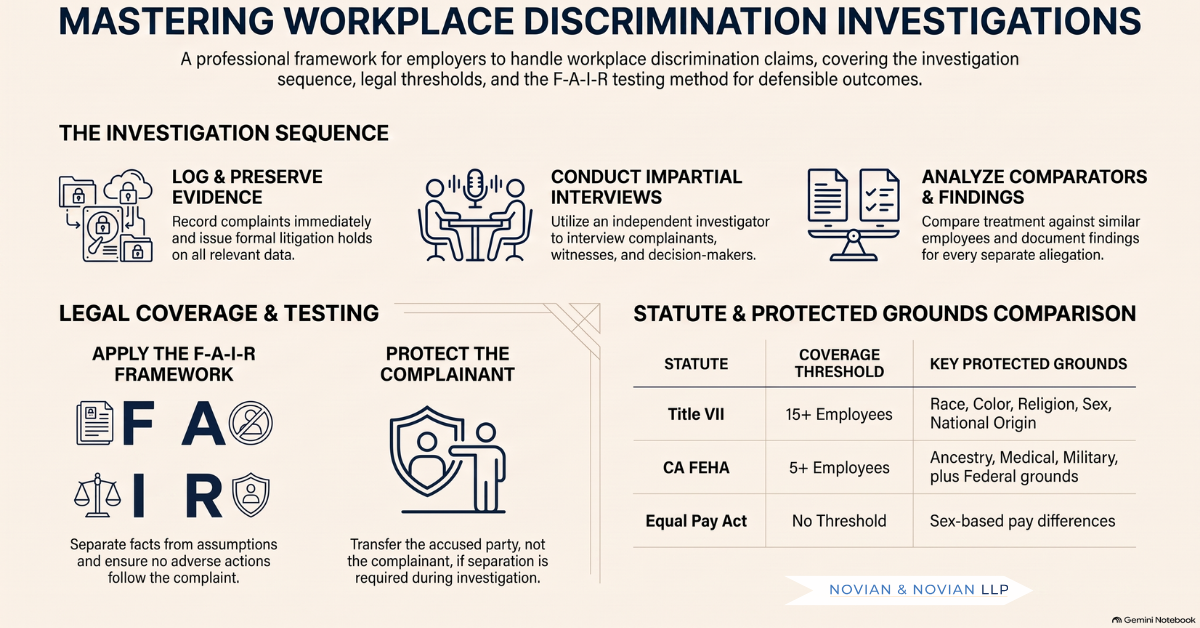
In our experience, it is more than most employers assume. The common shorthand that federal anti-discrimination law starts at fifteen employees is right for two statutes and wrong for the rest. The table below sets out the coverage threshold and the protected ground for each statute a California employer is likely to face.
| Statute | Employers Covered | Protected Ground |
|---|---|---|
| Title VII of the Civil Rights Act | 15 or more employees for each working day in 20 or more calendar weeks | Race, color, religion, sex, national origin |
| Americans with Disabilities Act (ADA) | 15 or more employees on the same weekly measure | Disability, plus a duty of reasonable accommodation |
| Age Discrimination in Employment Act (ADEA) | 20 or more employees on the same weekly measure | Workers who are at least 40 years of age |
| Genetic Information Nondiscrimination Act (GINA) | 15 or more employees, adopting the Title VII definition | Genetic information, including family medical history |
| Equal Pay Act (EPA) | No headcount threshold of its own | Sex-based pay differences for equal work |
| California Fair Employment and Housing Act (FEHA) | 5 or more employees for discrimination claims | Federal grounds and a broader list of state-protected characteristics |
The age statute is the row employers get wrong. Congress set the Age Discrimination in Employment Act threshold at twenty or more employees, not fifteen, and it protects workers who are at least forty. A company with seventeen employees is outside the federal age statute and squarely inside Title VII. Flattening every federal threshold to fifteen produces a coverage answer that is wrong in both directions.
The Equal Pay Act row deserves its own note. It sits inside the federal wage and hour statute rather than inside Title VII, so it carries no separate headcount floor and reaches employers that no other federal discrimination law touches. A small California employer that assumes it is too small to face a federal pay claim has assumed something the statute does not say. Coverage is the first thing our California employment law team checks when a complaint arrives.
Which Characteristics Does Federal Law Protect?
Title VII covers five grounds, and national origin is the one most often dropped from the list. The statute makes it unlawful to discriminate against an individual because of race, color, religion, sex, or national origin. An investigator working from a four-item list misses a large category of claim. Sex discrimination reaches further than the word suggests.
The Supreme Court decided Bostock v. Clayton County in June 2020. An employer who fires an individual merely for being gay or transgender discharges that person for traits it would not have questioned in members of a different sex. That violates Title VII. Sexual orientation and gender identity are therefore sex discrimination under federal law. Title VII also defines the terms because of sex and on the basis of sex to include pregnancy, childbirth, and related medical conditions.
Add the other federal statutes and the field widens again. Disability and the duty of reasonable accommodation come from the Americans with Disabilities Act. Age comes from the Age Discrimination in Employment Act. The Genetic Information Nondiscrimination Act covers genetic information, including family medical history. A complaint framed in ordinary language rarely names the statute, so part of the intake job is working out which grounds are actually in issue.
How Does California Law Widen the Field?
Substantially, and in three directions at once. The first difference is size. The Fair Employment and Housing Act defines an employer as any person regularly employing five or more persons. A company with six employees therefore falls under the state discrimination statute. It falls outside Title VII, the disability statute, and the genetic information statute. The harassment threshold is different again, and stating either half alone misleads.
Government Code section 12940(j)(4)(A) defines an employer, for the harassment subdivision only, as any person regularly employing one or more persons. That same subparagraph closes by providing that the section 12926(d) definition applies to every other provision of section 12940. Harassment therefore reaches an employer with a single employee, while everything else in section 12940, including the duty to prevent at subdivision (k), runs on the five-employee definition.
The second difference is the list of characteristics. California protects the federal grounds and then adds ancestry, medical condition, marital status, gender identity and gender expression, military and veteran status, and reproductive health decision-making, among others. Conduct that supports no federal claim may support a state one on the same facts.
The third difference is the enforcement path, and the California deadlines deserve to be stated precisely. Government Code section 12960(e)(5) gives an employee three years from the date of the unlawful practice to file a complaint with the Civil Rights Department. Once a right-to-sue notice issues, Government Code section 12965(c)(1)(D) gives that employee one year from the date of the notice to bring the civil action.
Section 12960(b) adds a detail employers miss. Filing means filing an intake form, and the operative date of the verified complaint relates back to the intake form. An employer that treats a federal deadline as the end of its exposure has looked at one clock out of several. A current California employee handbook should reflect the state list, not the federal one, because the policy the company publishes is the benchmark it gets measured against.
Must an Employee Go to the EEOC Before Suing?
For some claims, yes. For others, no, and the exceptions matter to an employer sizing up its exposure after an internal complaint. Title VII claims, disability claims, and age claims run through an administrative charge first. The employee files with the Equal Employment Opportunity Commission or with the state agency, and litigation follows the agency stage.
That sequence gives an employer notice, a defined response window, and a structured opportunity to put its investigation on the record. Our walkthrough of an example response to an EEOC charge of discrimination explains what the position statement must accomplish. Two mechanical points about that stage keep employers from misreading it. The first is that an online inquiry is not a charge. A charge shall be in writing and signed and shall be verified.
The agency describes the sequence on its own filing page, where a charge is completed through the public portal after the person submits an online inquiry and is interviewed. An inquiry that stops at that first step is not a charge. It does not put the employer on notice, and it does not stop the 180-day or 300-day clock. Employers who read portal activity as a filed charge misjudge both their notice and their deadlines.
The second point concerns a defense an employer can lose by sitting on it. In Fort Bend County v. Davis, decided in June 2019, the Supreme Court held that the Title VII charge-filing requirement is not jurisdictional. It is a mandatory claim-processing rule. A court will enforce it when it is raised in time, and it is ordinarily forfeited when it is not. An employer that spots a failure to exhaust and holds it back has not preserved a card. It has probably discarded one.
Two important claims skip that step entirely. A race discrimination claim brought under the federal civil rights statute at 42 U.S.C. section 1981 rests on the right to make and enforce contracts, and it carries no administrative exhaustion requirement. Equal Pay Act claims also do not require a charge. The Equal Employment Opportunity Commission says so in its own filing guidance. Under that statute, an employee need not file a charge with the agency and may go directly to court.
The practical consequence for an employer is straightforward. A quiet internal complaint alleging race discrimination or unequal pay can become a federal lawsuit without any agency letter arriving first. Nothing warns the company. That is one reason the internal investigation, rather than the agency response, is where the defensible record gets built.
Does the Law Require a Particular Investigation Process?

Federal law and California law answer that question differently, and the difference is worth more to a California employer than any checklist. Federal investigation guidance recommends. It does not bind. Every enforcement guidance document the Equal Employment Opportunity Commission publishes carries the same disclaimer on its face. The contents do not have the force and effect of law and are not meant to bind the public in any way.
The binding standard is the affirmative-defense case law the guidance interprets, developed in the Supreme Court’s supervisor harassment decisions. So an employer should never be told that the Commission requires a prompt, thorough, and impartial investigation. The Commission recommends one, and the recommendation carries weight because of the case law behind it rather than because of the document.
California is different in kind. Title 2 of the California Code of Regulations, section 11023, is a binding regulation adopted through formal rulemaking under Government Code section 12935(a). Subdivision (b)(4)(C) requires an employer’s complaint process to provide impartial and timely investigations by qualified personnel.
Subdivision (b)(7) goes further. It requires the policy to state that on receiving allegations of misconduct, the employer will conduct a fair, timely, and thorough investigation that provides all parties appropriate due process and reaches reasonable conclusions based on the evidence collected. Federal guidance recommends. California regulation binds.
The related statutory duty sits at Government Code section 12940(k), which makes it unlawful to fail to take all reasonable steps necessary to prevent discrimination and harassment from occurring. Two points about its reach are stated incorrectly. The first is scope. The statute names discrimination and harassment only, and the retaliation element appears in the regulation at section 11023(b), not in the statutory text.
The second point concerns who can sue. Section 11023(a)(2) states that there is no stand-alone private cause of action under section 12940(k), so a private claimant must also prevail on an underlying claim. Subdivision (a)(3) is the part employers miss. It allows the Department to seek non-monetary preventative remedies whether or not it prevails on an underlying claim. No underlying violation, therefore, does not mean no exposure.
How Should an Employer Investigate a Discrimination Complaint?
A discrimination investigation follows a predictable sequence, and each stage creates a record that can support the company later or undermine it. No statute prescribes a fixed number of steps. The sequence below reflects what the evidence has to cover for the findings to stand up.
Step 1 – Log the Complaint and Decide Scope on the Day It Arrives
Record the date received, who received it, and what was alleged, in the complainant’s own words where possible. Identify which protected characteristics are actually in issue, because that determines which comparators and which records matter. Assess immediately whether interim measures are warranted, such as a reporting-line change while the matter is open.
Step 2 – Issue a Preservation Instruction Before Anything Moves
The hold should cover the personnel file, performance documentation, scheduling and pay records, email, messaging platforms, and any device data belonging to the people named. Routine deletion that continues after notice creates a spoliation problem that is worse than the underlying allegation and far harder to explain.
Step 3 – Assign an Investigator With No Stake in the Outcome
The investigator must not report to either party and must not have participated in the decision under review. Where the accused sits in senior management, or where human resources itself made the decision, an internal assignment is difficult to defend, and an external investigator is usually the better answer.
Step 4 – Build the Comparator Analysis Before the Interviews, Not After
Discrimination is a comparative claim, so the file needs to show how the company treated employees outside the protected group who were in materially similar situations. Pull the records for every comparable decision in a defined period and apply the same criteria to each. This is the step most often skipped, and its absence is what turns a defensible decision into an unexplained one.
Step 5 – Interview the Complainant, Then the Witnesses, Then the Decision-Maker
Ask the decision-maker to state the reason for the decision and to identify the documents that support it. Note what existed before the complaint and what was created after it. A performance record written two weeks after an accommodation request carries little weight, and an investigator who misses that has left the problem for opposing counsel to find. Guidance on how to document employee issues contemporaneously sets out the standard the file is measured against.
Step 6 – Test the Stated Reason Rather Than Accepting It
The question is not whether a lawful reason exists on paper. It is whether that reason explains the decision and is applied consistently to everyone. If the reason shifts between accounts, or the policy was enforced against one employee but not another, record the inconsistency in the report instead of smoothing it over.
Step 7 – Write Findings on Each Allegation Separately and Act On Them
State the allegation, the evidence, the credibility assessment, and the conclusion, one allegation at a time. If you find a policy violation, take proportionate corrective action and confirm the conduct has stopped. Where discipline follows, our guidance on how to write up an employee applies with particular force. A write-up drafted during an open complaint is the document a plaintiff will read to a jury.
What Framework Should Employers Use to Test a Discrimination Complaint?

A discrimination investigation should go beyond determining the validity of a complaint. It should examine the facts, the employer’s explanation, the consistency of decisions, and the risk of retaliation. We use a four-part F-A-I-R framework to test these issues before closing the investigation: Facts, Application, Inconsistency, and Retaliation.
Facts: What happened, when did it happen, who made the decision, and what records establish it? The investigator should separate documented facts from conclusions, assumptions, and competing accounts.
Application: How was the relevant policy or decision-making standard applied to the employee and to comparable employees? A policy that exists on paper does not answer whether it was applied consistently.
Inconsistency: Do the decision-maker’s explanation, the documents, the comparator evidence, and the timeline tell the same story? Changes in the stated reason or unexplained departures from normal practice require further examination.
Retaliation: Did anything happen after the complaint, accommodation request, investigation participation, or other protected activity that could create a separate retaliation issue? The original allegation can lack merit while a subsequent employment action creates independent exposure.
The framework is deliberately broader than asking whether discrimination occurred. It tests whether the investigation has examined the evidence that would support or undermine the employer’s explanation if the decision were later challenged.
Which Party Should Move While the Investigation Is Open?

The accused, in general, and not the complainant. This is the key point in the sequence. The common belief that separating the parties protects the complainant is incorrect. Two separate stages are involved and should not be mixed. Interim measures are implemented while the investigation is ongoing, before any findings are made. Remedial actions come after a determination has been reached. The reasoning for the interim stage is that no findings have been made yet.
The key principle is derived from the retaliation provision, not from an investigation manual. According to 42 U.S.C. section 2000e-3(a), it is illegal to discriminate against an employee who has opposed an unlawful practice or filed a charge. Shifting a complainant to a less favorable shift, schedule, or assignment during the complaint process can be considered a materially adverse action.
The Commission’s retaliation guidance, still in effect, considers a transfer to a harder and dirtier job at the same pay grade as materially adverse. If parties must be separated, the safer course is to move the accused, unless the complainant prefers otherwise. Three qualifications maintain this rule. The first is consent: a complainant who agrees to a schedule change is in a different position from one who is simply moved.
Burdening a complainant can constitute retaliation, not just automatically being considered retaliation. This distinction matters because context determines such questions. Moving the accused is an example of a reasonable interim measure, not a safe harbor that discharges the employer’s liability on its own.
The counterweight needs equal consideration, as an employer might overcorrect. An interim measure does not constitute discipline. Leaving an employee on hold pending an investigation should be compensated and clearly non-disciplinary, to avoid imposing a sanction before a finding is made.
The Commission’s promising practices document remains in effect and has no rescission notice. It calls for processes that ensure alleged harassers are not prematurely presumed guilty or disciplined. An employer that suspends an accused employee without pay on the day a complaint arrives has decided the matter before investigating it, creating a second problem alongside the first.
How Should an Employer Balance the Interests of Everyone Involved?
A fair investigation has to protect more than the employer’s litigation position. The complainant needs a process in which the allegation can be examined without retaliation. The accused employee needs an opportunity to respond without being treated as responsible before the evidence is assessed. The employer needs enough information to stop unlawful conduct, correct mistakes, and make defensible decisions.
These interests can differ. A complainant might want immediate separation from the accused, while the employer must avoid taking punitive action before findings are made. The accused may want the investigation to be kept confidential, while the employer may need to interview witnesses and share information with those responding to the complaint.
The practical solution is not to promise an outcome to either side. It is to explain the process, preserve relevant evidence, limit unnecessary disclosure, give both sides a meaningful chance to provide relevant information, and make interim decisions based on the circumstances rather than assuming either party is right.
That method also safeguards the investigation’s integrity. The EEOC advises confidentiality when possible, a fair investigation, protection from retaliation, and suitable corrective action if needed. California’s rules similarly demand that complaint processes offer impartial and timely investigations by qualified staff, along with appropriate options for remedial action.
What Evidence Decides a Discrimination Investigation?

Comparator evidence, more than anything else. Discrimination claims turn on differences in treatment, and difference is only visible against a baseline. The records that carry weight are the ordinary ones. Personnel files and dated performance documentation show whether the stated reason existed before the complaint. Decision records covering hiring, promotion, discipline, and separation for the whole comparator group show whether the criteria were applied evenly.
Pay and classification data show whether a pay disparity tracks a protected characteristic or a legitimate factor. Email and messaging records show what decision-makers said at the time, not what they recall afterward. Selection procedure documentation matters wherever a test, screen, or scoring rubric was involved. In our experience, two categories of evidence weigh heavily against employers. The first is the reason that changes.
A company that gives one explanation to the employee, a second to the agency, and a third in deposition has supplied the inference it needs to defeat. The second is the timeline. Adverse action that follows closely on a complaint, an accommodation request, or an agency filing invites a retaliation claim that stands independent of the original allegation. Employers building a record on either point should read our material on how to win a discrimination case alongside the investigation file itself.
What Does a Workplace Discrimination Investigation Look Like in Practice?
Think about a California employer who suspends an employee for attendance issues, while other workers with similar records got less severe penalties. The employee claims discrimination related to a protected characteristic.
The investigator should review the employee’s attendance records, disciplinary history, relevant policies, and the stated reasons by decision-makers. If similar conduct is documented but treated differently, the investigator must identify if a valid distinction justifies the differing treatment.
If the employee also complained of discrimination before the suspension, the investigator should separately examine whether the timing and decision create a retaliation issue. To handle this, the investigator should test the decision, comparators, stated reason, and timeline rather than simply determining whether the employee violated a rule.
Which Bases Are Employees Actually Alleging?
Disability leads every other protected characteristic. That ordering surprises employers who still treat a discrimination complaint as a race or sex question by default. The Equal Employment Opportunity Commission received 88,201 charges of discrimination in fiscal year 2025. Of those, 36,256 alleged disability discrimination, or 41.1 percent of all charges received that year. That is the highest share disability has reached in the agency’s published series, which runs back to fiscal year 1997.
Race followed at 29,338 charges and sex at 26,941. A single charge may allege more than one basis, so the categories overlap and the percentages do not sum to one hundred. The figures count charges filed with the federal agency and exclude those filed with state fair employment agencies such as California’s Civil Rights Department.
For an employer designing an intake process, that distribution has a direct consequence. Accommodation requests, medical leave decisions, and fitness-for-duty questions generate more federal charges than any other category, and they are frequently handled by managers rather than by human resources. An investigation process built only around overt conduct will miss where the volume actually is.
What Are the Most Common Errors in a Discrimination Investigation?
In our experience, recurring failures are procedural rather than analytical, and each has a specific consequence in litigation. The table below pairs the error with the exposure it creates.
| Error | Why It Fails | Exposure Created |
|---|---|---|
| Treating the complaint as a performance dispute | Reframes the question and never tests the protected characteristic | Findings that answer the wrong issue and support no defense |
| No comparator analysis | Leaves the difference-in-treatment element unaddressed | The employer cannot show consistent application of its own criteria |
| Investigator reports to the accused | Defeats impartiality regardless of how careful the work was | Findings discounted; the assignment itself becomes an issue |
| Documentation created after the complaint | Post-dated records can appear reconstructed | The timeline becomes the complainant’s strongest exhibit |
| Applying the federal characteristic list in California | Misses additional state-protected grounds | A state claim survives after the federal analysis clears it |
| Adverse action taken while the matter is open | Close timing can support an inference of causation | A retaliation claim independent of the underlying allegation |
| Findings reached but no corrective action | Establishes notice without a response | Knowledge is proved and the failure to act becomes the case |
An employee who complains internally, requests an accommodation, or takes part in an investigation is protected from adverse action whether or not the underlying allegation has merit. A company can be right about the original decision and still lose on what it did afterward, which is the pattern our analysis of how to win a retaliation lawsuit addresses directly.
The protection also extends beyond the person who complained. Section 2000e-3(a) contains an opposition clause and a participation clause, and the participation clause covers an employee who has testified, assisted, or participated in any manner in an investigation or proceeding. Disciplining a witness in a coworker’s charge is actionable on its own footing.
When Should an Employer Involve Employment Counsel?
Earlier than most companies do, and the triggers are recognizable at intake. Several features of a complaint justify a call before the first interview is scheduled. Counsel belongs in the matter where the accused is a senior executive or an owner, or where more than one employee has raised the same issue.
The same applies when the allegations reach a policy or selection procedure rather than an individual, when the complainant has retained a lawyer, or when an agency charge is already pending. Pay equity allegations warrant the same treatment, because they carry no exhaustion requirement and can reach court without notice. Where an employee threatens a lawsuit, the decisions made in the following days usually matter more than the underlying facts.
Two structural decisions are hard to revisit once interviews begin. The first is scope, because an investigation that closes without addressing a raised allegation is worse than one that never started. The second is privilege. An employer that later defends itself by pointing to the adequacy of its investigation puts that investigation at issue and may lose the ability to withhold it.
Deciding at the outset whether a given investigation is meant to be relied upon or protected is far easier than deciding it in discovery. An employer defense attorney in Los Angeles should make that call with the company before the file grows.
Can Novian & Novian Help an Employer Facing a Discrimination Complaint?
A defensible investigation connects the allegation to the decision, the decision to comparator evidence, and the timeline to any retaliation risk. Our approach tests the employer’s explanation against contemporaneous records, comparable employees, and decision-making criteria. In California, that analysis must also account for state-specific investigation requirements.
At Novian & Novian, our team of employment attorneys is dedicated to delivering results through strategic advocacy that protects your interests. We also provide personalized attention to each case and strive to build a relationship based on trust and transparency with all clients. Schedule a free consultation with us today!
Frequently Asked Questions
These are the questions employers raise most often once a discrimination complaint reaches them.
Must an Employer Investigate Every Discrimination Complaint?
An employer should assess every complaint that identifies a protected characteristic, including an anonymous one. The obligation is triggered by notice rather than by the form the complaint takes, so an employer who should have known stands in the same position as one who was formally told.
Who Should Conduct a Workplace Discrimination Investigation?
An investigator with no stake in the outcome, no reporting relationship to either party, and no involvement in the decision under review. Where the accused is a senior executive, or where human resources made the decision being examined, an external investigator is the more defensible choice.
Can an Employer Promise a Complainant Complete Confidentiality?
No. Confidentiality should be maintained to the extent possible, and the employer should say exactly that. Findings often have to be shared with decision-makers. They may also be disclosed later in an agency proceeding or in litigation, so a commitment to total secrecy is one the company cannot keep.
What Records Should an Employer Gather in a Discrimination Investigation?
Personnel files, dated performance documentation, decision records for the comparator group, pay and classification data, relevant email and messaging records, and any selection procedure materials involved. The comparator records are the ones most often missed and the ones that decide the difference-in-treatment question.
Does a Prompt Investigation Protect an Employer From Liability?
Not by itself, and the effect differs by claim and by jurisdiction. A prompt and thorough investigation is a real defense to some claims. To others, it is a damages argument rather than a liability defense. That is why the scope and privilege decisions made at the outset deserve legal input.
Reviewed by Farhad Novian, Esq., Novian & Novian, LLP — Los Angeles, California
Legal Disclaimer: This article is provided for general informational purposes only and does not constitute legal advice. Reading it does not create an attorney-client relationship with Novian & Novian, LLP. Whether particular conduct amounts to unlawful discrimination depends on the specific facts. So does the question of which statutes cover a given employer, and what an investigation must do to be defensible. Those answers turn on the federal, state, and local laws that apply to that workplace. Those laws, the regulations implementing them, and the decisions interpreting them change over time, and filing deadlines are strict and vary by forum. Employers should consult a licensed attorney about their own circumstances before acting on any information in this article.
Attorney Advertising. The information on this website is provided for general informational purposes only and is not legal advice. Past results do not guarantee future outcomes. Viewing this website does not create an attorney-client relationship. The best way to get guidance on your specific legal issue is to contact a lawyer. To schedule a meeting with an attorney, please call (323) 747-8097.
 CALL:
CALL: