
Quick answer
For a California employer, a single-plaintiff sexual harassment case that settles before trial often lands somewhere between $30,000 and $200,000. Cases that go to a jury can run far higher, because California's Fair Employment and Housing Act (FEHA) puts no cap on damages and usually makes the employer pay the employee's attorney fees if the employee wins.
When an employee files a sexual harassment charge or claim, the first thing most employers wonder is how much it will cost them. For a California employer, a single-plaintiff sexual harassment case that settles before trial often lands somewhere between $30,000 and $200,000. Cases that go to a jury can run far higher, because California's Fair Employment and Housing Act (FEHA) puts no cap on damages and usually makes the employer pay the employee's attorney fees if the employee wins.
Novian & Novian has represented California businesses from its Century City office since 1988, and our workplace sexual harassment lawyers defend employers at every stage, from the first complaint to trial. Before you respond to a complaint accusing your company or a manager of harassment, talk to our team first.
We'll go over how much a harassment claim is worth, the different costs involved, what drives those numbers higher or lower, and ways to minimize your risk of exposure.
What Is a Sexual Harassment Lawsuit?

A sexual harassment lawsuit is a civil claim an employee brings against an employer, and sometimes against an individual coworker or supervisor, over unwelcome sexual conduct at work. To get the full story of what happens with these cases, our guide on the sexual harassment in the workplace lawsuit takes you through each step.
The law recognizes two main types. Quid pro quo harassment happens when a job benefit, such as a promotion, a schedule or continued employment, depends on accepting sexual advances. A hostile work environment claim covers unwelcome sexual conduct severe or pervasive enough to change the conditions of someone's job.
The conduct itself can be verbal (comments, jokes, propositions), visual (explicit images or gestures), physical, or digital, through texts, email, Slack or social media. In our piece about types of sexual harassment in the workplace, we go into more detail.
Federal and California Law
Under federal law, Title VII of the Civil Rights Act of 1964 prohibits discrimination based on sex in the workplace, and courts treat sexual harassment as a form of sex discrimination. The Equal Employment Opportunity Commission (EEOC) is the federal agency that enforces Title VII. Title VII applies to employers with 15 or more employees.
California goes further. FEHA, enforced by the California Civil Rights Department (CRD), bars harassment by any employer with one or more employees. Under FEHA, an employer is strictly liable for harassment by a supervisor, which means a good-faith response doesn't erase liability for what the supervisor did. Supervisors or coworkers who harass someone can also be personally liable. Our overview of California sexual harassment law explains how those rules apply to your business.
How Much Is a Sexual Harassment Lawsuit Worth in California?

There's no official average because most cases settle through private negotiations between the parties. Many single-plaintiff claims settle in the $30,000 to $200,000 range. Some settle for less. Cases with a supervisor as the harasser, a firing soon after a complaint, or strong written evidence can settle or end in verdicts well above that.
Three legal rules explain why California numbers run higher than in many other states.
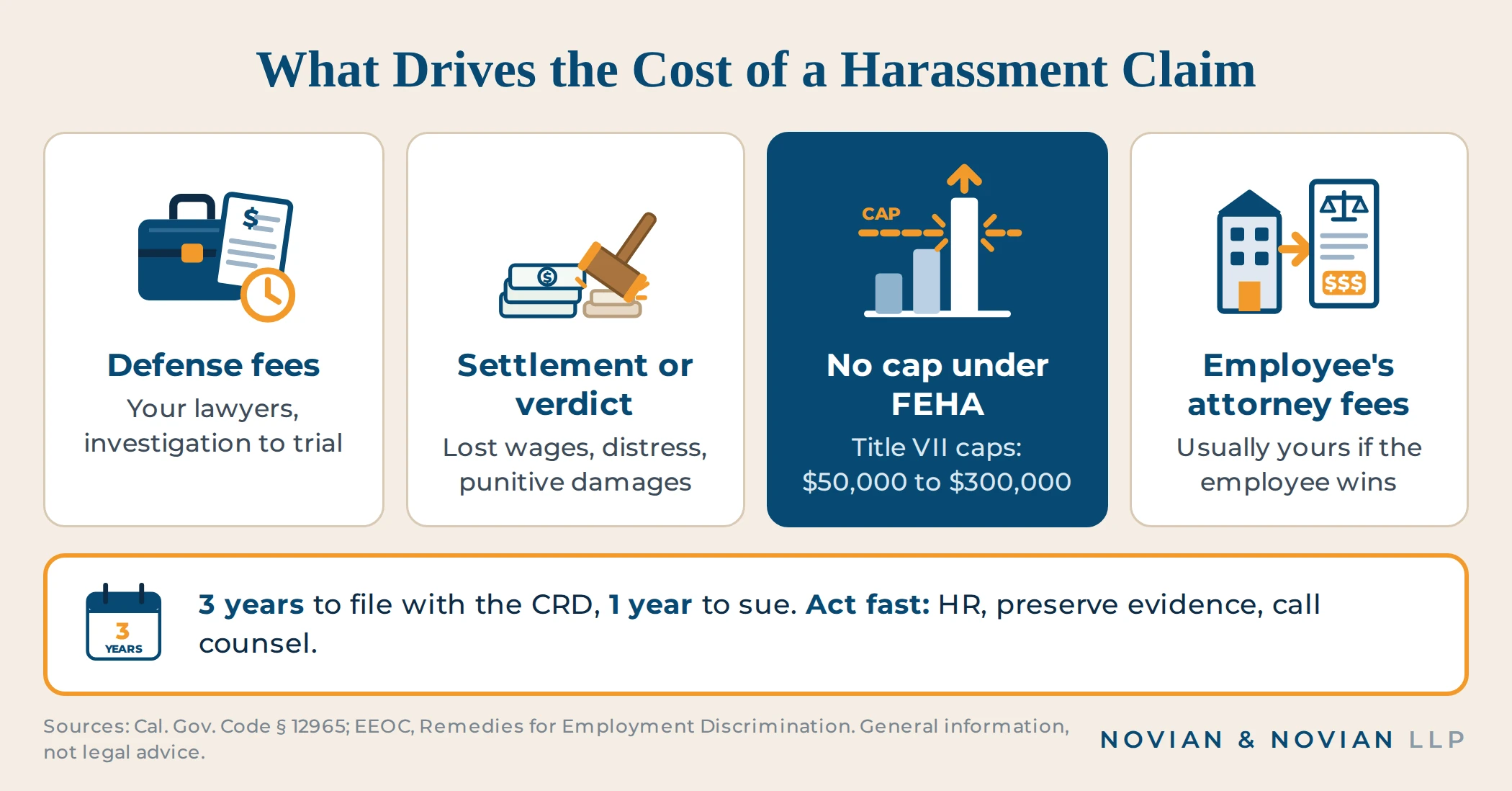
No cap on damages under FEHA. Under Title VII, federal law limits the total of compensatory and punitive damages based on the employer's size. The EEOC lists those limits as $50,000 for employers with 15 to 100 employees, $100,000 for 101 to 200, $200,000 for 201 to 500, and $300,000 for more than 500. FEHA has no comparable cap, so employees in California usually sue under state law.
Fee-shifting. Under Government Code section 12965, if the employee wins in court, a judge can order the employer to pay the employee's attorney fees and costs. In cases that go to trial, the fees alone can easily surpass the amount awarded in damages.
A long filing window. Employees now have three years to file a complaint with the CRD, so a claim can surface long after the conduct happened and after witnesses have left.
What a Claim Can Cost an Employer
A settlement or verdict is only one line on the bill. This table lists the major costs for employers and explains what drives each one.
| Cost | What it covers | What drives it up |
|---|---|---|
| Defense fees | Your own attorneys' work on the investigation, discovery, motions and trial | Number of depositions, motion practice, going to trial |
| Settlement or verdict | Lost wages (back pay and front pay), emotional distress, punitive damages | Supervisor involvement, retaliation, weak documentation |
| Employee's attorney fees | Paid by the employer if the employee prevails under FEHA | Length of the case and hours billed by the other side |
| Court costs | Filing and first-appearance fees, deposition transcripts, expert witnesses | Number of experts and length of discovery |
| Internal costs | Investigation, management time, replacement hiring | Delay in starting the investigation |
| Insurance | Deductible or retention under an EPLI policy and higher premiums at renewal | Prior claims and policy terms |
Filing fees for court cases in California run up to several hundred dollars per filing. Defense fees and the settlement are where the big money goes, and early decisions have a lot of impact on both. Our page on the cost of a defense settlement covers how employers weigh settling against fighting.
What Factors Affect the Value of a Sexual Harassment Claim?
A few facts move the number more than anything else.
The role of the harasser comes first. Because FEHA makes employers strictly liable for supervisor harassment, a claim against a manager carries more risk than one against a coworker. Next comes the employer's response. If the company reacts quickly and takes steps to correct what went wrong, it becomes harder for the employee to say that the company failed to prevent harassment from happening.
Retaliation tends to be the bigger problem. A termination, demotion or schedule cut that follows a complaint can turn a weak harassment claim into a strong retaliation claim. Evidence is important too. Emails, texts and witness statements flesh out the details of an employee's story, and clear documentation of company policies, training records and investigation notes does the same thing for employers.
Finally, damages vary based on the employee. Lost pay scales with salary and the time the employee is out of work, and emotional distress claims increase if medical or therapy treatment is documented.
How Can Employers Defend Against a Sexual Harassment Lawsuit?

Most of the defense is built in the first few weeks, before a lawsuit is ever filed. Here's the order we recommend.
- Route the complaint to HR right away: Log the date, who reported it and what was said. Don't let a manager handle it informally.
- Preserve evidence: Put a hold on emails, texts, chat logs, schedules and personnel files for everyone involved.
- Call employment counsel: Do this before any discipline, termination or written response to the employee. Our attorneys can tell you what to do if a manager is accused of harassment and how to avoid a retaliation claim.
- Notify your EPLI carrier: Most employment practices liability policies require prompt notice, and late notice can put coverage at risk.
- Run a neutral investigation: Interview the complainant, the accused and witnesses, and document the findings. Our piece on how long a workplace investigation takes has realistic timeframes.
- Respond to the CRD charge or lawsuit: Your counsel files the response and lays out the employer's defenses.
- Work through discovery and motions: Both sides exchange documents and take depositions. Motions can narrow the claims or end the case before trial.
- Decide on settlement or go to trial: Mediation is common in California employment cases. If the case goes to trial, you put forward evidence and witnesses, and both sides have the chance to appeal if they disagree with the verdict.
A Note From Our Defense Work
Defending claims means checking every accusation closely against the documents. In a recent arbitration, Novian & Novian clients faced more than $3 million in asserted claims. After a hearing that lasted seven days, the arbitrator ruled for our clients on every claim, as detailed in our $3 million arbitration result. That case involved a commercial lending dispute, not a harassment claim. The approach is the same: build the record early and make the other side prove each element.
Past results do not guarantee future outcomes. Each case depends on its own facts.
What Are the Financial and Non-Financial Consequences for Employers?

The direct costs are the ones in the table above: defense fees, settlement or judgment, the employee's attorney fees, and higher EPLI premiums at renewal. A verdict with punitive damages can be the most expensive outcome, and punitive damages are generally not insurable in California.
Indirect costs come up more gradually. Public filings and press coverage can follow a business for years, especially if the accused is a senior executive. When employees watch a harassment claim unfold, they tend to lose trust in management, and turnover tends to rise as a result. Managers spend long hours in interviews, collecting documents and going through depositions instead of running the business.
After a claim is filed, most companies have to change their policies, retrain staff and, in some cases, replace managers as well. Doing that work before a claim costs far less.
How Can Employers Prevent Sexual Harassment Claims?

Prevention is the cheapest defense, and in California part of it is mandatory.
Under Government Code section 12950.1, employers with five or more employees must provide sexual harassment prevention training every two years: two hours for supervisors and one hour for non-supervisory employees. The CRD offers free online training courses that meet the requirements. Keep records of who completed it and when, because those records are evidence if a claim comes in.
Training only helps if the policy behind it is clear. A written anti-harassment policy should define prohibited conduct, give employees more than one way to report it (so no one has to report to the person harassing them), and state plainly that retaliation is prohibited. Put it in your California employee handbook and get signed confirmations.
The rest comes down to follow-through. Investigate every complaint, even ones that seem minor, and act on what you find. Apply discipline the same way regardless of the accused person's rank. Most big verdicts come from cases where employers were aware of a problem and took no action at all.
Need a Workplace Sexual Harassment Lawyer?
If an employee has filed a CRD complaint, sent a demand letter or filed suit, the decisions you make in the next few weeks shape what the claim ends up costing. Novian & Novian's employment law attorneys represent California employers in harassment investigations, CRD proceedings, mediation, arbitration and trial. Our sexual harassment claims defense lawyers can review the complaint, your policies and your records, and give you a clear read on your exposure. Call (323) 455-2498 or come by our office at Suite 1201, 1801 Century Park East in Los Angeles.
FAQs
These are the questions California employers ask us most often after receiving a harassment complaint.
Does EPLI insurance cover sexual harassment claims?
Employment practices liability insurance usually covers defense costs and settlements for harassment claims, subject to the deductible and policy limits. Many policies exclude punitive damages, and most require prompt notice of a claim. Read the policy's notice requirements as soon as you receive a complaint.
Can a supervisor be personally liable for sexual harassment in California?
Yes. Under FEHA, anyone who harasses another employee can be personally liable, whether they are a supervisor or a coworker. The employer can still be liable too, and for harassment by a supervisor, the employer's liability is strict.
How long does an employee have to file a sexual harassment claim in California?
Generally speaking, an employee has three years from the last incident of harassment to file a complaint with the California Civil Rights Department. After the CRD issues a right-to-sue notice, the employee has one year to file a lawsuit.
Are sexual harassment damages capped in California?
Not under state law. Title VII caps combined compensatory and punitive damages at $50,000 to $300,000 depending on employer size, but FEHA has no cap. That is the main reason most harassment cases here are brought under FEHA.
Can a sexual harassment settlement be kept confidential?
Only partly. California law bars settlement terms that prevent an employee from disclosing facts about sexual harassment or other unlawful workplace conduct, and the federal Speak Out Act limits pre-dispute nondisclosure agreements for these claims. Settlement amounts themselves typically can stay secret as long as the employee consents to this secrecy.