
Most workplace investigations take two to four weeks when a single complainant raises a single issue, and six to eight weeks or longer when multiple parties, overlapping allegations, or substantial digital evidence are involved. No California statute sets a fixed deadline. The standard is that the investigation be fair, timely, and thorough. An employer is measured against the reasonableness of its progress, not against a date on a calendar.
At Novian & Novian, we help California employers respond to workplace complaints, discrimination claims, harassment allegations, retaliation issues, and related employment disputes. Our attorneys bring more than 35 years of experience to employment defense matters, including workplace discrimination and sexual harassment claims. If your business needs guidance on an internal investigation or employment claim, contact us today for a consultation.
This guide outlines realistic timelines by phase, what drives delay, and the legal exposure an avoidable delay creates for an employer.
Table Of Contents
- How Long Does a Workplace Investigation Take in California?
- Does California Law Set a Deadline for Completing a Workplace Investigation?
- What Factors Make a Workplace Investigation Take Longer?
- How Long Does Each Phase of a Workplace Investigation Take?
- How Can Employers Track Whether an Investigation Is Making Reasonable Progress?
- How Does an Employer Conduct a Defensible Workplace Investigation Step by Step?
- Step 1 – Assess the Complaint and Preserve Evidence
- Step 2 – Select an Impartial Investigator and Scope the Matter
- Step 3 – Interview the Complainant, the Accused, and Witnesses
- Step 4 – Collect Physical Evidence, Digital Evidence, and Relevant Documents
- Step 5 – Weigh Credibility and Reach a Final Decision
- Step 6 – Document the Findings in a Written Report
- Step 7 – Take Corrective Action and Monitor for Retaliation
- What Legal Risks Does a Delayed Workplace Investigation Create?
- Is a Longer Workplace Investigation Always a Legal Problem?
- Can an Employer Promise Absolute Secrecy During a Workplace Investigation?
- How Should an Employer Document the Investigation Timeline?
- Do You Need an Employment Defense Counsel?
- Frequently Asked Questions
- How Long Should an Employer Take to Complete a Workplace Investigation?
- Is There a Legal Deadline for Completing a Workplace Investigation in California?
- What Should an Employer Do if a Workplace Investigation Is Delayed?
- Must an Employer Investigate an Anonymous Complaint?
- What Happens if a Witness Is on Leave or Medically Unavailable?
How Long Does a Workplace Investigation Take in California?
A straightforward single-issue workplace investigation generally runs two to four weeks from intake to written findings. A multi-party matter more often runs four to eight weeks, and a systemic or pattern allegation can run eight to twelve weeks or longer. Those are working ranges rather than legal requirements, and it is worth being clear about the difference. They apply to internal investigations an employer runs itself, not to an agency proceeding.
For perspective, consider how long the enforcement agency takes on its own files. The Equal Employment Opportunity Commission tells charging parties that, on average, it takes about ten months to investigate a charge. The agency adds that the time required depends on many factors, including the amount of information that needs to be gathered and analyzed.
An employer completing a thorough internal investigation in four weeks is moving roughly ten times faster than the federal regulator does. Most published timelines for HR investigations come from consultants and software vendors rather than from any authority, which is why the numbers in circulation often contradict one another.
The useful question for an employer is not how many days an investigation should take. It is whether the employer can show that the investigation process moved with reasonable diligence and reached reasonable conclusions on the available evidence. Consistent investigation procedures, applied the same way each time, are what make that showing possible.
Does California Law Set a Deadline for Completing a Workplace Investigation?
No. Neither the Fair Employment and Housing Act nor its implementing regulations impose a fixed number of days for a private employer to complete an internal investigation. What California regulation does instead is impose a set of timing obligations and then hold the employer to them. The relevant laws are in the Civil Rights Council regulations at 2 CCR section 11023. Every covered employer must develop and distribute a harassment, discrimination, and retaliation prevention policy.
That policy must create a complaint process that ensures complaints receive timely responses and impartial, timely investigations by qualified personnel. The process must also provide documentation and tracking for reasonable progress. It must offer appropriate remedial options and close cases promptly. Those four commitments are the closest thing California has to a clock, and they describe a structured process rather than a deadline.
The practical consequence is that an employer writes its own benchmark and is then judged against it. Consider a policy promising a timely response and reasonable progress, paired with a file showing three months of silence. That problem is created by the employer’s own California employee handbook rather than by any statute. Human resources teams should therefore read the policy before promising anything to a complainant.
It is worth noting where California did impose a hard deadline, because the contrast is instructive. The Public Safety Officers Procedural Bill of Rights sets one. Under Government Code section 3304(d), a public agency may not discipline a peace officer at all if the investigation of the allegation is not completed within one year of discovery. The Legislature knows how to write a deadline. It wrote one for peace officer discipline and did not write one for private employers.
Does Title VII Impose a Completion Deadline on Employers?
No. Title VII contains no employer investigation deadline anywhere in its text. Every deadline the statute sets runs against the charging party or the agency, not the employer. The federal duty to respond promptly is judge-made, developed through the Supreme Court’s harassment decisions and elaborated in agency guidance rather than written into the statute. Employers should be careful with federal authority here.
The United States Equal Employment Opportunity Commission rescinded its 2024 enforcement guidance on harassment in January 2026. Its promising practices for preventing harassment remain available and are the safer federal reference. For a California employer, the federal framework matters less than employers assume, for reasons covered below.
What Factors Make a Workplace Investigation Take Longer?

In our experience, complexity drives duration far more than the seriousness of the allegation does. A formal complaint naming one person is not the same undertaking as one naming six. A single grave allegation with one witness can close faster than a minor allegation involving nine people.
The number of parties involved is the single largest factor, because every additional complainant, respondent or witness adds a scheduling dependency rather than a fixed increment of work. Volume of digital evidence is the second, since email, messaging, and device data must be preserved before it can be reviewed. Witness availability is the third and the least controllable, and medical leave, vacation, or a witness who retains counsel can add weeks that no amount of diligence removes.
Parallel proceedings complicate matters further. When a criminal referral, an agency charge, or pending litigation runs alongside the internal matter, sequencing decisions have to be made with an employer defense attorney in Los Angeles rather than by the HR team alone.
What Does a Delayed Workplace Investigation Look Like in Practice?

Consider a hypothetical California employer that receives a harassment complaint involving one employee and two witnesses. Human resources acknowledges the complaint but does not assign an investigator for three weeks. During that period, the complainant continues working in the same department as the accused and reports that the conduct has continued.
Once an investigator is appointed, the matter requires several interviews, a review of workplace messages, and an assessment of conflicting accounts. The investigation takes another four weeks to complete.
The problem is not necessarily that the investigation required four weeks. The more significant concern is the unexplained three-week period before the investigation began. The employer should be prepared to explain what it did after receiving the complaint, whether it considered interim measures, and why it did not assign the investigation sooner.
This example illustrates that the length of an investigation and the reasonableness of the employer’s response are not the same question. A complex investigation may require additional time, but an employer should be able to demonstrate what it did during that time and why.
How Long Does Each Phase of a Workplace Investigation Take?
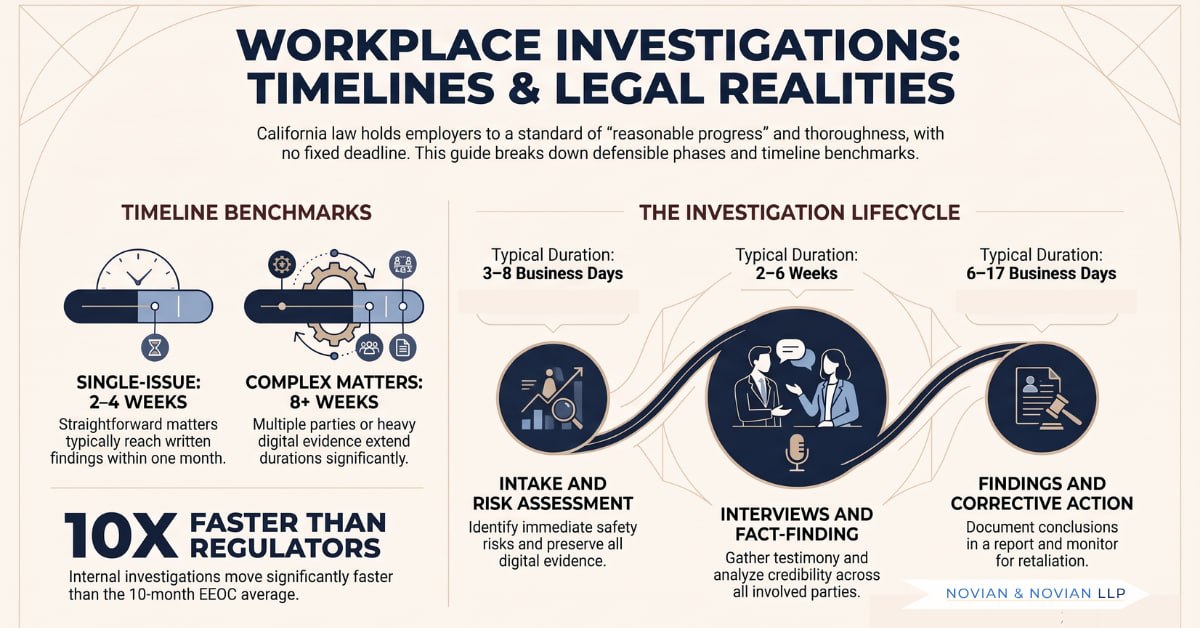
In our experience, an investigation is easier to manage, and far easier to defend, when it is tracked as discrete phases rather than as one open-ended matter. The table below sets out realistic durations for each phase and what typically extends it. These are planning estimates drawn from practice, not legal requirements.
| Investigation phase | Typical duration | What extends this phase |
|---|---|---|
| Intake and initial risk assessment | 1-3 business days | Threats of violence, safety risks, or need for interim separation |
| Investigator selection and scoping | 2-5 business days | Conflicts requiring an external investigator or vague allegations |
| Interviews of the complainant, accused, and witnesses | 1-4 weeks | Number of witnesses, leave, medical unavailability, or counsel involvement |
| Document and digital evidence review | 3-10 business days | High message volume, device preservation, or dependence on internal systems |
| Credibility analysis and findings | 3-7 business days | Conflicting accounts with limited or no corroborating evidence |
| Written investigation report | 3-10 business days | Multiple allegations requiring separate findings |
| Corrective action and closure | 2-5 business days | Disciplinary decisions requiring executive or counsel approval |
Reading the table together resolves an apparent conflict that appears in a great deal of published guidance. Figures such as one to four weeks and three to ten days are often quoted as competing totals for an entire investigation. They are not competing totals. They are different phases, and several of them overlap.
How Can Employers Track Whether an Investigation Is Making Reasonable Progress?
A useful way to assess investigation progress is to apply the CLEAR framework. This is a practical management tool, not a statutory test or a substitute for legal advice.
C – Complaint acknowledgment: Record when the complaint was received, acknowledge it promptly, and assess whether immediate safety or interim measures are necessary.
L – Lead investigator and scope: Assign an impartial investigator, identify the allegations, and establish which witnesses, documents, and policies require review.
E – Evidence and interviews: Track interview requests, completed interviews, evidence collection, and outstanding requests. Record obstacles that prevent the investigation from moving forward.
A – Assessment and findings: Evaluate the evidence, address conflicting accounts, and reach a reasonable conclusion on each allegation.
R – Resolution and monitoring: Document corrective action, communicate appropriate closure information, and monitor for retaliation or continuing workplace concerns.
This framework measures progress by completed investigative actions rather than elapsed days alone. An employer that cannot explain which stage a matter has reached, what remains outstanding, or why a task is delayed may struggle to demonstrate reasonable diligence.
How Does an Employer Conduct a Defensible Workplace Investigation Step by Step?

A defensible investigation follows a predictable sequence, and each stage carries its own timing pressure. No statute or regulation prescribes a fixed number of steps, and published frameworks range from three to fifteen. The sequence below reflects what California regulation requires an investigation to achieve.
Step 1 – Assess the Complaint and Preserve Evidence
Evaluate immediately whether anyone is at risk and whether interim measures such as schedule changes or paid administrative leave are warranted. Issue a preservation instruction covering email, messaging platforms, and devices before anything is deleted in the ordinary course. Record the date the complaint was received, because that date starts every clock that matters later.
Step 2 – Select an Impartial Investigator and Scope the Matter
The investigator must have no stake in the outcome and no reporting relationship to either party. The investigator’s role is to establish the facts, not to advocate for either side or to decide the discipline. Define in writing which allegations are being investigated and which company policy provisions are potentially in issue. A written investigation plan at this stage is what later demonstrates that the investigative process was structured rather than improvised.
Step 3 – Interview the Complainant, the Accused, and Witnesses
Begin with the complainant, then move to witnesses, then to the accused, so that the accused can respond to specific allegations rather than to a general accusation. Prepare interview questions in advance, use open-ended questions, and let the witness talk before narrowing.
Employee relations staff who conduct interviews regularly should still follow a written outline so questioning stays consistent across parties. Give the accused a genuine opportunity to identify witnesses and evidence in their favor, because due process for all parties is an explicit regulatory expectation.
Step 4 – Collect Physical Evidence, Digital Evidence, and Relevant Documents
Gather personnel files, scheduling records, access logs, messages, and any other documentation bearing on the allegations. Note what was requested and not produced, and why. The goal is a complete paper trail showing what relevant information the investigator sought and what was actually available. An incomplete record with an explanation is defensible; an incomplete record with no explanation is not.
Step 5 – Weigh Credibility and Reach a Final Decision
Where accounts conflict and no corroboration exists, the investigator must still reach a conclusion using recognized credibility factors such as plausibility, consistency, corroboration, motive to fabricate, and demeanor. The standard is a reasonable conclusion on the evidence collected, not certainty.
Step 6 – Document the Findings in a Written Report
The report should identify the allegations, the evidence gathered, the credibility assessments, and the findings on each allegation separately. A structured approach makes it far easier to determine later whether the conclusions followed the evidence. It should state whether policy violations were found. It should not editorialize, and it should not speculate about legal liability.
Step 7 – Take Corrective Action and Monitor for Retaliation
Where misconduct is found, appropriate remedial measures must follow, and the regulation says so expressly. Close the loop with the complainant to the extent appropriate, confirm that the conduct has stopped, and monitor for retaliation for a meaningful period afterward.
Employees who raise concerns in good faith retain employee rights that survive the outcome of the investigation, and legal action often follows what happens after the findings rather than what happened before them. Guidance on how to write up an employee without creating legal risk applies with particular force at this stage.
What Legal Risks Does a Delayed Workplace Investigation Create?
Delay is not merely inefficient. It is evidence, and in a FEHA case it is evidence the plaintiff can use. California law makes it unlawful for an employer to fail to take all reasonable steps necessary to prevent discrimination and harassment from occurring, under Government Code section 12940(k). That is a freestanding claim. An employer can prevail on the underlying harassment allegation and still lose on a failure-to-prevent claim if its process was inadequate.
Separately, harassment by a coworker who is not a supervisor is unlawful where the employer “knows or should have known of this conduct and fails to take immediate and appropriate corrective action.” An investigation that drifts is the clearest available proof that corrective action was not immediate. The table below maps specific points of delay to the specific exposure each one creates.
| Point of delay | Risk created | Governing standard |
|---|---|---|
| No response after notice of harassment | Failure to take immediate and appropriate corrective action | Gov. Code § 12940(j)(1) |
| No investigation of a known or suspected complaint | Independent failure to take reasonable steps to prevent harassment | Gov. Code § 12940(k) |
| Investigation opened but allowed to stall | Extended period of potential harm and increased liability exposure | FEHA damages principles |
| No documentation of investigative steps | Loss of records needed to defend the investigation and resulting decision | 2 CCR § 11023(b)(4) |
| Adverse action taken before findings are complete | Potential retaliation exposure | Lab. Code § 1102.5; Gov. Code § 12940(h) |
| No investigation of a workplace violence report | Potential violation of workplace violence prevention plan and recordkeeping duties | Lab. Code § 6401.9 |
The retaliation row deserves particular attention. Retaliation charges filed with the Equal Employment Opportunity Commission reached 54,350 in fiscal year 2025, the highest figure in the agency’s published series going back to 1992 and an increase of roughly twenty-eight percent over the prior year. Retaliation is frequently the claim that survives when the original complaint does not, and it is generated by how an employer behaves during and after an investigation rather than by the underlying conduct.
How Does Delay Increase an Employer’s Damages Exposure Under FEHA?
This is where California departs sharply from federal law, and where employers relying on federal assumptions get into difficulty. Under federal law, an employer facing a supervisor harassment claim may raise an affirmative defense by showing it exercised reasonable care to prevent and correct the conduct and that the employee unreasonably failed to use the complaint process. California does not adopt that defense to liability. For harassment by a supervisor, FEHA imposes strict liability on the employer. California instead recognizes a narrower avoidable consequences doctrine, which can reduce recoverable damages but does not defeat liability.
The practical consequence is significant and frequently misunderstood. For supervisor conduct, a prompt and thorough investigation is a damages argument, not a liability defense. It does not get the employer out of the case. What it does is limit the period of compensable harm, because harm the employee continued to suffer while the employer sat on the complaint remains squarely the employer’s responsibility. Every week of unexplained delay enlarges that period. That is the arithmetic behind defending wrongful termination claims in California and harassment claims alike.
Is a Longer Workplace Investigation Always a Legal Problem?
No. A longer investigation is not automatically evidence of employer wrongdoing. Some matters require additional time because witnesses are unavailable, relevant records are extensive, allegations expand during the inquiry, or the investigator must address conflicting accounts.
The distinction is between a delay that has a documented, reasonable explanation and a delay caused by inaction. An employer may need more time to complete a thorough investigation, but it should continue taking appropriate steps, communicate where appropriate, and maintain a record of its progress.
The same principle applies to the parties involved. A complainant may want an immediate conclusion, while an accused employee may need a fair opportunity to respond to the allegations. A reasonable investigation must account for both interests without allowing the process to stall unnecessarily.
The legal concern is therefore not simply the number of days that have passed. It is whether the employer responded appropriately, investigated impartially, and took reasonable steps to address the concerns raised.
Can an Employer Promise Absolute Secrecy During a Workplace Investigation?
No, and California regulations specifically prohibit a policy suggesting otherwise. Under 2 CCR section 11023, the employer’s policy must state that confidentiality will be kept to the extent possible, but not indicate that the investigation will be completely confidential. An employer that promises absolute secrecy therefore creates two problems at once. It makes a commitment it cannot honor, since it must often share findings with decision-makers and may later disclose them in a legal proceeding.
It also adopts a position contrary to the regulation governing its own policy. Federal labor law narrows the position further, and this point applies to non-union workplaces as well. Blanket instructions telling every participant to say nothing about an investigation are no longer protected by a categorical safe harbor.
Under the National Labor Relations Board’s current approach, as of September 2026, a confidentiality rule that tends to chill protected activity is presumptively unlawful, and the employer must justify it by reference to a legitimate and substantial business interest that a narrower rule would not serve. That area is under active challenge, and employers should confirm the position before relying on it.
The workable practice is to tailor rather than to blanket. Assess the need for confidentiality case by case, document the reason, state the scope and expected duration, and make clear that nothing prevents an employee from contacting a government agency.
How Does Timing Affect Attorney-Client Privilege Over the Investigation?
Timing determines whether the employer can rely on the investigation and keep it privileged, and the two are usually incompatible. California authority holds that an employer who defends itself by pointing to the adequacy of its investigation puts that investigation directly at issue and cannot then withhold it as privileged or as attorney work product. An employer cannot have the benefit both ways.
There is a meaningful contrast in the case law where the investigation took place after the employee had already resigned, because a departed employee could not have taken advantage of corrective measures adopted afterward. The practical lesson for an employer is to decide early, and deliberately, whether a given investigation is being run to be relied upon or to be protected. That decision is far harder to make once interviews have started.
How Should an Employer Document the Investigation Timeline?

Contemporaneously, and in a form that shows reasonable progress rather than merely a start date and an end date. The regulation calls for “documentation and tracking for reasonable progress,” which is a requirement about the record, not only about the outcome.
In practice, this means an investigation log capturing when the complaint was received, when the investigator was assigned, when each interview was requested and held, when evidence was requested and received, and when findings were reached. Where a gap occurs, the reason belongs in the log at the time it happens. A two-week pause because a witness was on medical leave is entirely defensible when recorded contemporaneously and very difficult to explain two years later from memory.
The same discipline that governs how an employer should document employee issues contemporaneously applies here. The investigation file is the evidence of the employer’s diligence, and in litigation it is very often the only evidence of it.
Do You Need an Employment Defense Counsel?
A useful investigation timeline should do more than provide an estimated completion date. It should explain what happens at each stage, identify the circumstances that may cause delay, and show how an employer can document reasonable progress. We combine planning estimates with California-specific legal considerations, practical investigation procedures, and examples of how unexplained delays can create exposure. That approach helps employers evaluate both the operational and the legal questions.
At Novian & Novian, our team of employment attorneys helps California employers manage workplace investigations, harassment and discrimination claims, retaliation concerns, and related employment disputes. We provide strategic advocacy, practical guidance, and careful attention to the facts that shape each matter. Schedule a consultation with us today.
Frequently Asked Questions
These are the questions employers raise most often when a complaint lands and the clock starts.
How Long Should an Employer Take to Complete a Workplace Investigation?
A single-issue matter generally takes two to four weeks, and a complex or multi-party matter commonly takes six to eight weeks or longer. What matters legally is that the employer began promptly and can document continuous, reasonable progress throughout.
Is There a Legal Deadline for Completing a Workplace Investigation in California?
No fixed deadline applies to private employers. California regulation requires a fair, timely, and thorough investigation with documented progress and timely closure, and the employer is measured against that standard and against its own written policy.
What Should an Employer Do if a Workplace Investigation Is Delayed?
Record the reason for the delay in the investigation file at the time it occurs, and communicate a revised expectation to the parties where appropriate. An explained delay is defensible, while an unexplained gap in the record is the version a plaintiff will present to a jury.
Must an Employer Investigate an Anonymous Complaint?
An employer should assess every anonymous complaint rather than dismissing it for lack of a named complainant. Once an employer knows or should know of potential harassment, the obligation to take appropriate action is triggered regardless of how it learned the information.
What Happens if a Witness Is on Leave or Medically Unavailable?
Continue with the parts of the investigation that can proceed and document why the remaining interview is on hold. Waiting on one unavailable witness is reasonable; stopping the entire matter without a contemporaneous note is not.
Reviewed by Farhad Novian, Esq., Novian & Novian, LLP – Los Angeles, California
Legal Disclaimer: This article is provided for general informational purposes only and does not constitute legal advice. Reading it does not create an attorney-client relationship with Novian & Novian, LLP. The timelines described here are practical planning estimates rather than legal requirements, and the obligations that apply to any particular investigation depend on the specific facts, on the employer’s own policies, and on the federal, state, and local laws that govern that workplace. Those laws and the agency guidance interpreting them change over time. Employers should consult a licensed attorney about their own circumstances before acting on any information in this article.
Attorney Advertising. The information on this website is provided for general informational purposes only and is not legal advice. Past results do not guarantee future outcomes. Viewing this website does not create an attorney-client relationship. The best way to get guidance on your specific legal issue is to contact a lawyer. To schedule a meeting with an attorney, please call (323) 747-8097.
 CALL:
CALL: