Quick answer
Say nothing to the accuser, keep every record, and talk to your own lawyer before giving any statement. Government Code section 12940(j)(3) lets an individual be held personally liable for harassment they committed, so company counsel does not represent you. An impartial investigator should run the inquiry, and you should stay out of choosing that person or reviewing findings.
If you have been accused of harassment at work in California, you should preserve every document, stay away from the person who complained, and get counsel before you respond. Do not investigate it yourself if the accusation names you, because your involvement will taint the process and become evidence later. Do not contact the accuser to explain or apologize, since that is the single fastest route to a retaliation claim that outlives the original allegation.
At Novian & Novian, we represent injured clients on a contingency fee basis, so you pay no attorney fees unless we recover compensation for you. Our attorneys have more than 35 years of experience handling employment law, and have secured reasonable settlements for clients. Our firm highlights more than $1 million recovered in settlements to date. If you are being accused of harassment, contact us today for a free consultation.
This post will explain how to handle workplace harassment, report complaints, preserve evidence, prevent retaliation, and respond appropriately to an accusation.
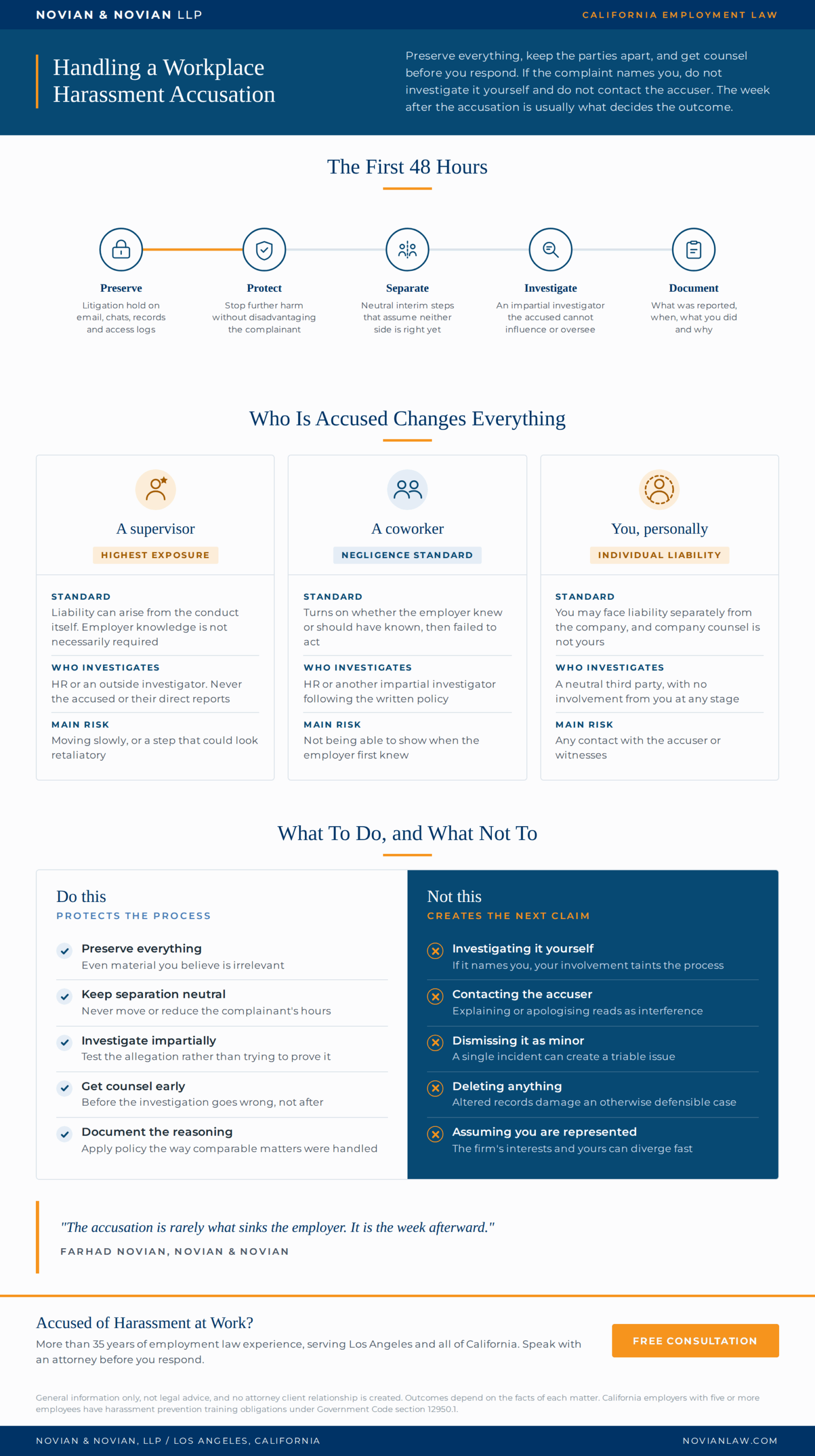
Table Of Contents
- What Qualifies as Harassment at Work in California?
- Who Is Actually Liable for Harassment Under California Law?
- The 48-Hour Harassment Response Framework
- What Are the First Steps After a Harassment Accusation?
- Step 1: Preserve All Relevant Evidence
- Step 2: Separate the Parties Without Creating Retaliation Risk
- Step 3: Avoid Contact With the Accuser About the Allegations
- Step 4: Conduct a Prompt and Neutral Investigation
- Step 5: Consult an Employment Attorney
- Step 6: Make and Document the Corrective Decision
- When a Harassment Complaint Becomes a Retaliation Problem
- How to Defend Yourself Against False Accusations of Harassment?
- Need a Lawyer to Defend Against Workplace Harassment Claims?
- Frequently Asked Questions
What Qualifies as Harassment at Work in California?

Harassment in the workplace is a serious issue that can harm both employees and employers. Under California’s Fair Employment and Housing Act (FEHA), illegal harassment generally involves unwelcome conduct based on a protected characteristic, including race, gender, disability, national origin, sexual orientation, or older age. It can take various forms, including unwanted sexual advances, discriminatory harassment, retaliation, offensive conduct, and certain forms of online harassment.
Sexual harassment may involve quid pro quo conduct, such as conditioning employment benefits on sexual cooperation, or a hostile work environment created by severe or pervasive unwelcome sexual advances. Offensive jokes, unwanted advances, inappropriate comments, and gender-based conduct can also contribute to a hostile work environment.
Discriminatory harassment can involve race, disability, national origin, gender, age, or other protected characteristics under California and federal law. Retaliation may also be unlawful when an employer takes adverse action against someone for reporting harassment or participating in an investigation. While workplace bullying is not always illegal, it may violate company policy or become unlawful when it involves protected characteristics or protected activity.
In our experience, many workers fear retaliation when they report discrimination or harassment, making clear reporting procedures especially important. Employers should know how to handle workplace harassment by taking complaints seriously, preserving evidence, conducting a prompt and impartial investigation, protecting employees from retaliation, and taking appropriate corrective action. These steps can help employers address harassment in many workplaces while reducing legal, financial, and reputational risks.
Who Is Actually Liable for Harassment Under California Law?

California does not treat all harassment the same way, and the difference decides how urgently you must act. Where a supervisor is the harasser, the employer is strictly liable. No knowledge is required, no prior complaint is required, and taking prompt corrective action afterward does not defeat liability. Where the harasser is a coworker or a non-employee, a negligence standard applies instead.
According to the EEOC’s Office of General Counsel, 93 merits lawsuits were filed in fiscal year 2025, including 29 cases involving harassment or sexual harassment and 31 involving retaliation. This means harassment appeared in approximately 31% of the office’s merits lawsuits, while retaliation appeared in about 33%.
The employer is liable only if it knew or should have known about the conduct and failed to take immediate and appropriate corrective action under Government Code section 12940. The first question in any harassment complaint is therefore whether the accused is a supervisor, because the answer determines whether the company already has exposure.
There is a second point that matters more to an individual than to the company. Under section 12940(j)(3), an individual can be held personally liable for harassment they committed. That is different from discrimination, where liability rests with the employer. A supervisor accused of harassment faces personal exposure separate from the organization, and the company’s interests and the individual’s interests can diverge quickly. If you are personally named, note that the company counsel is not yours.
The threshold for a viable claim is also lower than most employers assume. Government Code section 12923, added by Senate Bill 1300, lowered it. A single incident of harassing conduct can be enough to create a triable issue, where it unreasonably interfered with work performance or created an intimidating, hostile, or offensive working environment.
The same section records the Legislature’s view that harassment cases are rarely appropriate for disposition on summary judgment. Treating one complaint as too minor to investigate is the assumption that produces the worst outcomes. Under Government Code section 12950.1, California employers with five or more employees must train staff members on harassment prevention. Supervisory employees need two hours of interactive training, and everyone else needs one hour, repeated every two years.
Failing to train is not itself a harassment claim, but it is the first document requested when one is filed, and it shapes how a jury reads everything else. The response an employer owes depends on who is accused and what the complaint alleges. The table below sets out how the three common situations differ, and what each one requires of you.
| Scenario | Employer Liability Standard | Your First Obligation | Who Should Investigate | Personal Exposure | Biggest Risk |
|---|---|---|---|---|---|
| Supervisor is accused | Potential employer liability can arise from the supervisor’s conduct; the employer’s knowledge is not necessarily required | Separate the parties as appropriate, preserve evidence, and arrange a prompt, impartial investigation | HR or an independent outside investigator, not the accused supervisor or their direct report | A supervisor may face individual liability under California Government Code § 12940(j)(3) | Failing to respond promptly or taking actions that could appear retaliatory |
| Coworker is accused | Employer liability generally depends on whether the employer knew or should have known of the harassment and failed to take appropriate corrective action | Investigate promptly once the employer is on notice and document when and how the complaint was received | HR or another impartial investigator following the employer’s written policy | The coworker may potentially face individual liability under applicable California law | Failing to establish when the employer first learned of the conduct or failing to respond appropriately |
| You are personally accused | The employer may face liability separately from any individual liability you may face | Step back from the investigation and avoid influencing witnesses, evidence, or employment decisions involving the complaint | A neutral third-party investigator with no involvement in the allegations | You may face individual liability separate from the company | Any contact with the accuser or witnesses that could later be characterized as retaliation or interference |
A note on the third column. If the complaint names you, the company still owes the complainant an investigation, and that investigation must proceed without you. In our experience, attempting to manage it, select the investigator, or review findings before they are final converts a defensible process into evidence of bias.
The 48-Hour Harassment Response Framework

When a workplace harassment complaint is received, the first 48 hours should focus on five priorities: Preserve, Protect, Separate, Investigate, and Document.
Preserve: Secure emails, text messages, workplace chats, personnel records, schedules, access records, and other potentially relevant evidence before anything is lost or altered.
Protect: Take reasonable steps to prevent additional harassment or retaliation while avoiding actions that could punish or disadvantage the person who made the complaint.
Separate: If contact between the parties creates a legitimate concern, consider temporary separation or other interim measures. The arrangement should be neutral and should not assume that either side is telling the truth.
Investigate: Assign the complaint to an impartial investigator who can interview the relevant people, review the evidence, and evaluate the allegations without allowing the accused person to control the process.
Document: Record when the complaint was received, what was reported, what interim measures were taken, who investigated, what evidence was reviewed, and what corrective action was considered.
This framework is not a substitute for legal advice, but it provides a practical starting point for employers and managers who need to respond quickly without turning the initial response into a second legal problem.
What Are the First Steps After a Harassment Accusation?
The first week after a harassment accusation can significantly affect how the matter is handled. Employers should take proactive steps to preserve evidence, prevent retaliation, investigate the complaint fairly, and determine whether corrective action is necessary.
Whether the allegation involves sexual harassment, racial discrimination, gender-based harassment, disability harassment, or another form of workplace misconduct, employers should address the complaint promptly and consistently with applicable federal law, Title VII, the Equal Employment Opportunity Commission (EEOC) requirements, and state laws.
Step 1: Preserve All Relevant Evidence
The first step in handling workplace harassment is preserving potentially relevant evidence. Issue a litigation hold covering emails, text messages, workplace chats, personnel files, scheduling records, building-access logs, disciplinary records, and relevant social media or other electronic communications. Do not delete, alter, or conceal information after receiving a harassment or discrimination complaint, even if you believe the material is irrelevant.
Preserving evidence is particularly important when the allegations involve unwelcome comments, derogatory jokes, sexual favors, offensive comments, physical assault, or other conduct that could violate Title VII or state anti-discrimination laws. Employers should preserve evidence from both the accused and the victim while maintaining confidentiality to the extent reasonably possible.
Step 2: Separate the Parties Without Creating Retaliation Risk
The next step is addressing workplace harassment while protecting the complaining employee from further contact with the accused. If separation is necessary, it should be handled carefully and without penalizing the person who reported the workplace issues. Employers should avoid automatically transferring the complainant, reducing their hours, changing their duties, or taking other adverse actions against them.
Employees may fear retaliation after they report harassment or discrimination. California and federal law provide protections against retaliation in certain circumstances, and an employer does not necessarily need to prove that the underlying harassment occurred before a retaliation allegation can arise. Any separation should therefore be neutral, documented, and designed to protect everyone involved rather than punish the victim.
Step 3: Avoid Contact With the Accuser About the Allegations
If you are personally accused, do not contact the accuser to explain your position, demand clarification, apologize, ask them to withdraw the complaint, or discuss what happened. You should also avoid discussing the allegations with coworkers who are not involved in the investigation.
Even an intentional effort to resolve the situation informally can later be characterized as intimidation, interference, or retaliation. The same principle applies when the allegations involve sexual harassment, racial discrimination, gender discrimination, age discrimination, religious beliefs, disability-related treatment, or other legally protected activity.
Step 4: Conduct a Prompt and Neutral Investigation
In our experience, a neutral investigation should not be designed to prove that the complaint is true or false. The complaining employee has a legitimate interest in being heard and protected from further harassment or retaliation, while the accused has a legitimate interest in being treated fairly and not being disciplined based solely on an untested allegation.
That means employers should avoid two mistakes: dismissing a complaint because the allegation initially seems minor, and assuming that an accusation is proof of misconduct before the evidence has been evaluated. A fair process should give the relevant parties an opportunity to provide information, identify evidence and witnesses, and respond to material allegations as appropriate.
When a coworker is accused, internal human resources may be able to conduct the investigation, provided the investigator is impartial and follows the employer’s written anti-harassment policy. The investigation should generally document the complaint, interviews with the parties and relevant witnesses, supporting documents, text messages, electronic communications, and other evidence concerning the alleged conduct.
A holistic approach is particularly important because workplace harassment can take different forms, from repeated offensive comments and unwanted advances to gender-based harassment, discriminatory treatment, threats, or physical assault. The investigation should focus on the facts rather than assumptions about the accused or the victim.
Step 5: Consult an Employment Attorney

Legal counsel should be considered early in the process rather than after the investigation has already gone wrong. An employment attorney can help determine how to report harassment appropriately, assess whether the alleged conduct could constitute unlawful harassment or employment discrimination, establish an appropriate investigation process, and advise the organization regarding applicable federal and state laws.
This is especially important when the allegations could implicate Title VII, the Americans with Disabilities Act, the Age Discrimination in Employment Act, laws concerning genetic information, or state anti-discrimination laws. If you are personally accused, obtain independent legal advice rather than assuming that the attorney representing the employer also represents you personally.
Step 6: Make and Document the Corrective Decision
After the investigation, the organization should make the corrective decision when the accused is personally involved in the complaint. Employers should apply their policies consistently and consider how comparable workplace issues have been handled previously.
If the investigation substantiates harassment or discrimination, appropriate corrective action should be taken based on the circumstances and applicable law. Employers should also consider whether additional measures, such as training employees, updating reporting channels, reinforcing the anti-harassment policy, or addressing broader workplace problems, are necessary.
“The accusation is rarely what sinks the employer,” says Farhad Novian of Novian & Novian. “It is the week afterward. Somebody moves the complainant to a different shift to keep the peace, or the accused sends one message asking to talk it through, and now there is a retaliation claim that does not depend on whether the original allegation was true.”
Clear reporting channels and anonymous reporting systems can make it easier for employees to report harassment and reduce fear of retaliation. Immediate reporting also gives employers a better opportunity to investigate workplace issues before they escalate, protect employees, and maintain overall productivity. State laws may impose additional requirements, so employers should review the rules applicable to their workplace, including any special requirements affecting federal employees.
When a Harassment Complaint Becomes a Retaliation Problem

Consider a California company where an employee reports that a supervisor repeatedly made sexually inappropriate comments. The supervisor denies the allegations and believes the complaint is completely false. The employer decides to move the complaining employee to another shift to keep the peace while it investigates.
That decision may create a new problem. Even if the employer had a legitimate reason for separating the employees, moving the person who made the complaint can appear punitive if the change reduces hours, affects pay, disrupts responsibilities, or otherwise disadvantages the employee.
A better approach is to preserve the relevant communications, separate the parties only when necessary, use an impartial investigator, document the reason for any temporary workplace changes, and avoid treating the complaint itself as evidence that either person is telling the truth. If the accused supervisor is personally involved, the supervisor should not control the investigation or employment decisions connected to the complaint.
In our experience, the response to a harassment complaint can create a separate legal issue if it is handled carelessly. Employers should focus on protecting employees, preserving evidence, and maintaining a fair process while the facts are determined.
How to Defend Yourself Against False Accusations of Harassment?

A strong defense against a harassment accusation starts with documenting emails, texts, social media posts, conversations, and potential witnesses. At the same time, employers must take complaints seriously: they can be liable for supervisor harassment that results in negative employment actions and, in some circumstances, harassment by non-employees if they fail to act.
Workplace discrimination remains a significant concern, with 61% of Black employees reporting racial discrimination, 22% reporting gender-identity harassment, and 99% of workers age 40 or older reporting ageism in the cited data. If a complaint is not properly addressed, employees may file a charge with the Equal Employment Opportunity Commission (EEOC), while state laws may impose additional reporting requirements.
Employers should also provide continuous training on workplace standards and how to recognize harassment. If allegations are demonstrably false and involve malicious intent or reckless disregard for the truth, a defamation claim may be worth discussing with an attorney.
Need a Lawyer to Defend Against Workplace Harassment Claims?
When a harassment complaint arises, employers must protect employees from retaliation, preserve evidence, ensure a fair investigation, and maintain a respectful workplace. The response should address inappropriate behavior, consider whether the conduct is harassment based on the Civil Rights Act, document decisions and consequences, and take steps to prevent future issues. The Equal Employment Opportunity Commission (EEOC) provides more resources for employers and employees.
At Novian & Novian, our team of employment attorneys is dedicated to delivering results through strategic advocacy that protects your interests. We also provide personalized attention to each case and strive to build a relationship based on trust and transparency with all clients. Schedule a free consultation with us today!
Frequently Asked Questions
These are the questions California employers and executives ask most often after a harassment complaint lands.
What Do You Do When Someone Accuses You of Harassment?
Preserve every document, stop all contact with the person who complained, and get legal advice before responding in any form. If the accusation names you personally, step out of the investigation entirely, because participating in it will be read as interference later.
What Should You Do If You Are Being Targeted After an Accusation?
Document each incident with dates, times, and witnesses, and report it through the written policy rather than raising it informally. Keep the record factual and avoid responding in kind, since retaliatory conduct by an accused person is treated as a separate violation regardless of the original complaint’s merit.
Can You Be Personally Sued for Harassment in California?
Yes, and under Government Code section 12940(j)(3) an individual can be held personally liable for harassment they committed. That exposure is separate from any claim against the employer and is not covered by the company’s defense.
Does One Incident Count as Harassment Under California Law?
It can. Government Code section 12923 provides that one incident may create a triable issue where it unreasonably interfered with work performance or created a hostile working environment.
What Is the First Step to Take After a Harassment Complaint?
Preserve the evidence and create separation, taking care that the person who complained is not the one moved or reassigned. The investigation must then be conducted by someone independent of everyone named in the complaint, which means you cannot run it if you are named.