
Quick answer
The amount depends mostly on how badly you were hurt: minor cases commonly fall between $5,000 and $25,000, fractures or long recoveries between $25,000 and $100,000, and severe injury or wrongful death claims above $100,000, sometimes past $1,000,000. The at-fault driver's policy limits shape what can be collected. California's pure comparative negligence rule then reduces an award by your share of fault.
The actual payout for a car accident lawsuit in California can range widely. Minor injuries may lead to settlements in the thousands, while severe injuries or wrongful death cases can result in compensation reaching hundreds of thousands or even millions of dollars.
If you’ve been injured in a car accident and are unsure how much compensation you may be entitled to, Novian & Novian can help. Our experienced personal injury attorneys in California will assess your case, guide you through the legal process, and fight for the maximum compensation you deserve. Contact us today for a free consultation and let us help you get the justice you need.
This post will cover the settlement amounts and compensations for car accident lawsuits in California. It will also share tips on how to get the most compensation after a car accident.
Table Of Contents
- What Are Car Accident Lawsuits and How Do They Work in California?
- Understanding the Maximum Amount You Can Sue for a Car Accident in California
- Types of Damages You Can Sue for
- Factors That Influence Car Accident Settlement Amounts
- How Personal Injury Settlements Are Paid Out in California Car Accident Cases
- Understanding Insurance Coverage and Its Impact on Lawsuit Amounts
- Key Steps to Take After a Car Accident to Maximize Your Settlement
- Can You Sue If You Were Partially at Fault?
- Is It Worth Suing After a Car Accident?
- Why You Need the Best Car Accident Attorney After a Crash
- FAQs
- What is The Amount You Can Sue For a Car Accident Calculated in California?
- What Damages Can I Recover in a California Car Accident Lawsuit?
- How Long Do I Have To File a Lawsuit After a Car Accident in California?
- Will My Health Insurance Pay For Car Accident Injuries?
- What If The Other Driver Doesn’t Have Enough Insurance To Cover My Damages?
What Are Car Accident Lawsuits and How Do They Work in California?

A car accident lawsuit is a legal action filed by an injured party to recover compensation after a car crash caused by someone else’s negligence. In many cases, a car accident claim starts as an insurance claim with the at fault driver’s insurance company. But if the insurance company denies the claim, disputes liability, or refuses to offer fair compensation, the injured party may need to file a personal injury lawsuit.
As Farhad Novian, managing partner at Novian & Novian, explains, “Most car accident cases begin with insurance negotiations. But when the insurance company refuses to be reasonable, filing a lawsuit becomes the strongest way to protect our client’s rights.”
In California, the legal process typically begins by determining who was responsible for the auto accident. Because California follows a pure comparative negligence system, even if you were partially at fault, you may still recover compensation. However, your damages could be reduced by your percentage of fault. Once liability is established, we gather medical records, evidence of medical bills, lost wages, property damage, and other economic and non economic damages to calculate how much compensation is appropriate.
For example, we represented a car accident victim who was rear-ended by an uninsured driver during rush hour traffic. Our client suffered severe injuries, including a herniated disc and ongoing nerve pain that required extensive medical treatment and physical therapy. Initially, the own insurance company offered a low settlement through uninsured motorist coverage, arguing the injuries were minor. After filing a car accident lawsuit and presenting detailed medical records, expert opinions, and evidence of lost income and pain and suffering, we were able to significantly increase the recovery and secure fair compensation that reflected the true impact of the auto accident.
If negotiations with the insurance provider fail, your car accident attorney files a complaint in court, officially starting the car accident lawsuit. From there, both sides exchange evidence during discovery, take depositions, and may attempt mediation before trial. In our experience, many car accident cases settle before reaching a courtroom, but being prepared to go through the full legal process often results in stronger settlement offers.
It’s important to understand that not every car accident requires a lawsuit. When there is sufficient insurance coverage and the insurance involved acts in good faith, a fair settlement can often be reached without filing suit. However, when severe injuries, traumatic brain injuries, significant medical costs, or long-term lost income are involved, filing a personal injury lawsuit may be necessary to fully recover compensation for the financial losses and pain and suffering you’ve endured.
Understanding the Maximum Amount You Can Sue for a Car Accident in California

When it comes to car accident settlements, the amount you can sue for depends on the severity of your injuries, financial losses, and the circumstances of the crash. Settlements vary widely, ranging from a few thousand dollars for minor injuries to over a million dollars for severe cases or wrongful death.
Minor injury cases typically fall between $5,000 and $25,000, covering medical expenses, lost wages, and pain and suffering. For example, one of our clients, Tessa, was involved in a rear-end accident and suffered mild neck and back sprains. We were able to help her secure $12,000 in settlements.
Moderate injury cases are accidents that may involve fractures, significant medical treatment, or long-term recovery. These can result in settlements between $25,000 and $100,000. This was the case for another of our clients, Joe, who suffered a fractured wrist and concussion after a side-impact collision. His final settlement amounted to $85,000.
In severe injury cases or wrongful death claims, compensation can exceed $100,000 and even reach $1,000,000+, especially when lifelong medical care, permanent disability, or loss of life is involved. For example, two years ago, we filed a lawsuit for Tom, one of our clients, a cyclist who suffered a spinal injury after being struck by a negligent driver. We represented him in court, and the jury awarded him $1.2 million.
If you’re curious to calculate your own settlement, try our calculator:
Personal Injury Calculator

Types of Damages You Can Sue for

When filing a car accident lawsuit, victims may be entitled to various forms of compensation depending on the severity of the accident, the impact on their lives, and the at-fault driver’s negligence. Compensation in a car accident case is generally categorized into economic damages, non-economic damages, and, in some cases, punitive damages.
Economic Damages (Compensatory Damages)
Economic damages refer to the measurable financial losses incurred due to a car accident. These damages include medical expenses, which cover immediate medical treatment, ongoing medical costs, and future medical bills related to severe injuries. Victims often require extensive medical treatment, such as physical therapy, surgeries, and even mental health services for emotional trauma.
Car accident lawsuits also account for lost wages and reduced earning capacity. If a car crash prevents the injured party from working temporarily or permanently, they can sue for lost income.
Additionally, property damage compensation ensures that victims receive the necessary funds to repair or replace their vehicles. Insurance companies and law firms typically assess vehicle repair estimates and the fair market value of a totaled car when determining compensation.
Non-Economic Damages
Non-economic damages compensate for the pain and suffering caused by the accident, which does not have a direct financial cost but significantly impacts the victim’s quality of life. Emotional distress is another factor, as car accident victims may develop anxiety, depression, or even post-traumatic stress disorder (PTSD) due to the traumatic experience.
In severe cases, victims may suffer a loss of enjoyment of life, where their injuries prevent them from engaging in activities they once loved. There is also loss of consortium, which refers to the impact of the accident on personal relationships, particularly when injuries prevent the injured party from maintaining a normal relationship with their spouse or family. Since insurance policies may not always cover non-economic damages, hiring a personal injury attorney is essential for ensuring a fair settlement.
Punitive Damages
Punitive damages are awarded in cases where the at-fault driver’s actions were particularly reckless or intentional. Unlike economic and non-economic damages, which aim to compensate the injured party, punitive damages serve as a punishment for the responsible party and deter similar behavior in the future.
Examples of reckless or intentional behavior include drunk driving, excessive speeding, or fleeing the scene of an accident. However, punitive damages are subject to legal limitations in some states, and certain jurisdictions impose caps on the amount that can be awarded. Personal injury lawyers can help determine whether punitive damages apply to a case and navigate the legal process to recover compensation.
Factors That Influence Car Accident Settlement Amounts

When people ask us how much can someone sue for a car accident, the honest answer is that it depends on several key factors. The severity of your injuries, the available insurance coverage, state laws, the strength of your evidence, and the at fault driver’s ability to pay all affect the final number. As Farhad Novian, our managing partner at Novian & Novian, explains, “There’s no universal settlement amount in a car accident case. The value comes from how deeply the crash affected the injured party’s health, finances, and future.”
The extent of injuries sustained in a car crash significantly influences how much someone can sue for. Minor injuries, such as whiplash or bruises, typically result in lower settlements, while severe injuries like broken bones, spinal cord damage, or traumatic brain injuries can lead to much higher payouts. In cases where a victim suffers long-term or permanent disabilities, the compensation amount increases due to ongoing medical treatment, physical therapy, and lost earning capacity.
Insurance policies also play a major role in determining how much compensation a car accident victim can recover. The at-fault driver’s liability insurance coverage dictates the maximum payout available, but if their insurance provider denies a claim or their coverage limits are too low, victims may need to seek compensation through other means. Uninsured motorist coverage from your own insurance company can help if the at-fault driver lacks sufficient insurance. Additionally, personal injury protection (PIP) or medical payment coverage can help cover immediate medical expenses, regardless of fault.
Car accident claims vary widely depending on state laws. Some states follow comparative negligence rules, which reduce compensation based on the victim’s percentage of fault, while others adhere to no-fault laws that require injured parties to first seek compensation from their own insurance provider.
States also impose minimum coverage amounts that drivers must carry, affecting how much can be recovered in an insurance claim. A personal injury lawsuit may be necessary if the insurance settlement is insufficient to cover medical costs, lost income, and other financial losses.
Furthermore, strong evidence is important in proving negligence and securing fair compensation in an auto accident lawsuit. Police reports, medical records, witness statements, and photographs of the accident scene provide clear proof of liability and the extent of injuries. Without sufficient evidence, an insurance company may deny a claim, leaving the injured party struggling to recover compensation. Personal injury lawyers can help gather and present this evidence effectively during legal proceedings.
Even if a lawsuit results in a high compensation award, the at-fault driver’s financial situation can impact the actual payout. If the defendant lacks assets or insurance coverage, collecting the full amount may be difficult. In such cases, a law firm may explore alternative options, such as wage garnishment or structured settlements, to help car accident victims receive what they are owed.
How Personal Injury Settlements Are Paid Out in California Car Accident Cases
After a car accident settlement is reached, one of the first questions car accident victims ask is how the money is actually paid. In California, personal injury settlements are typically distributed either as a lump sum payment or through a structured settlement, and the right option depends on the injured party’s financial needs and long-term outlook.
A lump sum settlement means the insurance company issues one payment for the full agreed-upon amount. This option is common in most car accident cases and can be helpful when victims need to immediately pay medical bills, cover lost wages, repair property damage, or address other urgent financial losses.
A structured settlement, on the other hand, distributes payments over time. It could be monthly, annually, or according to a customized schedule. This can provide long-term financial stability, especially in cases involving severe injuries or ongoing medical treatment.
The timeline for receiving payment varies. Once a settlement agreement is signed and a release is executed, the insurance provider typically issues payment within a few weeks, although complex car accident lawsuits or multiple insurance policies can extend the process. If a lawsuit was filed, court procedures and final documentation may add additional time before funds are released.
It’s important to understand that the settlement check does not go directly into your pocket without adjustments. Medical liens, attorney fees, and case-related costs are deducted before the injured party receives their net recovery. For example, if your health insurance, medical providers, or government programs paid for medical expenses related to the car crash, they may assert a lien and seek reimbursement from the settlement. Attorney fees are also deducted, along with litigation expenses such as filing fees, expert witness costs, and medical record retrieval.
In our experience, negotiating medical liens can significantly increase what a client ultimately recovers. A skilled car accident attorney will often work to reduce outstanding balances so that more of the settlement remains with the injured party. We recommend reviewing a detailed settlement breakdown with your legal representation before funds are distributed, so you clearly understand how much compensation you will actually receive.
Understanding Insurance Coverage and Its Impact on Lawsuit Amounts

When clients ask us how much can you sue someone for a car accident, insurance coverage is often the real limiting factor. Even if a car accident results in severe injuries, high medical bills, and significant lost wages, the available insurance policies frequently determine how much compensation can actually be recovered. In California, drivers are required to carry car insurance that meets minimum coverage amounts, but those required insurance limits are often far lower than the true financial losses suffered by car accident victims.
Under current California law, drivers must carry liability insurance with minimum coverage amounts of $15,000 for bodily injury per person, $30,000 for bodily injury per accident, and $5,000 for property damage. In serious car crash cases involving traumatic brain injuries, surgeries, or extended medical treatment, those limits can be exhausted quickly. If the at fault driver only carries minimum liability insurance and your medical expenses exceed that amount, you may need to explore other insurance policies or pursue a car accident lawsuit to seek fair compensation.
Health insurance can also play an important role after an auto accident. Your health insurance provider may cover hospital visits, surgery, physical therapy, and even mental health services while your car accident claim is pending. However, many health insurance companies assert reimbursement rights and may place a lien on your settlement, which can reduce the net amount you recover compensation.
Uninsured motorist coverage and underinsured motorist coverage can significantly affect how much can someone sue and actually collect. If you are hit by uninsured drivers, your own insurance company may step in under your uninsured motorist coverage. If the other driver has insurance but not sufficient insurance to cover your damages, underinsured motorist coverage may help bridge the gap. In our experience, many injured parties are surprised to learn that their own insurance policies can become a primary source of recovery when the responsible party does not carry insurance or does not carry as much insurance as needed.
Auto Insurance Coverage Types and Their Impact on Your Lawsuit
| Coverage Type | What It Covers | Typical Limits in California | Impact on Lawsuit Settlement |
|---|---|---|---|
| Liability Insurance | Covers bodily injury and property damage caused by the at fault driver to the injured party. | Minimum required insurance: $15,000 per person / $30,000 per accident (bodily injury), $5,000 property damage. | Often sets the maximum recovery available unless additional insurance or assets exist; low limits may require filing a personal injury lawsuit to seek additional compensation. |
| Uninsured Motorist (UM) | Covers medical expenses, lost wages, and pain and suffering if the other driver does not carry insurance. | Limits usually match your own liability coverage, depending on what you purchased. | Critical when dealing with uninsured drivers; can significantly increase how much can someone sue and recover if the other driver lacks sufficient insurance. |
| Underinsured Motorist (UIM) | Covers the gap between the at fault driver’s liability insurance and your total damages. | Varies based on your policy; typically mirrors your UM limits. | Helps bridge the gap when damages exceed the other driver’s coverage limits, increasing total available compensation. |
| Medical Payments (MedPay) | Pays immediate medical bills regardless of fault. | Commonly ranges from $1,000 to $10,000 depending on policy. | Provides early financial relief for medical treatment but does not increase the total lawsuit value; may be reimbursed from final settlement. |
Key Steps to Take After a Car Accident to Maximize Your Settlement

Maximizing how much compensation you recover after a car accident requires a deliberate, strategic approach from day one. In our experience, insurance companies move quickly to protect their bottom line, so the injured party must be equally proactive in protecting their rights.
Below is the step-by-step process we recommend to strengthen your car accident claim and position yourself for fair compensation.
Step 1: Seek Immediate Medical Treatment
Your health comes first. Even if injuries seem minor after a car crash, you should seek medical treatment right away because conditions like whiplash, internal injuries, or traumatic brain injuries may not show symptoms immediately. Prompt care not only protects your well-being but also creates medical records that directly connect your injuries to the auto accident, which is critical evidence in any car accident case.
Step 2: Document Everything at the Scene and After
If you are physically able, gather evidence immediately. Take photos of vehicle damage, property damage, road conditions, visible injuries, and obtain contact information for witnesses. Police reports, medical records, and documentation of medical bills and lost wages will later support your insurance claim and, if necessary, your car accident lawsuit.
Step 3: Notify Your Insurance Company
Report the accident to your own insurance company promptly. Even if the other driver was clearly the at fault driver, your own insurance coverage may play a role in helping you recover compensation. Be factual in your report, but avoid giving recorded statements or detailed explanations until you understand your legal position.
Step 4: Do Not Accept a Quick Settlement
Insurance companies often offer early payouts before the full extent of injuries or financial losses is known. These initial offers rarely account for future medical expenses, ongoing physical therapy, lost income, emotional distress, or pain and suffering. Once you accept a settlement, you typically waive the right to pursue additional compensation, even if your condition worsens.
Step 5: Consult a Car Accident Attorney Early
Working with a car accident attorney significantly improves your ability to seek compensation for both economic and non economic damages. A personal injury attorney will calculate the full scope of financial losses, negotiate aggressively with the insurance provider, and, if necessary, initiate a personal injury lawsuit. In our experience, legal representation often leads to substantially higher settlements compared to handling a claim alone.
Step 6: Do Not Sign Documents Without Legal Review
Insurance companies may ask you to sign medical authorizations, releases, or settlement agreements. Some of these documents can limit your rights or give the insurance company access to unrelated medical history that may be used to reduce your claim. Always have a personal injury lawyer review any paperwork before signing to ensure you are not unknowingly limiting your ability to recover compensation.
Can You Sue If You Were Partially at Fault?
Being partially at fault in a car accident does not necessarily prevent you from recovering compensation. Many states follow comparative negligence laws, which allow accident victims to sue for damages even if they share some responsibility for the crash with the at-fault driver. However, the percentage of fault assigned to each party can impact the final compensation amount.
Comparative negligence is a legal principle that determines compensation based on each party’s level of fault in an accident. Instead of barring recovery completely, as some older laws did, comparative negligence allows injured parties to recover damages even if they were partly responsible for the crash.
This means that even if a driver was speeding but another driver ran a red light, they may still be able to sue for a portion of the damages. For example, if a car accident victim is found 20% at fault and their total damages are $100,000, they would still be eligible to receive $80,000.
State laws vary when it comes to handling car accident cases involving shared fault. For pure comparative negligence states, victims can recover damages even if they are 99% at fault, but their compensation is reduced accordingly. However, in comparative negligence states, victims can recover damages only if they are less than 50% or 51% at fault. Then, in contributory negligence states, if the victim is even 1% at fault, they are barred from recovering compensation.
Is It Worth Suing After a Car Accident?
After a car accident, deciding whether to file a lawsuit depends on several factors, including the severity of injuries, property damage, and whether the insurance company offers fair compensation. Some car accident victims may resolve their claims through an insurance settlement, while others may need to pursue a personal injury lawsuit to recover compensation for medical expenses, lost wages, and non-economic damages.
One of the first things to consider is the cost versus the benefit of suing. Lawsuits can be time-consuming and may take months or even years to resolve. However, personal injury lawyers often work on a contingency fee basis, meaning they only get paid if you win your case. This can make it more accessible for injured parties to seek compensation without worrying about upfront legal fees.
The severity of injuries and property damage also plays a big role. If an accident resulted in minor injuries with minimal medical bills, negotiating with the insurance company may be sufficient. However, if the accident caused severe injuries such as traumatic brain injuries, broken bones, or permanent disabilities, suing might be the only way to secure fair compensation.
Insurance limitations are another factor to consider. If the at-fault driver only carries the minimum coverage amounts required by state law, their insurance may not be enough to cover all damages. In cases where an insurance provider denies a claim or offers an unfair settlement, filing a car accident lawsuit may be the best option to recover compensation.
Seeking legal advice is always recommended. An experienced car accident attorney can evaluate the case, negotiate with the insurance company, and take legal action if necessary.
Do You Always Need a Lawyer to Sue for a Car Accident?
The short answer is no. You do not always need a lawyer to sue for a car accident. In minor car accident cases where liability is clear, injuries are limited, and the insurance company offers fair compensation for medical bills, property damage, and lost wages, some car accident victims may successfully resolve their insurance claim on their own. As Farhad Novian, always say, “If the injuries are minor and the insurance company is acting reasonably, some claims can be resolved without litigation. But the moment liability or damages are disputed, legal representation becomes important.”
However, more complex cases are a different story. If the car crash results in severe injuries, long-term medical treatment, traumatic brain injuries, or significant medical costs, the stakes are much higher. Insurance companies often attempt to minimize payouts in high-value car accident cases, and without legal representation, injured parties may not fully understand how much compensation they are entitled to seek.
Hiring a lawyer is worth it when the insurance provider refuses to offer fair compensation or when the accident results in severe injuries requiring long-term medical treatment. A personal injury lawyer can help gather crucial evidence such as medical records, police reports, and witness statements to strengthen the case. Additionally, if the at-fault driver was uninsured or underinsured, a lawyer can help explore other options, such as filing a claim through the victim’s own uninsured motorist coverage. In cases involving substantial economic damages, loss of future earnings, or disputes over liability, having an experienced law firm handle the legal process can ensure that the injured party receives fair compensation.
Why You Need the Best Car Accident Attorney After a Crash
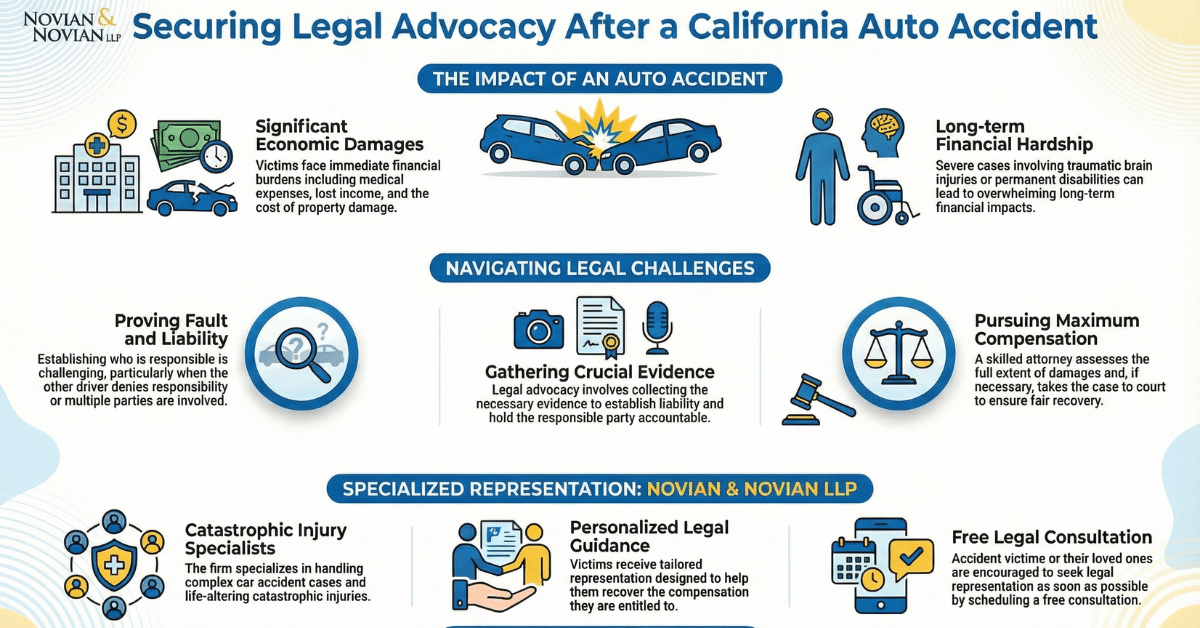
After an auto accident in California, victims may face significant economic damages, including medical expenses, lost income, and property damage. In more severe cases, such as those involving traumatic brain injuries or permanent disabilities, the long-term financial impact can be overwhelming. A skilled personal injury attorney understands how to assess the full extent of damages and fight for fair compensation.
Additionally, proving fault in a car accident case can be challenging, especially when multiple parties are involved or when the other driver denies responsibility. An attorney can gather crucial evidence to establish liability, ensuring that the responsible party is held accountable. If necessary, they can also take the case to court to pursue maximum compensation.
If you or a loved one has been injured in a car accident, it is best to seek legal representation as soon as possible. Our experienced attorneys at Novian & Novian specialize in handling car accident cases and catastrophic injuries. We offer personalized legal guidance and representation to help accident victims recover fair compensation. Schedule a free consultation with us today!
FAQs
Below are answers to some of the most common questions we receive from car accident victims who want to understand their rights and how much compensation they may be entitled to recover. Every car accident case is different. So, the details of your injuries, insurance coverage, and the legal process will affect the outcome.
What is The Amount You Can Sue For a Car Accident Calculated in California?
The amount you can sue for in a car accident is calculated based on economic damages like medical bills, lost wages, property damage, and medical costs, as well as non economic damages such as pain and suffering and emotional distress. The final value depends on the severity of injuries, available insurance coverage limits, and whether the at fault driver or other liable third parties have sufficient insurance or assets.
What Damages Can I Recover in a California Car Accident Lawsuit?
You may recover compensation for economic and noneconomic damages, including medical expenses, lost income, future medical treatment, physical pain, and emotional distress. In rare cases involving extreme misconduct, punitive damages may also be available through a personal injury lawsuit.
How Long Do I Have To File a Lawsuit After a Car Accident in California?
In most California car accident cases, you have two years from the date of the auto accident to file a personal injury lawsuit. Missing this deadline can prevent you from seeking compensation entirely, so it is important to speak with a car accident attorney as soon as possible.
Will My Health Insurance Pay For Car Accident Injuries?
Health insurance may cover medical treatment after a car crash, including hospital visits, surgery, and physical therapy, depending on your policy. However, your health insurance provider may seek reimbursement from any settlement you receive, which can affect your net recovery.
What If The Other Driver Doesn’t Have Enough Insurance To Cover My Damages?
If the other driver does not carry sufficient insurance or is uninsured, you may be able to file a claim under your own uninsured motorist coverage or underinsured motorist coverage. An experienced personal injury attorney can review all insurance policies involved and help you pursue every available source of fair compensation.