
Quick answer
A workers' compensation defense attorney protects employers and their insurers by testing whether a claim is compensable under laws such as California Labor Code §3600. The job includes interviewing witnesses, sometimes alongside private investigators, attending hearings, cross-examining claimants, weighing settlement offers and filing required compliance reports. No-fault coverage still leaves room to contest exaggerated or fraudulent claims.
A workers’ compensation defense attorney represents employers and insurance companies when a workplace injury claim is filed. However, what they really do is prevent routine claims from turning into costly problems. They review the claim to ensure it meets legal requirements and investigate the facts for any inconsistencies. They also manage negotiations, hearings, and compliance throughout the entire process.
At Novian & Novian, we’ve handled thousands of workers’ compensation defense cases in 35 years of practice. Our employment law team works with employers across industries, and we’ve seen how a single mishandled claim can escalate into six figures of unnecessary liability. If you’re an employer facing a workers’ compensation claim and need experienced defense counsel, schedule a free consultation with our team.
This blog explains workers’ compensation claims and how a lawyer helps employers achieve the best results.
What is Workers’ Compensation?

Workers’ compensation is a form of insurance that provides financial benefits and medical care to employees who are injured or become ill as a direct result of their job. It is designed to cover medical expenses, lost wages, and rehabilitation costs, ensuring employees receive the support they need without going through a lengthy legal process. Typically, the primary goal of workers’ compensation is to provide financial support and promote workplace safety.
In exchange, employees generally forfeit the right to sue their employer for negligence, making workers’ compensation a crucial aspect of workplace safety and employee rights. Some of the most common workers’ compensation claims that necessitate a legal defense include injuries from accidents, occupational illnesses, psychological injuries, and repetitive strain injuries.
The concept of a legal defense comes into play when disputes arise over a workers’ compensation claim. For example, employers and insurance companies may contest the validity of a claim, leading to legal proceedings where a workers’ compensation defense attorney is essential. These attorneys protect the interests of employers, ensuring that only legitimate claims are compensated and helping to manage the financial impact on the business.
Table Of Contents
- Why Is a Workers’ Compensation Defense Lawyer Important?
- What Does a Workers’ Compensation Attorney Do in Defending Employers?
- Real Case Example: How a Mishandled Claim Turned Into a $120,000 Exposure
- Our 5-Step Defense Framework
- What Are the Most Common Types of Workplace Injuries Handled by Workers’ Compensation Lawyers?
- How Do You Choose the Right Workers’ Compensation Defense Lawyer for Your Business?
- What Skills and Qualifications Should You Look for in a Workers’ Compensation Defense Attorney?
- How Do Workers’ Compensation Defense Attorneys Handle Disputes and Litigation?
- What Happens When You Don’t Have a Workers’ Compensation Lawyer on Your Side?
- How Much Does a Workers’ Compensation Attorney Cost?
- Why Do Employers Need Workers’ Compensation Attorneys?
- Need a Worker’s Compensation Attorney?
- Frequently Asked Questions
- How Are Defense Attorneys Different from Claimant Attorneys?
- How Long Does a Workers’ Compensation Case Typically Take?
- Can Employers Represent Themselves in Workers’ Comp Cases?
- Can Carpal Tunnel Be Covered Under Workers’ Compensation?
- What Are the Odds of Winning a Workers’ Comp Case?
- Do Defense Lawyers Only Get Paid if They Win?
- How Can Employers Benefit From Hiring a Workers’ Comp Defense Lawyer?
Why Is a Workers’ Compensation Defense Lawyer Important?

Workers’ compensation is a no-fault insurance system. Employees who are injured on the job receive medical treatment and wage replacement benefits regardless of who caused the injury. In exchange, they typically give up the right to sue their employer for negligence. That trade-off is the foundation of workers’ compensation law in every state, codified in statutes like the California Labor Code §3600.
But no-fault doesn’t mean no defense. Employers still have the right to challenge claims that are exaggerated, fraudulent, or don’t meet the legal definition of a compensable workplace injury. That’s where a workers’ compensation defense attorney comes in. According to data from the National Safety Council, the average workers’ compensation claim involving lost work time can exceed $40,000, with more complex or disputed cases climbing significantly higher.
We handle two broad categories of cases, which are employer defense and insurance carrier defense. On the employer side, we’re protecting the business from inflated claims, helping manage return-to-work programs, and advising on how to maintain compliance with state reporting requirements. On the insurance side, we’re evaluating compensability and building the evidentiary record for hearings.
“The biggest misconception employers have is that workers’ compensation claims are automatic,” says Farhad Novian, managing partner at Novian & Novian. “An employee files a claim, and the employer assumes they just have to pay it. That’s not how it works. Every claim has elements that can and should be evaluated.”
The defense attorney’s role starts the moment a claim is filed and often extends months or years through hearings, medical evaluations, settlement negotiations, and sometimes appeals. For employers, navigating a workers’ compensation claim can be complex and costly. A defense lawyer can help by investigating the claim and providing legal representation. They also give advice on legal compliance and mitigate costs by negotiating settlements.
What Does a Workers’ Compensation Attorney Do in Defending Employers?

A workers’ compensation defense attorney plays a key role in representing employers and insurance companies throughout the workers’ compensation claims process. Their responsibilities are extensive, covering everything from initial case assessments to legal representation and compliance with workers’ compensation laws. Below is a breakdown of their key responsibilities:
Initial Case Assessment
The first step in the workers’ compensation claims process is a thorough initial case assessment. The attorney reviews claim details, gathers relevant documentation, and evaluates the merits of the claim. This initial assessment helps determine the best defense strategy and whether the claim is compensable under workers’ compensation laws.
Investigations
Conducting thorough investigations is another responsibility of a workers’ compensation defense attorney. They gather statements, interview witnesses, and, if necessary, collaborate with private investigators. The goal is to uncover any fraudulent claims or discrepancies in the workers’ compensation claim, ensuring that only legitimate claims are compensated.
Legal Representation
One of the core duties of a workers’ compensation defense lawyer is to represent employers and insurance companies in legal proceedings. This includes preparing for and attending hearings and trials, cross-examining claimants and witnesses, and advocating on behalf of their clients. Their legal counsel ensures that the employer’s interests are well-protected throughout the workers’ compensation system.
Negotiations and Settlements
A significant aspect of the claims process involves negotiations and settlements. The attorney engages in settlement negotiations, evaluates settlement offers, and advises clients on the best course of action. By taking an aggressive approach when necessary, they aim to secure the best possible results for their clients, minimizing liability and financial losses.
Compliance and Reporting
Ensuring compliance with state workers’ compensation laws is another responsibility as the defense attorney prepares and submits required documentation and reports. They also have to keep their clients informed about their legal obligations. In addition, they advise on best practices and risk management programs. This helps employers avoid potential disputes and ensures a smooth process.
Real Case Example: How a Mishandled Claim Turned Into a $120,000 Exposure
A manufacturing client came to us after initially accepting a repetitive strain claim without legal review. The employee alleged cumulative trauma over five years, but there were gaps in employment history and prior medical records showing similar complaints before they were hired.
We stepped in during the discovery phase and uncovered prior treatment that allowed us to argue apportionment. We also challenged the timeline using time-clock data and job duty inconsistencies. The result: the claim exposure was reduced by more than 60%, avoiding what would have been a six-figure payout. This is a common pattern. Claims that look routine on the surface often carry hidden liability if they’re not evaluated early.
Our 5-Step Defense Framework
Workers’ compensation claims are often treated as routine, but for employers, they can quickly become one of the most expensive and complex legal risks a business faces. A single claim that is poorly evaluated or mishandled early on can escalate into prolonged litigation, inflated settlements, and increased insurance premiums.
That’s why having a structured defense approach matters. Instead of reacting to claims as they develop, experienced workers’ compensation defense attorneys follow a deliberate process to assess validity, control risk, and position the case for the best possible outcome. At our firm, we approach every claim using a structured framework designed to reduce exposure early:
- Validate: Confirm whether the claim meets legal and medical thresholds.
- Investigate: Cross-check facts, timelines, and prior injuries.
- Position: Build a defensible narrative before discovery begins
- Leverage: Use medical-legal evaluations and evidence strategically.
- Resolve: Settle efficiently or litigate aggressively when needed
This framework ensures consistency across cases and prevents costly oversights in the early stages.
What Are the Most Common Types of Workplace Injuries Handled by Workers’ Compensation Lawyers?
Most workers’ compensation claims fall into a handful of injury categories. Slip-and-fall accidents lead the list, wet floors, uneven surfaces, and cluttered walkways, producing back, knee, and head injuries. Repetitive strain injuries like carpal tunnel and rotator cuff tears are common in warehouse, clerical, and assembly work.
Machinery accidents, pinches, crush injuries, and amputations concentrate in manufacturing and construction. An experienced attorney also handles delivery-driver vehicle accidents, lifting injuries in healthcare, and exposure claims tied to chemicals or noise. As soon as an accident occurs, employers and their third-party administrators move quickly to gather evidence.
Validity is the threshold question. The defense counsel checks the incident report against time-clock records and looks for prior injuries to the same body part, especially in cumulative trauma claims. The goal is to pay only valid claims, flag exaggerated claims early, and frame the legal issues correctly. Injury type then shapes the litigation defense playbook.
Clear-cut traumatic injuries with witnesses are usually accepted. However, cumulative trauma and post-termination claims are where apportionment, statute of limitations, and federal regulations like OSHA reporting or Medicare set-aside rules come into play. Some workplace accidents also trigger general liability, product liability, or professional liability against a third party.
Employers who protect their clients’ interests best take a proactive approach to workers’ compensation matters. For example, if an employee reports a back injury after lifting, but there were no witnesses and delayed reporting, that claim will be evaluated very differently from a documented fall with immediate medical treatment. These nuances shape how aggressively a case is defended.
How Do You Choose the Right Workers’ Compensation Defense Lawyer for Your Business?
Choosing the right workers’ compensation defense attorney isn’t just about credentials. What good representation actually means is shaped by the risks your business faces, the claims you see, and the jurisdictions you work in. A firm that works for one company may not work for another with a different claim profile. That’s why a structured, data-driven approach gives you a clear advantage when making the decision.
Start by focusing on qualifications and direct experience. A strong workers’ comp defense attorney should have a proven track record handling employer-side cases, not just general personal injury law. Look for someone who regularly represents businesses in workers’ compensation claims, understands employer liabilities, and has experience dealing with insurance carriers, claims administrators, and medical evidence.
Familiarity with both local and federal workers’ compensation laws is equally critical. Regulations can vary significantly depending on jurisdiction, and even small procedural missteps can lead to costly penalties or unfavorable outcomes. An attorney who knows the nuances of your state’s system can help you avoid unnecessary risk while keeping your business aligned with legal standards.
Beyond knowledge, litigation and negotiation skills make a measurable difference. Not every claim goes to court, but when disputes escalate, you need a lawyer who is confident in hearings and prepared to challenge questionable claims. At the same time, strong negotiation abilities can lead to faster, more cost-effective settlements, reducing prolonged disruptions to your operations.
Finally, consider the value of working with a dedicated workers’ compensation defense law firm rather than a solo practitioner handling multiple unrelated areas. A specialized firm typically offers broader resources, consistent support, and proactive strategies, such as claims management guidance, training for HR teams, and ongoing legal advice. This kind of partnership turns your attorney into more than just a reactive problem-solver; they become a long-term asset in managing risk and maintaining business continuity.
What Skills and Qualifications Should You Look for in a Workers’ Compensation Defense Attorney?

When hiring a workers’ compensation defense attorney, it is best to consider their educational background and legal qualifications. A successful workers’ compensation defense lawyer typically has a solid educational background in law, holding a Juris Doctor (JD) degree from an accredited law school. Additionally, they must be licensed to practice law in the relevant state and should have substantial experience with workers’ compensation laws and the claims process. Many experienced workers’ compensation attorneys also pursue specialized training in workers’ compensation law to deepen their expertise.
It is also helpful for workers’ compensation defense attorneys to possess strong analytical skills to review medical records, evaluate the details of a workers’ compensation claim, and identify potential issues that could affect the outcome. Their ability to analyze complex legal and medical documentation is crucial in determining whether a claim is compensable or non-compensable.
Another quality to look out for when picking a workers’ compensation defense attorney is their negotiation skills, as negotiation is a critical aspect of the claims process. An effective workers’ compensation defense attorney needs excellent negotiation skills to engage in settlement discussions with claimants, their attorneys, and other parties. Their goal is to protect the employer’s interests while minimizing liability and financial losses.
Furthermore, whether cross-examining witnesses during hearings, explaining legal options to clients, or drafting legal documents, a workers’ compensation defense lawyer must have communication skills. This helps them articulate complex information in a way that is easy for clients and courts to understand.
Additionally, they should also be able to pay attention to detail. Workers’ compensation cases often involve intricate details, such as specific incidents related to workplace injury, medical documentation, and legal requirements. A successful defense attorney must pay close attention to these details to identify warning signs of fraudulent claims and ensure that all aspects of the case are handled meticulously.
How Do Workers’ Compensation Defense Attorneys Handle Disputes and Litigation?
The lifecycle of a disputed workers’ compensation claim follows a general pattern, though the timeline and complexity vary by case.
- Stage 1: Claim filing and initial response. The employee files a claim (in California, a DWC-1 form). The employer’s insurance carrier investigates and either accepts or denies the claim within the statutory deadline. A defense attorney is typically engaged at this point, especially if there are grounds for denial.
- Stage 2: Discovery and medical-legal evaluation. Both sides exchange evidence. The defense attorney deposes the injured worker, requests medical records, and arranges for a QME or AME evaluation. If the employer has surveillance or social media evidence contradicting the claim, it’s introduced during this phase.
- Stage 3: Negotiation. With the medical-legal report in hand, both sides typically attempt a settlement. The defense attorney evaluates the exposure and negotiates accordingly.
- Stage 4: Hearing. If the settlement fails, the case goes before a WCALJ. The defense attorney presents evidence, cross-examines the applicant’s witnesses, and argues the employer’s position. The judge issues a Findings and Award.
- Stage 5: Post-hearing. Either side can file a Petition for Reconsideration with the Workers’ Compensation Appeals Board (WCAB) or, in rare cases, appeal to the Court of Appeal.
| Stage | What Happens | Typical Timeline | Defense Attorney’s Role |
| Claim Filing | Employee submits DWC-1; carrier investigates | 0–90 days | Reviews claim, advise on accept/deny |
| Discovery | Medical records, depositions, QME/AME | 3–12 months | Builds an evidentiary record |
| Negotiation | Settlement discussions based on evidence | Ongoing | Evaluates exposure, negotiates terms |
| Hearing | Trial before WCALJ | 12–24+ months from filing | Presents defense, cross-examines |
| Post-Hearing | Reconsideration or appeal | 30–60 days to file | Files petitions if grounds exist |
One thing employers don’t always realize is that the strength of your defense at the hearing depends almost entirely on what happened during the discovery phase. If you missed the deadline to depose the applicant’s treating physician, or if the QME panel produced an evaluator who’s known for plaintiff-friendly opinions, you’re fighting uphill. The defense attorney’s job is to control those variables before they become problems.
What Happens When You Don’t Have a Workers’ Compensation Lawyer on Your Side?

Not having an experienced workers’ compensation attorney to represent you during a workers’ compensation claim can lead to serious consequences for your business. Without an experienced workers’ compensation defense lawyer, you are at a much higher risk of facing inflated or fraudulent claims, leading to significant financial losses. A lawyer helps minimize liability by ensuring that only legitimate claims are compensated.
There is also a higher likelihood of claim denial or loss. A defense attorney ensures that your case is presented effectively, improving your chances of a favorable outcome.
Furthermore, there could be a negative impact on the company’s reputation, especially if disputes escalate or employees feel their claims are unfairly denied. A lawyer helps maintain your company’s image by ensuring claims are handled professionally and fairly.
Additionally, managing workers’ compensation cases on your own can be time-consuming and stressful. A workers’ compensation attorney takes on the legal burden, allowing you to focus on your business operations while ensuring the best possible results.
How Much Does a Workers’ Compensation Attorney Cost?
The cost of hiring a workers’ compensation attorney can vary depending on several factors. These factors include the complexity of the case, the attorney’s experience, and the fee structure they use. Generally, workers’ compensation attorneys charge either a contingency fee or an hourly rate.
If an employment attorney charges on an hourly basis, it can range from $300 to $1,500 per hour. Meanwhile, plaintiff employment lawyers are working entirely on contingency. This means that they take somewhere between 30% to 40% of the final compensation or settlement.
Why Do Employers Need Workers’ Compensation Attorneys?

The cost of an inadequately defended workers’ compensation claim is rarely just the indemnity payout. A claim that closes at full reserve when it should have closed at half inflates the experience modification rate, which in turn raises premiums on every policy the employer renews for the next three years. A claim accepted that should have been denied creates a record that strengthens the next questionable claim. A missed apportionment defense leaves the employer paying for years of pre-existing degeneration.
Defense counsel who knows the jurisdiction, the carrier, and the claim type catches these moments early. The work focuses on bringing settlement-to-reserve ratios down, shortening average claim duration, and keeping penalty exposure low through timely filings. On compliance, an attorney tracks changes to state workers’ compensation statutes, federal frameworks like Medicare set-aside reporting, and state-specific fraud reporting obligations, then updates the employer’s protocols before a regulator does.
On suspect claims, the firm coordinates with the carrier’s special investigation unit, refers matters to state fraud bureaus when the threshold is met, and shifts the cost of investigation to the right place in the file. The math is straightforward: defense counsel that saves five thousand dollars on twenty claims a year covers the firm’s annual fee several times over. Employers who treat defense counsel as a cost center tend to underspend on the function with the largest return.
Need a Worker’s Compensation Attorney?
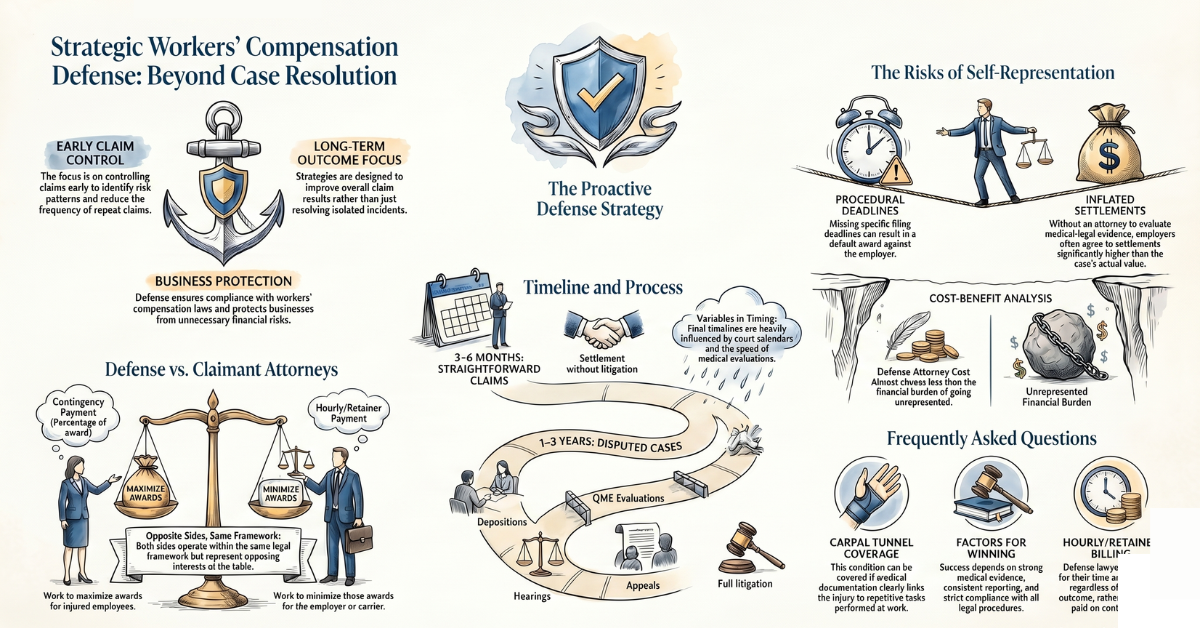
Most defense firms react to claims. We focus on controlling them early. Our team works directly with employers and carriers to identify risk patterns, reduce repeat claims, and improve long-term claim outcomes, not just resolve individual cases. A skilled workers’ compensation defense attorney helps protect your business from unnecessary financial risks, ensures compliance with workers’ compensation laws, and achieves fair outcomes in disputed claims.
If you need workers’ compensation defense in Los Angeles, reach out to us at Novian & Novian. With our comprehensive legal knowledge and experience in personal injury cases, we will work to ensure you receive the compensation you deserve. Schedule a free consultation today!
Frequently Asked Questions
Workers’ compensation defense raises a lot of questions, especially for employers dealing with their first claim. Here are the ones we hear most often.
How Are Defense Attorneys Different from Claimant Attorneys?
Claimant attorneys represent the injured employee and work on contingency as they take a percentage of the award. Defense attorneys represent the employer or insurance carrier and typically bill hourly. The objectives are opposite: claimant attorneys maximize the award, defense attorneys minimize it. Both operate within the same legal framework, but from different sides of the table.
How Long Does a Workers’ Compensation Case Typically Take?
It depends on whether the case settles or goes to a hearing. Straightforward claims with clear medical evidence can be resolved in 3–6 months. Disputed cases that go through the full litigation process, such as depositions, QME evaluation, hearing, and possible appeal, can take 1–3 years. The timeline also depends on the court’s calendar and how quickly medical evaluations are completed.
Can Employers Represent Themselves in Workers’ Comp Cases?
Technically, yes. But it’s risky. Workers’ compensation law has specific procedural requirements, filing deadlines, and evidentiary rules that are easy to miss without legal training. A missed deadline can result in a default award. And without an attorney evaluating the medical-legal evidence, employers often accept settlements that are significantly higher than what the case warrants. The cost of defense settlement is almost always less than the cost of going unrepresented.
Can Carpal Tunnel Be Covered Under Workers’ Compensation?
Yes, carpal tunnel syndrome can be covered if you can show it was caused or significantly aggravated by repetitive tasks at work. Medical documentation and a clear link between your job duties and the condition are critical for approval.
What Are the Odds of Winning a Workers’ Comp Case?
The odds depend heavily on the strength of medical evidence, consistency in reporting, and compliance with deadlines and procedures. Straightforward claims with clear work-related injuries tend to have much higher success rates than disputed or poorly documented cases.
Do Defense Lawyers Only Get Paid if They Win?
No, workers’ compensation defense lawyers are typically paid hourly or on a retainer by the employer or insurance company. Their payment is not contingent on winning the case.
How Can Employers Benefit From Hiring a Workers’ Comp Defense Lawyer?
A defense lawyer helps control claim costs by identifying weak or fraudulent claims and ensuring compliance with workers’ compensation laws. They also handle litigation, negotiations, and strategy, reducing risk and allowing the business to focus on operations.