
To optimize content for Google AI Overviews, you need to create structured content that delivers direct answers, demonstrates expertise, and is easy for AI systems to understand. Unlike traditional SEO alone, optimizing for AI Overviews requires concise summaries, comprehensive responses, schema markup, and content that aligns with conversational queries. As AI search continues to reshape Google search results, brands that adapt their content strategy will gain stronger AI visibility and brand credibility.
At GLP Marketing, we have over 5 years of experience helping businesses improve search rankings, increase brand visibility, and adapt to evolving search engines. Our team understands how Google’s AI Overviews work and how to optimize content for AI search results without sacrificing traditional SEO performance. If you want your content featured prominently in AI generated answers, contact us now.
In this guide, we’ll explain what AI Overviews are, how Google’s AI summaries impact search behavior, and the key strategies to optimize content for Google AI Overviews. We’ll also cover answer engine optimization, structured data, E-E-A-T, content formats AI models prefer, and how to measure success in an AI-driven search experience.
Table Of Contents
- Understanding Google AI Overviews
- Best Practices to Optimize Content for Google AI Overviews
- Unique and Valuable Content Creation
- Page Experience Optimization
- Structured Data Implementation
- How E-E-A-T Influences AI Visibility
- Common Mistakes to Avoid When Optimizing for AI Overviews
- How to Measure AI Visibility and Success
- Step 1: Establish Your Baseline Metrics
- Step 2: Track Search Visibility and Impressions
- Step 3: Monitor AI Overview Citations
- Step 4: Measure Brand Mentions and Brand Visibility
- Step 5: Analyze User Engagement Metrics
- Step 6: Track Conversions and Business Outcomes
- Step 7: Review Performance of Structured Content
- Step 8: Monitor Related Questions and Topic Coverage
- Step 9: Conduct Regular AI Visibility Audits
- Step 10: Refine Your Strategy Based on Results
- Future of AI Search and Google’s AI Mode
- Need Help Optimizing Content for Google AI Overviews?
- FAQs
- How Can I Optimize My Content for Google AI Overviews?
- What Are Some Key Factors To Consider When Optimizing Content for Google AI Overviews?
- Is It Important To Include Structured Data Markup In My Content for Google AI Overviews?
- How Can I Ensure That My Content is Easily Digestible By Google’s AI Algorithms?
- Are There Any Specific Tools or Resources That Can Help Me Optimize My Content for Google AI Overviews?
Understanding Google AI Overviews

Google AI Overviews are AI generated summaries that appear at the top of Google search results for selected search queries. They use Google’s AI to gather information from multiple relevant sources and provide users with direct answers on the search engine results page. The purpose is to improve the search experience by helping users find key information faster without visiting multiple websites.
Google’s AI Overviews have become increasingly important for modern SEO strategies because they are changing how users interact with search engines. According to the nonprofit Pew Research Center, users click traditional search result links only 8% of the time when an AI Overview appears, compared to 15% when no AI Overview is present. This highlights how AI generated answers can significantly impact organic traffic and user behavior.
Unlike featured snippets, which usually pull information from one page, Google’s AI Overviews generate comprehensive responses using information from several relevant sources. These AI generated summaries are powered by Google’s Gemini model and other AI systems that analyze content relevance, authority, and usefulness. In our experience, AI Overviews are most common for informational queries and conversational queries where users need a detailed answer rather than a simple fact.
Google’s AI Overviews affect search results in several ways. They increase competition for visibility at the top of the search engine results page and often reduce click-through rates for informational content. However, being cited within AI generated responses can improve brand visibility, strengthen brand credibility, and position your content as a trusted source. This is why answer engine optimization has become an important extension of traditional SEO.
AI Overviews work by combining Google’s search technology with advanced large language models. When someone enters a search query, Google’s AI reviews relevant sources, evaluates E-E-A-T signals, analyzes user intent, and generates concise summaries designed to answer the question directly. The system also processes different content formats, including text, images, and videos, because AI search is increasingly multimodal.
For content creators, this means optimizing for AI Overviews requires more than keyword research and search rankings. Content must provide direct answers, include structured content, use schema markup, and deliver valuable insights that AI systems can easily parse. We recommend creating content that is specific, comprehensive, and organized around topics rather than individual keywords. This approach helps increase AI visibility and improves the likelihood of being featured prominently in Google’s AI summaries.
Best Practices to Optimize Content for Google AI Overviews

The first best practice is answering the main question immediately. AI prefers concise summaries that address search intent quickly and clearly. We recommend placing the direct answer within the opening paragraph because AI Overviews often pull key information from the beginning of a page. This also improves the user experience by helping visitors find answers faster.
Another important strategy is focusing on topics instead of individual keywords. While keyword research remains valuable, Google’s AI increasingly relies on semantic search to understand concepts and relationships between topics. Instead of targeting a single keyword repeatedly, create content around broader themes and related questions. This approach helps AI systems connect your content to more search queries and improves overall search visibility.
You should also make sure your content aligns closely with user intent. Every search query reflects a specific need, whether users want information, comparisons, instructions, or recommendations. We recommend researching conversational queries and related questions before creating content. This helps ensure your content provides the detailed answers users expect while increasing its relevance for AI generated responses.
Content structure plays a major role in AI search optimization. Structured content is easier for AI systems to parse, summarize, and reference. Use clear headings, short paragraphs, concise summaries, and bullet points where appropriate. Question-based headings are particularly effective because they often match the way people search using voice search and AI search tools.
Implementing structured data is another essential strategy. Structured data helps search engines understand the context and purpose of your content. According to Schema, schema markup creates machine readable information that allows search engines to categorize content more effectively. FAQ schema is especially valuable because it makes pages eligible for enhanced search engine results and increases opportunities to appear in AI generated summaries.
AI tools can also support content optimization when used correctly. These tools can identify content gaps, uncover targeted queries, and provide insights into search trends. However, relying entirely on AI generated content is often the wrong game. We recommend combining AI-driven insights with original research, first-hand experience, and expert knowledge. This creates unique value that AI systems and users both appreciate.
Finally, make sure to address People Also Ask questions and related questions throughout your content. These questions reveal exactly what users want to know about a topic. Creating content around these informational queries strengthens topical authority and improves your chances of appearing in AI Overviews, featured snippets, and other SERP features. When combined with strong technical SEO, internal linking, and ongoing content updates, this approach can significantly improve AI visibility and help your content perform better in modern search results.
Unique and Valuable Content Creation

Creating unique and valuable content is one of the most effective ways to improve AI visibility. Google’s AI Overviews are designed to surface content that offers original insights rather than recycled information. In our experience, content that provides first-hand experience, expert commentary, original research, or unique perspectives has a better chance of being featured in AI generated answers and AI generated summaries.
Originality matters because Google’s AI systems are designed to identify content that adds unique value to the search experience. If your content simply repeats information already available elsewhere, Google’s AI may choose another source for its AI generated responses. We recommend including personal experiences, industry expertise, proprietary data, customer stories, or original analysis whenever possible. These elements help differentiate your content from competing pages in search results.
As Chidinma Enemanna, Head of Content at GLP Marketing, explains, “The easiest way to stand out in AI search is to publish something only your brand can say. Original insights will always outperform recycled information.”
For example, a generic article about content marketing may struggle to gain AI visibility. However, an article that includes original findings, client results, or practical lessons from real campaigns offers valuable insights that AI models can use when generating answers. In our experience, some of the best-performing content combines expert knowledge with real-world examples and actionable advice.
Creating unique content starts with understanding your audience. We recommend conducting audience research to identify common pain points, search queries, and related questions. Instead of creating content for search engines alone, create content written specifically for the people you want to reach. This approach improves relevance and helps align content with user intent.
Personalization also plays an important role. Different audiences have different needs, challenges, and levels of expertise. Tailoring your content strategy around those needs makes your content more useful and increases engagement. It also helps Google’s AI understand who the content is intended to serve.
Multimedia elements can further strengthen your content. Google’s AI is increasingly multimodal, meaning it can process text, images, videos, and other content formats. We recommend incorporating relevant images, videos, infographics, charts, and visual explanations whenever possible. These elements improve user engagement while providing additional context that AI systems can interpret.
Another effective strategy is creating content clusters. A pillar page supported by interlinked articles helps establish topical authority and strengthens internal linking. This structured content approach makes it easier for search engines and answer engines to understand the relationship between topics and identify your expertise.
Several AI tools can help support content creation and optimization. These tools can assist with keyword research, topic discovery, content gaps, and trend analysis. However, they should support human expertise rather than replace it. The most effective content combines AI-driven insights with genuine expertise, creativity, and original thought.
To stay current with evolving AI search trends, we recommend regularly reviewing guidance from Google’s developer resources. The information available at developers.google.com provides valuable updates on search systems, structured data, technical SEO, and content best practices. Staying informed helps ensure your content strategy remains aligned with how Google’s AI Overviews work and how modern search engines evaluate content quality.
Page Experience Optimization

Page experience optimization is an important part of both traditional SEO and answer engine optimization. Even the most valuable content can struggle to perform if users have a poor experience on your website. In our experience, websites that load quickly, work well on mobile devices, and provide smooth interactions are more likely to maintain strong search visibility and user engagement.
As Juan Reyes, Head of SEO at GLP Marketing, explains, “Great content gets users to your page, but great page experience keeps them there. Both are essential for long-term SEO success.”
One of the most important page experience factors is Core Web Vitals. These are Google’s performance metrics that measure how quickly a page loads, how responsive it is to user interactions, and how visually stable it remains while loading. Core Web Vitals focus on loading performance, interactivity, and visual stability because these elements directly affect the user experience.
According to Google Search Central, Core Web Vitals help site owners understand and improve real-world user experience. Google uses these metrics to evaluate page quality and identify pages that provide a better experience for visitors. While great content remains essential, page experience can influence how users interact with content and whether they stay on the page.
This becomes even more important in the era of Google’s AI Overviews. AI systems aim to recommend content that is trustworthy, accessible, and useful. If users consistently abandon a slow or poorly designed page, that sends negative engagement signals. We recommend treating Core Web Vitals as a foundational part of your content strategy rather than a technical afterthought.
Mobile optimization should also be a top priority. According to the nonprofit StatCounter Global Stats, mobile devices account for the majority of global web traffic. This means many users will encounter your content through smartphones rather than desktop computers. A responsive design ensures your content remains readable, accessible, and easy to navigate across all screen sizes.
Fast loading times are equally important. Visitors expect websites to load almost instantly, especially when using mobile devices. We recommend compressing images, reducing unnecessary scripts, improving server performance, and using modern website technologies. These improvements can significantly enhance both user experience and search performance.
Interactivity also affects how content performs. Buttons, forms, menus, and navigation elements should respond quickly and function properly. A frustrating user experience can reduce engagement, increase bounce rates, and limit conversions. Small improvements in usability often produce measurable improvements in content performance.
For example, we have seen websites improve user engagement simply by reducing page load times and improving mobile responsiveness. In some cases, faster pages resulted in longer session durations, lower bounce rates, and stronger search visibility. While results vary by industry, the relationship between page experience and user satisfaction remains consistent.
The most successful websites combine high-quality content with excellent technical performance. We recommend regularly monitoring Core Web Vitals, testing mobile usability, and conducting technical SEO audits. When valuable content is paired with a strong page experience, it becomes easier for users, search engines, and AI systems to recognize the quality of your website.
Structured Data Implementation

Structured data is one of the most important technical SEO elements for improving AI visibility. It helps search engines understand the meaning, context, and relationships within your content. In our experience, websites that implement structured data correctly are better positioned to appear in AI Overviews, featured snippets, and other valuable SERP features.
As Juan Reyes, Head of SEO at GLP Marketing, explains, “Structured data acts like a roadmap for search engines. The easier you make content to understand, the easier it becomes for AI systems to reference and surface it.”
Structured data uses schema markup to provide machine readable information about a page. Instead of forcing search engines to interpret content on their own, schema markup clearly identifies key information such as articles, FAQs, products, organizations, authors, and reviews. This additional context helps search engines process content more accurately and efficiently.
According to Schema, schema markup creates a shared vocabulary that allows search engines to better understand website content. Google also states that structured data can make pages eligible for enhanced search features and rich results. These enhanced results often improve visibility and help content stand out within search engine results.
Structured data is particularly important for Google’s AI Overviews because AI systems rely on clear and organized information. AI generated summaries are created by evaluating content from multiple relevant sources. When content includes schema markup, Google’s AI can more easily parse key information and understand how that content relates to specific search queries.
For example, FAQ schema can help search engines identify direct answers to common questions. Article schema provides context about authorship and publication details. Organization schema helps establish brand credibility, while How-To schema can improve visibility for instructional content. Together, these structured data types make content easier for AI systems to evaluate and summarize.
Implementing structured data starts with selecting the correct schema markup for your content. We recommend reviewing the purpose of each page before choosing a schema type. FAQ pages should use FAQ schema, blog posts should use Article schema, and business websites should include Organization schema whenever appropriate.
The next step is adding the schema markup to your website. Many content management systems and SEO plugins simplify this process. However, implementation should always be reviewed carefully because inaccurate schema can limit effectiveness.
Testing and validation are equally important. According to Google Search Central, properly validated structured data improves Google’s ability to understand and display content. We recommend using Google’s Rich Results Test and Schema Markup Validator to verify implementation and identify errors before publishing.
Competitive analysis can also reveal valuable opportunities. Reviewing how competitors use structured data helps identify gaps in your own strategy. For example, developers.google.com extensively uses structured content, schema markup, and machine readable documentation to help search engines understand technical information. Similarly, Finch emphasizes structured content and organized data architecture to improve search performance and content discoverability.
We recommend evaluating competitor pages that consistently appear in AI search results and AI Overviews. Pay attention to their schema implementation, content structure, FAQ usage, internal linking, and content organization. In many cases, the websites featured prominently in AI generated answers have invested heavily in making their content easy for AI systems to understand.
It depends on your industry and content type, but structured data has become a foundational part of optimizing for AI Overviews. When combined with high-quality content, strong E-E-A-T signals, and effective technical SEO, schema markup helps improve search visibility, strengthens brand credibility, and increases the likelihood of being featured in Google’s AI generated summaries.
How E-E-A-T Influences AI Visibility
E-E-A-T, which stands for Experience, Expertise, Authoritativeness, and Trustworthiness, plays a major role in AI visibility. While Google has stated that E-E-A-T is not a direct ranking factor, its systems are designed to identify signals that demonstrate these qualities. In our experience, content with strong E-E-A-T signals is more likely to appear in AI Overviews, AI generated answers, and other prominent search features.
According to Google’s Search Central documentation, Google’s ranking systems prioritize helpful, reliable, people-first content and use a variety of signals to identify content that demonstrates strong E-E-A-T qualities. Google also notes that these signals are especially important for topics that can impact a person’s health, finances, safety, or well-being.
E-E-A-T is particularly important because AI Overviews rely on trusted sources when generating summaries. Google’s AI systems evaluate content quality, source credibility, author expertise, and evidence of first-hand experience before selecting information for AI generated summaries. Content that demonstrates real-world expertise and trustworthy information is more likely to be referenced in AI search results.
Experience has become increasingly important since Google expanded E-A-T to E-E-A-T. According to Google’s Search Quality Rater Guidelines Overview, quality raters are instructed to consider the creator’s first-hand experience, expertise, authoritativeness, and trustworthiness when evaluating content quality. The guidelines also emphasize that trust is critical when determining page quality.
One effective way to strengthen E-E-A-T is by incorporating first-hand experiences, case studies, original research, and expert commentary. For example, instead of publishing generic content written from secondary sources, share real campaign results, practical lessons, or client success stories. This creates unique value that AI models can recognize and reference.
Author transparency also matters. We recommend including detailed author bios, professional credentials, industry experience, and links to relevant profiles. These signals help search engines and AI systems better understand who created the content and whether they are qualified to discuss the topic.
Trustworthiness is equally important. According to Google’s Quality Rater Guidelines Overview, trust relates to whether a page is accurate, honest, safe, and reliable. Content that includes credible sources, factual information, and clear attribution is more likely to earn trust from both users and AI systems.
Another important strategy is maintaining content freshness. Google’s systems often favor content that is updated regularly, especially for rapidly evolving topics like AI search and answer engine optimization. We recommend reviewing key content periodically to ensure statistics, examples, and recommendations remain accurate.
Common Mistakes to Avoid When Optimizing for AI Overviews
As AI search continues to evolve, many businesses make mistakes that limit their AI visibility. In our experience, avoiding these common issues can significantly improve your chances of appearing in Google’s AI Overviews, AI generated answers, and other AI search results.
| Mistake | Why It Hurts AI Visibility | What to Do Instead |
|---|---|---|
| Focusing Only on Keywords | AI models rely on topics, context, and user intent rather than keyword density alone. | Build content around topics and related concepts. Use keyword research to support content, not drive every sentence. |
| Failing to Answer Questions Directly | AI systems prefer content that provides immediate answers. Pages that bury answers deep within content are less likely to be cited. | Place direct answers near the beginning of the page and use clear question-based headings. |
| Ignoring E-E-A-T Signals | Content lacking expertise, authority, and trustworthiness may struggle to appear in AI generated summaries. | Include expert insights, author bios, original research, case studies, and credible sources. |
| Publishing Generic AI-Generated Content | Generic content often lacks unique value and may not stand out among competing sources. | Combine AI tools with human expertise, first-hand experience, and original insights. |
| Not Using Structured Data | Without schema markup, AI systems may have difficulty understanding content context and relevance. | Implement structured data, FAQ schema, Article schema, and other relevant markup types. |
The biggest mistake is treating AI Overviews as a completely separate strategy from SEO. The most successful websites combine traditional SEO, answer engine optimization, structured content, technical SEO, and strong E-E-A-T signals to improve both search rankings and AI visibility.
How to Measure AI Visibility and Success
Measuring AI visibility requires a different approach than traditional SEO. Since many AI generated answers result in zero-click searches, rankings and traffic alone do not tell the full story. In our experience, the most effective strategy is tracking a combination of AI visibility, user engagement, brand mentions, and business outcomes.
Step 1: Establish Your Baseline Metrics
Before optimizing for AI Overviews, document your current performance. Record your organic traffic, search rankings, click-through rates, impressions, and conversions.
We recommend using Google Search Console and Google Analytics to establish benchmark data. This makes it easier to identify whether your optimization efforts are improving results over time.
Step 2: Track Search Visibility and Impressions
AI Overviews can increase visibility even when users do not click through to your website. For this reason, impressions are often just as important as clicks.
Monitor how frequently your content appears in Google search results for targeted queries. Rising impressions often indicate growing visibility within AI search and traditional search results.
Step 3: Monitor AI Overview Citations
Search for your target keywords regularly and review whether your content is being cited within Google’s AI Overviews. Pay attention to which pages, topics, and content formats appear most frequently.
We recommend maintaining a tracking spreadsheet for important search queries. This helps identify patterns and opportunities for further optimization.
Step 4: Measure Brand Mentions and Brand Visibility
Being featured in AI generated summaries can increase brand awareness even without direct website visits. Monitor branded searches, brand mentions, and referral traffic to understand whether AI visibility is increasing brand recognition. For example, if more users search for your company name after AI Overview exposure, your content may be building authority and credibility.
Step 5: Analyze User Engagement Metrics
Strong engagement signals often indicate that your content aligns with user intent. Review metrics such as average engagement time, pages per session, scroll depth, and return visits. Content that keeps users engaged is more likely to demonstrate value to both search engines and AI systems.
Step 6: Track Conversions and Business Outcomes
Visibility alone does not drive growth. The ultimate goal is generating meaningful business results.
Track contact form submissions, consultation requests, demo bookings, sales inquiries, newsletter signups, or other conversion actions. We recommend measuring whether AI-focused content contributes to these outcomes over time.
Step 7: Review Performance of Structured Content
Evaluate which pages with schema markup, FAQ schema, and structured data generate the strongest results. This helps determine whether your structured content strategy is improving search visibility and AI performance. Compare structured pages against similar pages without schema implementation whenever possible.
Step 8: Monitor Related Questions and Topic Coverage
AI systems reward comprehensive topic coverage. Review whether your content ranks for additional conversational queries, related questions, and informational searches. Growing keyword visibility across a topic cluster often signals increasing authority and relevance.
Step 9: Conduct Regular AI Visibility Audits
Search behavior and AI systems evolve rapidly. We recommend conducting a monthly or quarterly audit of your AI search performance.
Review AI citations, content freshness, technical SEO, structured data implementation, internal linking, and competitor activity. This process helps identify gaps before they affect performance.
Step 10: Refine Your Strategy Based on Results
The final step is continuous improvement. If certain content formats, topics, or pages consistently earn AI visibility, create more content around those areas.
It depends on your industry and goals, but successful optimization is rarely a one-time effort. The brands that perform best in AI search continuously measure results, update content, strengthen E-E-A-T signals, and adapt their content strategy based on real-world performance data.
Future of AI Search and Google’s AI Mode
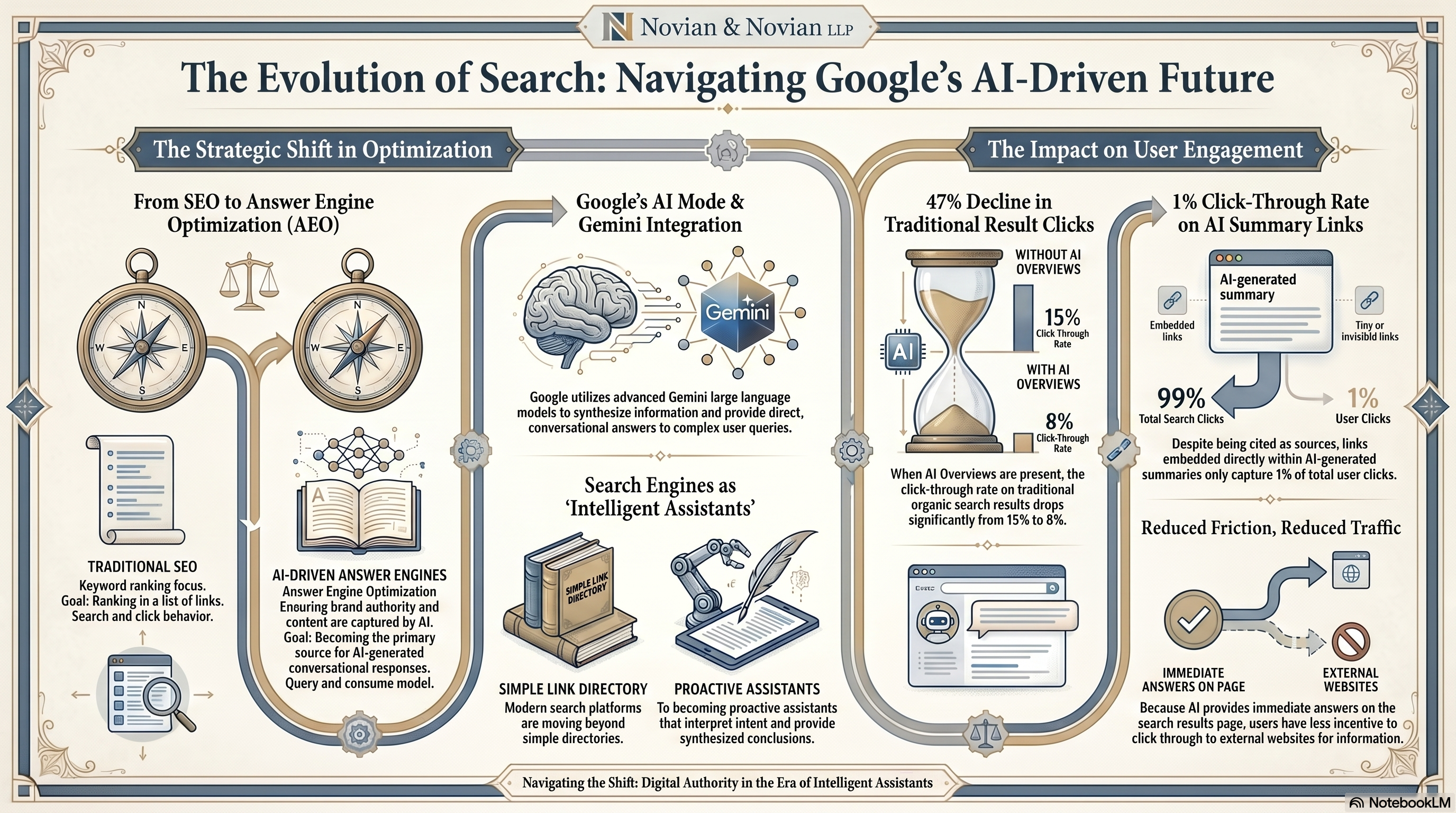
AI search is rapidly transforming how people discover information online. Instead of browsing multiple search results, users increasingly receive AI generated answers directly within Google search. This shift is changing the role of SEO, content creation, and answer engine optimization as businesses compete for visibility within AI systems rather than traditional rankings alone.
Google’s AI Mode represents the next evolution of search. Unlike traditional search engines that primarily display links, AI Mode delivers conversational responses powered by Google’s Gemini models. Google explains that AI Mode uses advanced search techniques and multiple related searches to generate comprehensive responses while connecting users to relevant sources.
AI Overviews and AI Mode are designed to help users explore complex topics more efficiently and discover a wider variety of websites. , users clicked a traditional search result only 8% of the time when an AI Overview appeared, compared to 15% when no AI Overview was present. The study also found that users clicked links within AI summaries only 1% of the time. These findings highlight why businesses must focus on AI visibility and not just traditional search rankings. more like an intelligent assistant than a traditional search engine.
Need Help Optimizing Content for Google AI Overviews?
Google’s AI Overviews are changing how users interact with search engines and discover information online. To optimize content for Google AI Overviews, businesses must focus on direct answers, structured content, schema markup, E-E-A-T, user intent, and comprehensive topic coverage. We recommend creating content that is easy for AI systems to understand while still delivering unique value to users. The brands that adapt their content strategy now will be better positioned for long-term AI visibility and search success.
In our experience, successful optimization combines traditional SEO, answer engine optimization, technical SEO, content marketing, and ongoing content refinement. Strategies such as implementing structured data, targeting conversational queries, improving page experience, building content clusters, and addressing related questions can significantly improve visibility in AI search results. At the same time, avoiding common mistakes like keyword stuffing, generic AI generated content, and poor content structure helps protect search performance.
If you’re ready to improve your AI visibility and strengthen your presence in Google’s AI summaries, now is the time to act. At GLP Marketing, we help businesses create content that performs in both traditional search and AI-driven search experiences. We encourage you to start implementing these strategies today, and if you’ve already experimented with AI search optimization, share your experiences and insights in the comments. We’d love to hear what’s working for your business.
FAQs
Optimizing content for Google AI Overviews can seem complicated because AI search continues to evolve. To help, we’ve answered some of the most common questions about AI visibility, structured data, content optimization, and answer engine optimization
How Can I Optimize My Content for Google AI Overviews?
Focus on providing direct answers, creating structured content, and aligning content with user intent. We recommend using schema markup, question-based headings, and comprehensive topic coverage to improve AI visibility.
What Are Some Key Factors To Consider When Optimizing Content for Google AI Overviews?
The most important factors include E-E-A-T, structured data, content relevance, and user intent. Content should also be easy to scan, contain valuable insights, and answer search queries clearly.
Is It Important To Include Structured Data Markup In My Content for Google AI Overviews?
Yes, structured data helps search engines and AI systems understand your content more effectively. Schema markup can also make pages eligible for enhanced search engine results and AI generated summaries.
How Can I Ensure That My Content is Easily Digestible By Google’s AI Algorithms?
Use clear headings, short paragraphs, bullet points, and concise summaries throughout your content. We recommend organizing information logically so AI systems can easily parse and understand key information.
Are There Any Specific Tools or Resources That Can Help Me Optimize My Content for Google AI Overviews?
Tools such as Google Search Console, Google Analytics, schema validators, and keyword research platforms can support optimization efforts. You should also monitor updates from developers.google.com to stay informed about changes to Google’s AI search experience.
 CALL:
CALL: