
Correcting employee misclassification requires businesses to review the employment relationship, determine the correct classification, correct payroll and employment records, and address any amounts owed. Employee misclassification occurs when a business treats a worker as an independent contractor when the worker should legally be classified as an employee. The mistake can create tax liabilities, unpaid wages, overtime claims, benefit disputes, and regulatory exposure under federal and state laws.
At Novian & Novian, our attorneys bring more than 35 years of experience to employment law matters and help employers address complex workplace classification issues. If your business is facing an employee misclassification issue, contact us today for a free consultation.
This guide explains how to correct employee misclassification and how employers can avoid similar problems in the future.
Table Of Contents
- What Is Employee Misclassification?
- What Is the Difference Between an Employee and an Independent Contractor?
- What Causes Worker Misclassification?
- What Are the Consequences of Employee Misclassification?
- What Is the CLEAR Framework for Correcting Misclassification?
- How Do You Correct Employee Misclassification Step by Step?
- Step 1 – Audit Every Worker Currently Classified as an Independent Contractor.
- Step 2 – Determine Which Test Governs Each Relationship Before Deciding Anything.
- Step 3 – Quantify the Exposure Before You Change Anything.
- Step 4 – Choose the Correction Path.
- Step 5 – Onboard the Worker as an Employee.
- Step 6 – Correct the Prior Periods With the Right Filings.
- Step 7 – Tell the Affected Workers What Is Changing and Why.
- What Does Employee Misclassification Correction Look Like in Practice?
- Can You Reduce What You Owe Through Section 530 or Section 3509 Relief?
- Which Worker Classification Tests Apply to Your Business?
- What Are California’s Misclassification Penalties?
- How Far Back Can a Misclassification Claim Reach?
- What Can Employers Learn From Misclassification Cases?
- Do You Need Help Correcting Misclassification?
- Frequently Asked Questions
- How Can I Tell If a Worker Has Been Misclassified?
- What Should I Do If I Suspect a Worker Has Been Misclassified?
- How Should I Communicate a Reclassification to a Worker?
- Can I Reclassify a Worker Without Triggering an IRS Audit?
- Does Receiving a 1099 Mean Someone Is an Independent Contractor?
- Can an Independent Contractor Agreement Establish Contractor Status?
What Is Employee Misclassification?
Employee misclassification generally occurs when a worker who should be treated as an employee is classified as an independent contractor. A worker’s title, contract, or payment method does not necessarily determine legal status.
For federal tax purposes, the Internal Revenue Service examines the relationship between the worker and business under common-law rules. The IRS considers behavioral control, financial control, and the type of relationship between the parties when determining whether someone is an employee or independent contractor.
The Fair Labor Standards Act also has its own framework for determining employee status. Under the current DOL rule, the economic reality of the relationship is examined using multiple factors, including control, opportunity for profit or loss, investments, permanence, whether the work is integral to the business, and skill and initiative.
This means receiving a 1099 form does not guarantee independent contractor status. Similarly, signing an independent contractor agreement does not automatically make someone an independent contractor.
What Is the Difference Between an Employee and an Independent Contractor?
The difference is control and independence, not business paperwork. An employer controls how, when, and where an employee performs the work. Employees may be entitled to minimum wage, overtime pay, unemployment insurance, workers’ compensation, tax withholding, and job-protected leave under the Family and Medical Leave Act, along with other statutory protections. Which of those apply depends on the federal, state, and local laws covering that workplace.
Payroll taxes are the clearest practical split. For an employee, the business withholds income tax and the employee share of Social Security and Medicare taxes, then pays a matching employer share and federal unemployment tax. A genuine independent contractor handles that obligation personally through self-employment tax; the hiring business withholds nothing.
An independent contractor also runs a business. That worker sets the methods, carries the risk of profit and loss, serves other clients, and supplies the tools of the trade. Genuine contractors file business paperwork of their own, whether that means forming a business entity, holding a license, or carrying their own insurance. A worker does not become an independent contractor simply because the company says so.
One relationship can produce different answers under different employment laws. A worker may be properly classified as a contractor for federal tax purposes and still be an employee under a state wage statute. Employers therefore need to identify which test governs the obligation before concluding that a classification is correct. Employers weighing that question often bring in California employment law counsel before making the call.
Is Independent Contracting Always a Problem?
No. Independent contracting is a legitimate business model when the worker genuinely operates an independent business and the relationship satisfies the classification test that applies. Businesses may properly engage contractors for specialized, project-based, temporary, or independently operated services.
The risk arises when the business relationship looks like employment despite the contractor label. Employers should therefore avoid treating every contractor arrangement as inherently risky or assuming that reclassification is always required.
There is also a practical trade-off. Employee classification can create additional payroll, benefits, recordkeeping, and administrative obligations, while genuine independent contracting can give businesses flexibility and allow independent professionals to operate their own businesses. Those benefits do not override the law, however, and the parties cannot simply choose the classification that is most convenient.
The better approach is to structure the relationship correctly from the beginning and review it when the facts change. A business that genuinely needs an independent contractor should preserve the characteristics of an independent business rather than relying solely on contract language to establish that status.

What Causes Worker Misclassification?
In our experience, most worker misclassification is not deliberate. It comes from applying a label once and never revisiting it. Businesses treat employees as independent contractors because they misread the law’s definition, rely on a signed contract as proof, or copy whatever industry practice looks like. A hiring team classifies workers without legal input. Contract wording describes an arrangement nobody checked against reality.
Sometimes nothing was wrong at the start, but the relationship simply changed. A contractor brought in for a short project takes on a permanent schedule, absorbs duties that sit inside the core business activities, and ends up managed like staff. The paperwork never catches up, and the misclassification risk grows quietly. The fix is the same in every case. Classify workers on the employment relationship as it operates today, not on the title, the payment method, or the language in the agreement.
What Are the Consequences of Employee Misclassification?
Misclassifying employees creates tax, wage, and litigation exposure. The size of it depends on which federal and state laws apply, how long the misclassification ran, how many workers it covered, and whether the conduct was voluntary and knowing.
A business may owe employment taxes, unpaid wages, and overtime pay, along with penalties and interest. Since the employer withheld nothing, the Social Security and Medicare taxes that should have been withheld and matched were never paid, and unemployment insurance contributions were never made either.
Benefit and retirement questions surface for the same period, including eligibility for job-protected family leave the worker was never offered. Employees are also covered by workers’ compensation, so an injury to a misclassified worker can land outside the policy. Information return penalties are the quiet line item. The IRS charges a penalty for each information return filed late or incorrectly, and a separate penalty for each payee statement, so one misclassified worker can generate two.
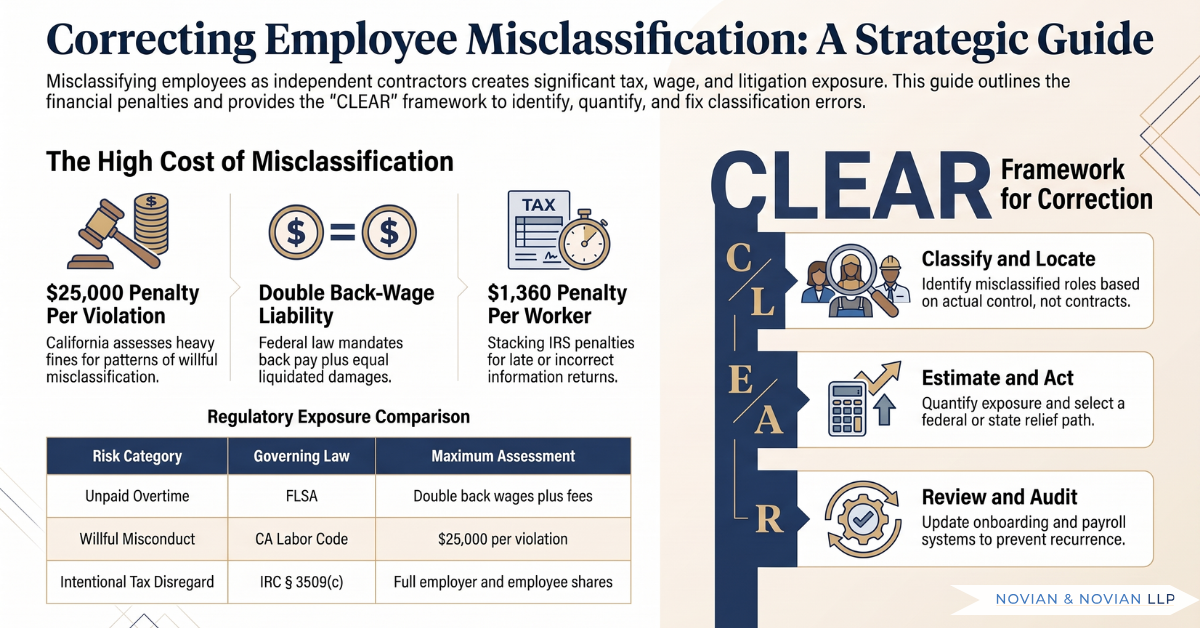
For returns due in 2026, the information return penalty ranges from $60 if the correction is made within thirty days to $340 if the return is filed after August 1 or never filed at all. Intentional disregard raises it to $680 per return with no annual maximum. The penalty for the return and the penalty for the payee statement stack, so intentional disregard can reach $1,360 for a single worker.
Federal and state-level regulatory agencies can open audits independently. Misclassified workers can bring legal claims individually and, where the law permits it, on behalf of a group of similarly situated workers. A classification error that reaches more than one worker rarely stays administrative, and it becomes employment litigation with a class or representative dimension.
Under federal wage law, the stakes are concrete. A misclassified worker loses FLSA protections such as minimum wage and overtime pay. The U.S. Department of Labor calls misclassification a serious problem for exactly that reason. An employer that treats an employee as a contractor without a reasonable basis may be liable for the employment taxes it failed to withhold and remit.
The table below sets out the main categories of exposure and where each one is decided. Amounts are current as of publication and change with statutory and inflation adjustments.
| Exposure | Governing Law | What Is Assessed | Amount or Rate |
|---|---|---|---|
| Federal employment tax, reduced rates | IRC § 3509 | Income tax withholding and the employee Social Security share, at reduced rates | 1.5% of wages and 20% of the employee share |
| Federal employment tax, reporting failures | IRC § 3509(b) | The same employment taxes, doubled when required information reporting was not completed | 3% of wages and 40% of the employee share |
| Federal employment tax, intentional disregard | IRC § 3509(c) | Reduced rates are unavailable; full employment tax liability applies | Full employer and employee amounts, plus penalties and interest |
| Information return penalties | Internal Revenue Code | Each incorrect or late information return and each payee statement | $60 to $340 per return; $680 for intentional disregard, with no maximum |
| Unpaid wages and overtime | FLSA, 29 U.S.C. § 216(b) | Back wages plus an additional equal amount as liquidated damages | Effectively double the unpaid wages, plus fees and costs |
| Willful misclassification | California Labor Code § 226.8 | Civil penalty for each violation, plus a public notice requirement | $5,000 to $15,000; $10,000 to $25,000 for a pattern or practice |
| State payroll taxes | California Unemployment Insurance Code | Unpaid UI, ETT, and SDI contributions and PIT withholding | Assessment plus statutory penalties and interest |
| Benefits and retirement | Plan documents and ERISA | Retroactive plan eligibility and required contributions | Plan-dependent |
What Is the CLEAR Framework for Correcting Misclassification?
At Novian & Novian, we recommend approaching a misclassification problem through four stages: Classify, Locate, Estimate, Act, and Review (CLEAR). The framework helps employers separate the legal classification question from the financial and operational work that follows.
Classify: Determine whether the worker is an employee or independent contractor under every federal and state law that applies. Start with the actual working relationship, not the contract, job title, or payment method.
Locate: Identify where the problem exists. Review payroll records, tax filings, wage records, benefit eligibility, worker classifications, and any government notices or worker complaints connected to the relationship.
Estimate: Calculate the potential exposure before taking corrective action. Consider unpaid wages, overtime, payroll taxes, information-return penalties, benefits, interest, and state-specific assessments.
Act: Choose the appropriate correction strategy and implement it deliberately. Depending on the facts, that may involve prospective reclassification, federal relief, corrected filings, back-pay calculations, or a combination of measures.
Review: After the correction, audit similar worker relationships and update contracts, onboarding procedures, payroll systems, timekeeping, and management practices. A correction is incomplete if the same classification error can simply happen again with the next hire.
The value of this framework is its order: classify first, quantify second, correct third, and prevent recurrence last. That sequence helps employers avoid making a rushed reclassification decision without understanding the legal and financial consequences.
How Do You Correct Employee Misclassification Step by Step?

Correcting employee misclassification means reclassifying the worker, fixing the records that were filed incorrectly, and resolving what is owed for the period the worker was treated as a contractor. Changing a title in the payroll system is the smallest part. The process below runs from internal audit through legal review, exposure calculation, the choice of relief program, system changes, prior period filings, and worker communication.
Step 1 – Audit Every Worker Currently Classified as an Independent Contractor.
Pull job descriptions, contracts, invoices, payment records, schedules, supervision practices, and performance expectations. Compare each one against the services the person actually performs. Ask who decides when, where, and how the work gets done. Ask who supplies the equipment, whether the worker serves other clients, how payment is calculated, and whether the person performing services operates a real business of their own. Those answers, not the contract, drive the proper classification.
Workers who fail them are employees, not independent contractors. Look closely at whether those services sit inside the core business activities, because that factor carries weight under more than one test. Do not stop at a single worker, because a flaw in the reasoning reaches everyone it was applied to. A thorough internal audit is what surfaces a systemic problem while it is still fixable.
Step 2 – Determine Which Test Governs Each Relationship Before Deciding Anything.
A California business is usually answering to at least three standards at once, and they do not produce the same answer. Bring in employment counsel and a tax professional where employment taxes are in play. Early advice also protects the correction itself, because reclassifying without a plan can create admissions and filing problems that were avoidable.
Step 3 – Quantify the Exposure Before You Change Anything.
Calculate the unpaid wages and overtime pay, the payroll taxes, the information return penalties, and any benefit contributions tied to the same months. Run the state numbers alongside the federal ones. This step comes before communication and before filing for a reason: the relief program you qualify for depends on facts you have not verified yet, and a premature filing can cost you the option.
Step 4 – Choose the Correction Path.
If you meet the three Section 530 requirements, the federal employment tax liability may be eliminated outright. If not, the Voluntary Classification Settlement Program may still allow a prospective reclassification at ten percent of one year of liability, computed at reduced rates. Those two routes and their conditions are covered in the next section.
Step 5 – Onboard the Worker as an Employee.
Reclassification touches payroll, tax withholding, onboarding documentation, benefits administration, timekeeping, and personnel files. Collect a Form W-4 and complete a Form I-9, register the hire with the state, and bring the worker under your California employee handbook, including timekeeping, meal and rest period, and expense reimbursement policies.
Step 6 – Correct the Prior Periods With the Right Filings.
Employment taxes already reported for closed quarters are corrected on Form 941-X, one per affected quarter. Prior-year worker reporting is corrected with a Form W-2c and a corrected Form 1099-NEC. California payroll tax reporting runs separately through the state quarterly returns. Getting the forward-looking payroll right while leaving the prior filings untouched is the most common half-correction, and it leaves the exposure exactly where it was.
Step 7 – Tell the Affected Workers What Is Changing and Why.
Cover the effective date and the practical effects on pay, tax withholding, and employee benefits. Keep the message accurate about the future without volunteering characterizations of the past. Statements about prior periods can become admissions, and promises about back pay or benefits can bind the company before anyone has run the numbers.
Coordinate the wording with counsel whenever unpaid wages, benefits, or taxes may be owed. Give workers a real chance to ask what the change means for them, because how a worker perceives the reclassification often determines whether it ends there or turns into legal trouble.
What Does Employee Misclassification Correction Look Like in Practice?
Consider a California company that has classified its field technicians as independent contractors for several years. The technicians work regular schedules, use company-provided equipment, follow company procedures, receive assignments from supervisors, and perform services that are central to the company’s business.
The company’s contracts describe the technicians as independent contractors, and each technician receives a Form 1099-NEC. During an internal review, however, the company realizes that the day-to-day relationship does not match the paperwork. The business therefore pauses new contractor onboarding, reviews the applicable classification tests, calculates potential wage and payroll-tax exposure, and has counsel determine whether any federal relief program is available.
The company then reclassifies the technicians prospectively, updates payroll and personnel records, addresses required prior-period filings, and communicates the change without making unsupported admissions about historical liability. The important lesson is that the company did not solve the problem merely by changing the workers’ titles. It corrected the underlying relationship, the payroll treatment, and the records supporting that relationship.
This example also illustrates why an internal audit should happen before a company makes a blanket reclassification decision. The same facts that identify an employee relationship can also reveal unpaid overtime, benefit issues, payroll-tax exposure, or potential claims that require a coordinated response.

Can You Reduce What You Owe Through Section 530 or Section 3509 Relief?
Yes, and this is something most employers do not know about. Federal law contains two separate mechanisms to reduce or eliminate employment tax liability arising from misclassification, plus a voluntary program for businesses that want to fix the problem before anyone audits them.
What Does Section 530 Relief Require?
Section 530 of the Revenue Act of 1978 terminates a taxpayer’s employment tax liability for a worker not treated as an employee, provided three requirements are met. Those requirements are reporting consistency, substantive consistency, and reasonable basis. Where all three hold, the relief covers the periods under audit and future periods as well, which the IRS describes as a permanent cure for that group of workers.
The business does not have to claim Section 530 for it to apply, and an examiner must consider whether it applies even when the taxpayer never raises it. The IRS must also provide Publication 1976, titled Do You Qualify for Relief Under Section 530, at the start of a worker classification examination. An employer under audit who never received it should ask why. Section 530 addresses worker classification, not wage issues, and it does not extend to the worker, who may still owe the employee share of FICA.
Who Qualifies for the Voluntary Classification Settlement Program?
The Voluntary Classification Settlement Program lets an eligible business reclassify workers as employees prospectively while paying a fraction of the back liability. The participant pays ten percent of the employment tax liability that would have been due on the most recent tax year’s compensation, computed at the reduced Section 3509(a) rates.
Eligibility is narrow and specific. The taxpayer must currently treat the workers as nonemployees, must have consistently treated them that way, and must have filed all required Forms 1099 for those workers for the three preceding calendar years. The business must have no current dispute with the IRS over the classification, must not be under IRS employment tax examination, and must not be under examination by the Department of Labor or a state agency concerning the classification of those workers.
A business examined previously must have complied with the result and not be contesting it in court. Application is made on Form 8952, and timing is where employers get it wrong. The form should be filed at least 120 days before the date the business wants to begin treating the workers as employees. Payment is not submitted with the application; it follows the signed closing agreement.
The Voluntary Classification Settlement Program resolves federal employment tax treatment. It does not resolve state payroll tax assessments, state wage claims, or representative claims under California law.
Which Worker Classification Tests Apply to Your Business?
There is no single worker classification test. Federal tax rules, federal wage law, and state laws each apply their own standard, and the same worker can come out differently under each one. The IRS applies common law rules for federal employment tax purposes, grouping the evidence into behavioral control, financial control, and the type of relationship.
Federal wage law is the unsettled one, and employers should understand why. The regulation on the books is 29 CFR Part 795, adopted in 2024\. The FLSA’s current economic reality framework considers multiple factors, including the worker’s opportunity for profit or loss, investments, permanence, control, whether the work is integral to the business, and skill and initiative.
California’s ABC test uses three criteria for many workers: freedom from the hiring entity’s control and direction, work outside the usual course of the hiring entity’s business, and an independently established trade, occupation, or business. These differences demonstrate why employers should not rely on a single classification test for every worker or legal obligation.
What Are California’s Misclassification Penalties?
California penalties are assessed on top of anything the federal government collects, and they are usually the larger exposure. The state also audits at scale. In calendar year 2024, the Employment Development Department conducted 5,175 payroll tax audits and investigations, issued roughly $213.5 million in assessments, and identified about 77,000 misclassified workers or unreported employees.
Labor Code 226.8 makes willful misclassification unlawful and sets a civil penalty of $5,000 to $15,000 for each violation. Where the Labor and Workforce Development Agency or a court finds a pattern or practice, the range rises to $10,000 to $25,000 for each violation.
Willful misclassification means avoiding employee status by voluntarily and knowingly misclassifying a worker. A genuine mistake in applying a difficult test is not the same thing, which is why documented, contemporaneous reasoning behind a classification decision is worth so much.
On a finding of willful misclassification, Labor Code 226.8 requires the business to post a notice on its own website, in an area accessible to employees and the public, for one year from the final decision. The notice must be signed by an officer, must state that the employer committed a serious violation of the law by engaging in willful misclassification, and must tell employees how to contact the agency. For a business that sells to the public, that is the most expensive sentence in the statute.
Under the Private Attorneys General Act, civil penalties recovered by aggrieved employees are distributed 65 percent to the Labor and Workforce Development Agency and 35 percent to the employees. The same facts that support reclassification usually support a wage and hour claim for unpaid overtime and missed meal and rest periods. In our experience, when weighed against the cost of defending an employment lawsuit, a voluntary correction is almost always the cheaper path.
How Far Back Can a Misclassification Claim Reach?
In our experience, this depends on the claim, and the longest one usually sets the real size of the exposure. Under the FLSA, an action must be commenced within two years after the cause of action accrued, extended to three years for a willful violation. Federal employment tax assessment periods run on their own schedule, separate from the wage claims.
California wage claims reach back further than the federal ones in most cases, which is why the statute of limitations on California wage and hour claims tends to drive the numbers in a misclassification file. Since a single misclassification can produce several claims with different windows, the arithmetic is rarely as simple as multiplying one worker’s unpaid overtime by one number of years.
What Can Employers Learn From Misclassification Cases?
Misclassification disputes often demonstrate that paperwork alone cannot resolve a classification problem. A company may have an independent contractor agreement while simultaneously exercising substantial control over the worker’s schedule, methods, duties, and performance.
The lesson for employers is to classify workers based on the actual employment relationship and the applicable legal standard. Contract language should accurately reflect the relationship, but it should not be used as a substitute for proper worker classification. Misclassification can also affect more than one worker. If a company uses the same classification model for a large group of workers, a classification error can create broader wage, tax, benefit, or litigation exposure.

Do You Need Help Correcting Misclassification?
Misclassification can create overlapping wage, tax, benefits, and employment-law issues. We recommend addressing these issues together rather than treating reclassification as a payroll change. We identify the applicable classification tests, calculate potential exposure, evaluate available relief, and coordinate the correction across legal, payroll, and HR functions. This helps employers address current classification issues and any prior liabilities while reducing the risk of repetition.
At Novian & Novian, our team of employment attorneys is dedicated to delivering results through strategic advocacy that protects your interests. We also provide personalized attention to each case and strive to build a relationship based on trust and transparency with all clients. Schedule a free consultation with us today!
Frequently Asked Questions
These are the questions employers raise most often once they start reviewing their contractor relationships.
How Can I Tell If a Worker Has Been Misclassified?
Compare the worker’s actual duties, degree of control, financial independence, and working relationship against the classification test that governs the obligation at issue. Do not rely on the worker’s title, payment method, or independent contractor agreement.
What Should I Do If I Suspect a Worker Has Been Misclassified?
Run a documented review of the classification and identify which federal and state laws apply. If the review confirms the problem, work with employment or tax counsel on reclassification and on the unpaid wages, benefits, and taxes that may be owed.
How Should I Communicate a Reclassification to a Worker?
Explain what is changing, when it takes effect, and how it affects pay, tax withholding, and employee benefits, then give the worker room to ask questions. Have counsel review the wording first, because statements about the prior period can become admissions.
Can I Reclassify a Worker Without Triggering an IRS Audit?
The Voluntary Classification Settlement Program exists for exactly this situation and allows a prospective reclassification with partial relief for past periods. It is available only to businesses that are not already under an IRS employment tax examination or a Department of Labor or state classification examination.
Does Receiving a 1099 Mean Someone Is an Independent Contractor?
No. A Form 1099 records how a business reported a payment, and agencies look at the substance of the relationship under the applicable legal test.
Can an Independent Contractor Agreement Establish Contractor Status?
Not on its own. The agreement documents what the parties intended, but the working relationship governs, and under the FLSA, a signed agreement does not by itself establish independent contractor status.
Reviewed by Farhad Novian, Esq., Novian & Novian, LLP – Los Angeles, California
Attorney Advertising. The information on this website is provided for general informational purposes only and is not legal advice. Past results do not guarantee future outcomes. Viewing this website does not create an attorney-client relationship. The best way to get guidance on your specific legal issue is to contact a lawyer. To schedule a meeting with an attorney, please call (323) 747-8097.
Legal Disclaimer: This article is provided for general informational purposes only and does not constitute legal or tax advice. Reading it does not create an attorney-client relationship with Novian & Novian, LLP. Worker classification outcomes depend on the specific facts of each relationship and on the federal, state, and local laws that apply to it, and those laws and the amounts stated here change over time. Employers should consult a licensed attorney and a qualified tax professional about their own circumstances before acting on any information in this article.
 CALL:
CALL: