
Quick answer
An injured person can usually seek two kinds of money: compensatory awards that repay actual harm, and punitive awards meant to punish gross negligence, fraud or malice. The repayment side covers provable costs plus subjective suffering, and lawyers sometimes estimate the latter by applying a 1.5 to 5 multiplier. Nominal sums acknowledge a violated right without real loss.
Damages in personal injury cases are monetary compensation sought by, or awarded to an injured party (plaintiff), for injuries and losses caused by another party’s (defendant) negligence (someone else’s negligence) or intentional actions. The goal of these damages is to make the victim “whole” again by covering financial, physical, and emotional losses. These are generally divided into three main categories: Compensatory (Economic), General (Non-Economic), and Punitive Damages. Understanding these damages is crucial for calculating the potential value of a claim and setting realistic expectations for a fair settlement or verdict.
With over 35 years of experience and extensive knowledge, our personal injury attorneys at Novian & Novian have helped several clients navigate the process of filing personal injury claims, negotiating fair compensation with insurance compensation with insurance companies, and providing legal advice and guidance to the clients. Schedule a call with us today for a free consultation.
This article explains the types of damages in personal injury cases and how they are calculated. It also highlights the importance of legal representation in personal injury cases and how to maximize your compensation.
Table Of Contents
- What Are Personal Injury Damages?
- How Are Economic Damages Calculated?
- What Are Non-Economic Damages?
- How Do Punitive Damages Work?
- Why Consult a Personal Injury Attorney?
- Maximize Your Compensation Now
- Frequently Asked Questions
- What Are The Different Types Of Damages In Personal Injury Cases?
- How Are Damages Calculated In Personal Injury Cases?
- What Are The Common Types Of Damages In Personal Injury Cases And How Can I Budget For Them?
- What Are The Most Common Mistakes People Make When Seeking Damages In Personal Injury Cases And How Can I Avoid Them?
What Are Personal Injury Damages?

Personal injury damages are monetary compensation awarded to someone injured by another party’s fault, covering financial losses (medical bills, lost wages) and non-financial harm (pain, suffering, emotional distress) to make them whole again. The main types of damages are Compensatory Damages (which include Economic and Non-Economic) and Punitive Damages. Below is the detailed explanation of each of these damages. Understanding these damages helps to calculate the amount of settlement to be expected, and also understand what the average settlement for personal injury claim is.
1. Compensatory Damages (Actual Damages)
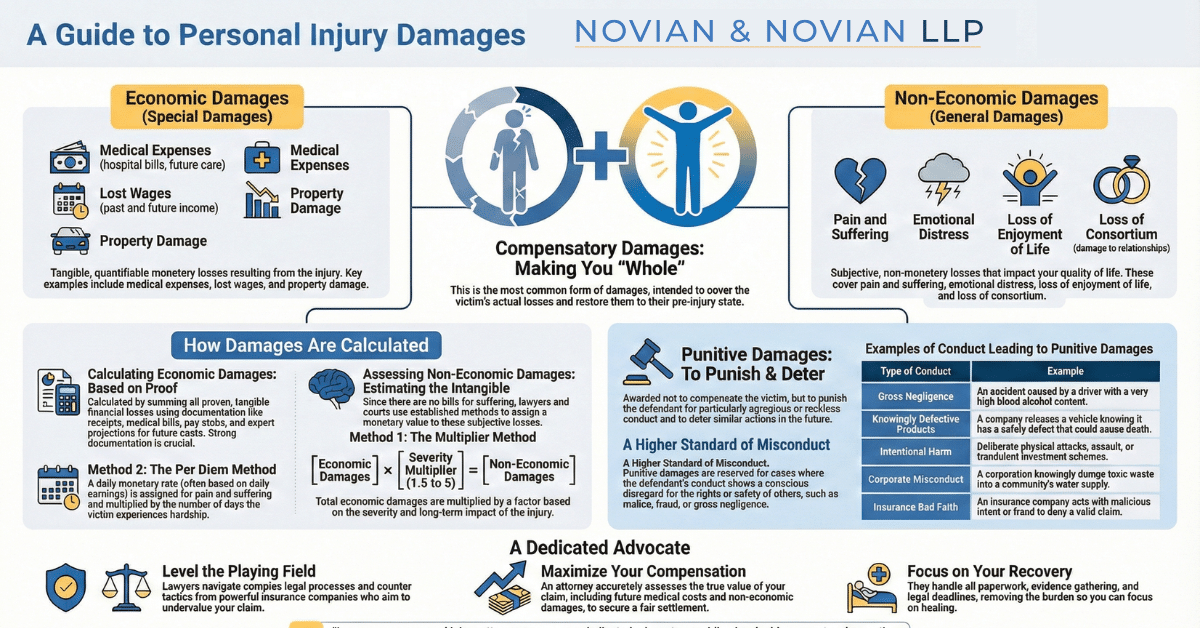
Compensatory damages are the most common form of damages, intended to make the injured party “whole” again by covering their actual losses. They are split into two main categories which are economic damages (special damages), which are tangible, quantifiable monetary losses resulting from the injury. Economic damages include medical expenses like cost of hospital bills, treatments, surgeries and future medical care, lost wages (which covers income lost while unable to work) , and property damage (costs to repair or replace damaged property). The second category is the non-economic damages (general damages), which cover subjective, non-monetary losses that are harder to calculate but impact the victim’s quality of life. Non-economic damages include pain and suffering, loss of consortium (damage to relationship with loved ones), and loss of enjoyment of life (reduction in ability to participate in hobbies or activities once enjoyed).
2. Punitive Damages (Exemplary Damages)
Punitive damages are not designed to compensate the victim, but rather to punish the defendant for particularly egregious, intentional, or reckless conduct. The main purpose of punitive damages is to deter the defendant and others from committing similar actions in the future. These are generally only awarded in cases of gross negligence, fraud, or malice, such as in drunk driving accidents or willful violations of safety regulations.
3. Nominal Damages
Nominal damages are a small, symbolic, or token amount of money awarded when a legal wrong has occurred, but the plaintiff did not suffer any significant financial loss or actual, measurable injury. The aim of nominal damages is to acknowledge that a legal right was violated, even if no real damage was done.
4. Liquidated Damages
Liquidated damages are specific, predetermined amounts of money specified within a contract to be paid in the event of a breach. Liquidated damages serves to provide a fair, agreed-upon estimate of losses when actual damages might be hard to calculate. Furthermore, if the amount is unreasonable and designed only to punish, courts may deem it an unenforceable penalty.
5. Other Specialized Damages
Other specialized damages include consequential Damages (Special Damages in Contract) which are damages that are not direct, but rather a consequence of the breach. A good example of special damages include lost profits, provided they were foreseeable at the time the contract was made. Another type of damages is Incidental Damages. This refers to commercially reasonable expenses incurred as a result of the other party’s breach, such as costs for finding a new supplier. Aggravated Damages is a type of compensatory damage awarded in cases where the defendant’s behavior was particularly high-handed, malicious, or oppressive. This results in an increase in the plaintiff’s (victim) mental distress.
How Are Economic Damages Calculated?

Economic damages are calculated by summing all proven, tangible financial losses (past and future), such as medical bills, lost wages, and property damage, using documentation like receipts, pay stubs, and tax returns, often with help from financial or medical experts for complex future losses. The core principle is totaling the actual monetary harm, contrasting with non-economic damages like pain and suffering.
Calculation Methods
Calculating economic damages involves meticulous documentation of all tangible financial losses (medical bills, lost wages, property damage) and future projected costs, requiring detailed records like bills, pay stubs, and repair estimates, often supported by financial experts to assess future losses and present a comprehensive, verifiable claim for compensation. Below are the steps for calculating personal injury damages.
Steps for Calculation
1.Document Everything by Keeping meticulous records from day one, including all bills, receipts, and financial statements.
2.Gather Evidence for Each Category such as Medical Expenses, collect all hospital bills, doctor statements, pharmacy receipts, rehabilitation costs, and transportation to appointments. All of these make up a fundamental part of the personal injury settlement (this also answers the question “does personal injury settlement include medical bills?”). Also, gather pay stubs, tax returns, and employment records showing missed work and any reduction in earning capacity. This serves as a proof for lost wages claim. To prove property damage, get repair estimates, replacement costs, or total loss valuations for damaged vehicles or belongings, with receipts. Finally, include receipts for hired help (housekeeping), modifications to your home, or assistive devices.
3.Calculate Current Losses: Sum up all documented expenses and lost income to get your current economic damages.
4.Estimate Future Losses (Using Experts): For future medical care or lost earning capacity, consult financial experts or economists who use projections, inflation rates, and other variables to estimate these long-term costs.
5.Apply Multipliers (If Needed): In personal injury, lawyers may use a multiplier (1.5-5x) on your economic damages to help assess non-economic damages (pain and suffering), but this isn’t part of the economic calculation itself.
6.Present the Claim: Compile all evidence and calculations to present to the court or insurance company, often with expert testimony.
Key considerations to be made when calculating the value of damages include economic damages. Which must be quantifiable and objective, unlike pain and suffering. You should remember that The goal is to restore you financially to the position you were in before the incident. You should also differentiate between immediate, past losses and ongoing or future projected losses, which require expert evaluation.
Documentation is King, therefore, strong evidence (bills, pay stubs, estimates) is crucial for proving your claim. Legal & Financial Expertise are very vital factors to be considered for complex cases involving future earnings or large claims. In essence, consulting a lawyer is the best decision to make when dealing with damages evaluation in a personal injury case.
It is a well known fact that medical expenses/bills form a major part of personal injury claims, this is due to the basic fact that personal injury settlement is meant to help the victim regain his/her life as it was prior to the car accident. It is important to note that documentation forms the backbone of any personal injury claim, without which the claim would be baseless.
What Are Non-Economic Damages?
Non-economic damages are compensation for subjective, intangible losses in personal injury cases, such as pain and suffering, emotional distress, loss of enjoyment of life, disfigurement, and loss of consortium, which aren’t easily measured by receipts or invoices but represent real harm (either physical or emotional harm) to a person’s physical, mental, and social well-being from an injury or trauma. One of the key characteristics of non-economic damages is that it is subjective, this means that unlike economic damages, they lack precise monetary value and are harder to quantify. They are also intangible, which means they cover non-financial losses stemming from an accident or negligence.
The role of non-economic damages in personal injury cases include:
- Full Compensation: They make sure victims are made whole, covering the devastating impact on their daily life, not just their wallets.
- Subjective Valuation: Since there are no receipts, lawyers and courts use methods like the Multiplier Method (multiplying economic damages by a factor based on injury severity) or the Per Diem Method (daily rate for suffering) to quantify these intangible losses.
- Severity Matters: Non-economic damages often become substantial in severe or permanent injury cases (like brain or spinal injuries) where quality of life is significantly diminished.
- Legal Significance: While economic damages are factual (bills, pay stubs), non-economic damages recognize the human experience, making them a vital, though complex, part of personal injury claims.
Understanding Non-Economic Losses
Assessing non-economic damages (pain, suffering, emotional distress, loss of enjoyment) involves subjective methods like the Multiplier Method (multiplying economic damages by a severity factor) or the Per Diem Method (assigning a daily value for suffering), combined with evidence like medical records, expert testimony, and personal accounts to show the injury’s impact on life quality, with lawyers helping quantify these intangible losses. These are some of the most common methods that provide insight on how to determine the value of a personal injury claim.
Common Assessment Methods
- Multiplier Method: This involves calculating total economic damages (medical bills, lost wages) first. After which A multiplier (e.g., 1.5 to 5) is chosen based on injury severity, duration, and impact. finally, economic damages are multiplied by this factor to get the non-economic award (e.g., $100,000 economic damages x 3 multiplier = $300,000 non-economic).Per Diem Method: In this method, a daily rate (often based on daily earnings) is assigned for pain and suffering. This rate is multiplied by the number of days the person experiences pain or distress. This method is effective for injuries with clear recovery timelines.
Types of Non-Economic Damages
Types of non-economic damages include pain and suffering (Physical pain, chronic discomfort, and physical limitations from the injury), emotional distress such as anxiety, depression, PTSD, fear, or psychological trauma). Other types of non-economic damages are Loss of Enjoyment of Life which refers to the inability to participate in hobbies, activities, or relationships previously enjoyed, and disfigurement, which means permanent scarring or physical changes affecting identity.
How Do Punitive Damages Work?

Punitive damages (also known as “exemplary damages”) are monetary awards ordered by a court in a civil lawsuit, intended not to compensate the victim, but to punish the defendant for egregious intentional misconduct and deter future similar behavior/actions by the defendant or others. They are generally awarded in cases involving fraud, malice, oppression, or gross negligence. The purpose of punitive damages can therefore be broken down into three basic aspects which are, punishment, deterrence, and symbolic condemnation.
The step by step process of awarding punitive damages are:
- Establishing Liability: The plaintiff must first prove the defendant is liable for the underlying tort and that compensatory damages are warranted.
- Higher Burden of Proof: The plaintiff must prove the need for punitive damages through “clear and convincing evidence,” a higher standard than the “preponderance of the evidence” used for most civil cases.
- Bifurcated Trial (Often): Many states require a two-phase trial. The first phase determines liability and compensatory damages; the second phase, if liability is found, focuses specifically on whether punitive damages are justified and in what amount.
- Assessing the Amount: The judge or jury determines the amount based on the severity of the misconduct, the defendant’s financial status (net worth), and the potential harm that was averted or caused.
- Judicial Review: Courts (including the U.S. Supreme Court) review awards to ensure they are not “grossly excessive” or violating due process, typically aiming for a single-digit ratio (e.g., 4:1) between punitive and compensatory damages.
Conditions for Punitive Damages
Punitive damages (or exemplary damages) are awarded in civil cases to punish a defendant for particularly egregious, malicious, or reckless behavior rather than simply to compensate the victim. They are generally reserved for cases where the defendant’s conduct shows a conscious disregard for the safety or rights of others. A senior counsel at Novian & Novian, Sean Bozart, had this to say about punitive damages.
Punitive damages transform a civil suit from merely making someone “whole” (compensatory) to punishing them for behavior that society deems unacceptable, acting as a powerful deterrent.
Scenarios where punitive damages are applicable are categorized by the type of conduct. Below are some of such conducts and their examples.
| Type Of Conduct | Example Of Such Conduct | Why Punitive Damages Are Applicable. |
| 1. Gross Negligence & Reckless Conduct. | Extreme Drunk Driving | Accidents caused by drivers with high blood alcohol content, particularly repeated offenders. |
| Reckless Driving | Actions such as driving at extremely high speeds through crowded pedestrian areas. | |
| Knowingly Defective Products | Companies that release products such as vehicles or toys, despite knowing about safety defects that could cause death (leading to wrongful death claims) or serious injury. | |
| Medical Malpractice/Nursing Home Neglect | Healthcare providers who deliberately ignore safety protocols or fail to provide basic care. | |
| Ignoring Known Safety Hazards | Landlords or property owners who fail to fix dangerous conditions like faulty wiring or broken security, despite multiple warnings, leading to injuries or fires. | |
| Systematic Safety Violations | Trucking companies forcing drivers to violate hourly limits, leading to fatigue-related fatal accidents | |
| 2. Intentional Harm & Misconduct. | Assault & Battery | Deliberate physical attacks, violence, or sexual assault. |
| Intentional Fraud or Deceit | A person or business that deliberately misleads or lies about essential details to cause financial harm e.g., fraudulent investment schemes. | |
| Insurance Bad Faith | When an insurance company acts with malicious intent or fraud to deny a valid claim | |
| 3. Corporate & Environmental Distress | Environmental Pollution | Corporations that dump toxic waste into water supplies while aware of the risks. |
| Covering Up Dangers | Pharmaceutical companies that hide clinical trial results showing dangerous side effects, or hiding safety reports. | |
| Severe Workplace Discrimination | Cases where workplace violations are flagrant, intentional, and demonstratemalice toward the victim. |
Why Consult a Personal Injury Attorney?
Some victims might wonder why they have to consult a personal injury attorney for their case or ask themselves “is-it-worth-hiring-a-personal-injury-attorney?“. Legal representation in personal injury cases is crucial because lawyers level the playing field against powerful insurance companies, using their expertise to gather evidence, navigate complex laws, and negotiate for higher settlements, which significantly increases the chances of victims receiving fair compensation while allowing them to focus on recovery. They handle legal complexities, manage documentation, and represent clients in court, providing vital support and expertise to secure damages for medical bills, lost wages, and pain and suffering, ensuring clients’ rights are protected.
Hiring a personal injury attorney offers crucial advantages by navigating complex legal processes, handling insurance company tactics, and maximizing compensation through expert valuation, investigation, and negotiation, ultimately providing peace of mind and better financial recovery by letting you focus on healing while they manage all legal burdens.
One major role a personal injury lawyer plays is to help navigate the complex legal processes involved in whatever case presented to you. They also utilize their expert legal knowledge which helps reduce errors and ensures compliance, as not everyone understands personal injury law. Other major roles of a personal injury lawyer include investigation and evidence, paperwork and filing, and court representation.
A skilled personal injury lawyer also provides accurate claim valuation by assessing the true value of your claim, including current and future medical costs, lost wages, and pain and suffering, while preventing undervaluation. Other key advantages include peace of mind for the victim (plaintiff), they charge no upfront costs because personal injury attorney fees are usually taken care of by the defendant (the at-fault party). Finally, attorneys have access to vital resources that can help your case.
Maximize Your Compensation Now
This article provides a detailed breakdown of the various types of damages in personal injury cases in order for the average person to have a basic understanding of what is involved in damages calculation and what to expect from a personal injury claim in terms of settlement. This post points you in the right direction by explaining the importance of having a legal representation for the process of filing a personal injury claim. Our managing partner at Novian & Novian, had this to say about the importance of having legal representation in a personal injury case.
In essence, a personal injury attorney serves as a dedicated advocate, providing invaluable support and expertise to secure justice and a favorable outcome during a challenging time.
Our experienced personal injury attorneys at Novian & Novian, with over 35 years of experience and an impressive track record of success in personal injury cases, will provide you with the best possible legal representation and help you obtain a befitting settlement. Take a decisive legal action to secure the full range of damages in personal injury cases by visiting our office or by contacting us for a free consultation and let us work together for justice and protection of your legal rights.
Frequently Asked Questions
Understanding the intricacies of personal injury claims and how to calculate damages for settlements can be quite confusing without the guidance of an attorney or knowledge from prior experiences. Here are some common questions people ask and their answers.
What Are The Different Types Of Damages In Personal Injury Cases?
Personal injury damages fall into three main types: Economic Damages (special damages, covering calculable financial losses like medical bills, lost wages), Non-Economic Damages (general damages, for intangible losses like pain and suffering, emotional distress), and Punitive Damages (awarded in rare cases to punish extreme misconduct, not to compensate the victim). These aim to make the injured party whole by covering tangible costs, intangible suffering, and, in some cases, deter malicious behavior.
How Are Damages Calculated In Personal Injury Cases?
Damages in personal injury cases are calculated by totaling economic losses (like medical bills, lost wages) and non-economic losses (physical and emotional pain, suffering, emotional distress). Economic damages are direct, documented costs, while non-economic damages, often estimated using the multiplier method (economic damages x 1.5 to 5) or the per diem method (daily rate x days of hardship). The final value depends on injury severity, fault, and impact on life, with factors like venue and legal representation influencing negotiation.
What Are The Common Types Of Damages In Personal Injury Cases And How Can I Budget For Them?
Common types of damages in personal injury cases are divided into compensatory damages (covering actual losses) and punitive damages (intended to punish the wrongdoer). Compensatory damages are further broken down into economic (special) damages, which are tangible, and non-economic (general) damages, which are intangible. Budgeting for these involves meticulously tracking all expenses and, in many cases, using a formula that multiplies economic losses to estimate intangible ones.
What Are The Most Common Mistakes People Make When Seeking Damages In Personal Injury Cases And How Can I Avoid Them?
Common mistakes in personal injury cases include delaying medical care, not documenting the scene/injuries, talking to insurance adjusters without a lawyer, accepting low initial offers, posting on social media, and missing legal deadlines; you can avoid these by seeking immediate treatment, gathering evidence, hiring an attorney to handle communications, keeping detailed records, and being cautious online.
Disclaimer: This content is provided for informational purposes only and does not constitute legal advice or a guarantee of results. The information presented is not intended to create, and receipt or viewing does not establish, an attorney-client relationship. Every case is different, and outcomes depend on the specific facts and circumstances involved. For advice regarding your individual situation, you should consult a qualified attorney.