

Personal injury cases cover a wide range of scenarios, from car accidents and workplace injuries to slip and fall incidents. However, fees for these cases can vary significantly depending on the complexity of the case, the lawyer’s experience, and the fee structure.
When seeking a personal injury attorney, it is natural to wonder, “How much will this cost me?” Attorney fees are commonly structured in different ways, including contingency fees, hourly rates, or flat fees. Contingency fees are typical in personal injury cases, meaning you only pay if your case is successful. However, the exact percentage and additional expenses can vary from lawyer to lawyer. This is why it is important to understand what is included in your agreement.
At Novian & Novian, we have expert California personal injury lawyers that are readily available to assist you in your catastrophic injury and personal injury case. We typically operate on a contingency fee basis, because we have your best interest at heart. Schedule a free consultation with us to get started!
This post will cover the various types of attorney fees and what can influence a personal injury attorney’s fee. It will also cover the pros and cons of the various fee structures.
Table Of Contents
- What Are Personal Injury Attorney Fees in Different Types of Cases?
- What Can Influence a Personal Injury Lawyer’s Fees?
- What Can Influence a Personal Injury Lawyer’s Fees in California?
- How Personal Injury Lawyer Fees Affect Your Settlement in California
- Other Expenses Involved in Personal Injury Claims
- Step 1: Filing the Case and Paying Court Filing Fees
- Step 2: Collecting Medical Records and Billing Documentation
- Step 3: Conducting Investigations and Evidence Gathering
- Step 4: Retaining Expert Witnesses
- Step 5: Managing Administrative and Document Costs
- Who Pays for Costs If You Lose Your Case?
- Is it Worth Hiring a Personal Injury Lawyer?
- Looking to Consult a Lawyer for a Personal Injury Claim in California?
- FAQs
What Are Personal Injury Attorney Fees in Different Types of Cases?

When dealing with a personal injury, knowing what attorney fees to expect can make the legal process smoother and more predictable. In our experience, California personal injury lawyers primarily rely on contingency fee arrangements, but certain cases may involve hourly billing, flat fees, or even a retainer agreement. It depends on the type of case, the complexity of the legal issues, and the level of risk involved.
Most personal injury attorneys in California operate on a contingency fee basis, which means they only receive payment if they successfully secure compensation for you. Instead of paying upfront legal fees, the attorney takes a percentage of your settlement or verdict.
We’ve found this structure is especially helpful for accident victims facing mounting medical bills, lost income, and other financial pressures. It shifts much of the financial risk away from you and onto the law firm.
However, keep in mind that fee arrangements can vary, and you should always receive a written fee agreement that clearly explains the percentage charged, how the costs are handled, and when fees increase (for example, if a lawsuit is filed). Make sure to read the fee agreement carefully before signing.
California generally does not cap contingency fees for most personal injury cases. However, medical malpractice cases are an important exception and governed by the Medical Injury Compensation Reform Act (MICRA).
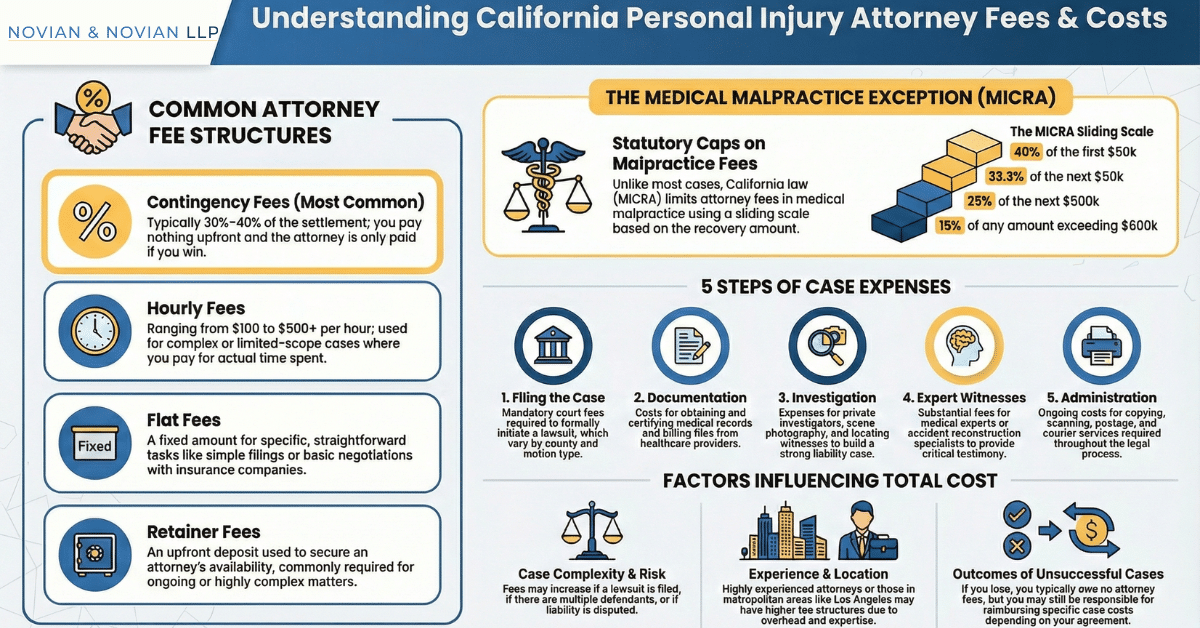
Under the California Business and Professions Code Section 6146, contingency fees in medical malpractice claims are limited by a sliding scale that caps attorney’s fees based on the amount recovered. This rule aims to safeguard injured patients while enabling attorneys to handle intricate malpractice cases.
In plain terms, the larger the recovery, the lower the percentage an attorney may charge. This cap applies only to medical malpractice, not to car accidents, slip and falls, or wrongful death claims. We recommend confirming with your lawyer whether your case falls under any special fee rule.
Generally, Attorney fees may change based on:
- Whether a lawsuit is filed (pre-litigation vs. litigation)
- Case complexity (multiple defendants, disputed liability, catastrophic injuries)
- Type of case (medical malpractice, wrongful death, product liability)
- Risk level (uncertain liability or damages)
For instance, if your personal injury claim settles quickly after submitting medical records and police reports, your fee percentage may be lower. However, if your attorney must file court documents, conduct depositions, and go to trial, your fee percentage may likely increase.
What Can Influence a Personal Injury Lawyer’s Fees?

One of the main factors influencing fees in personal injury cases is the complexity of the case. Personal injury cases can range from straightforward car accidents to intricate medical malpractice claims. Complex cases generally require more time and resources. These resources could include expert witness fees and court filing fees. As a result, a complicated personal injury case will likely incur higher attorney fees due to the additional hours and services rendered.
Another factor that determines the attorney’s fee is the attorney’s experience and reputation. An attorney’s level of experience and reputation can significantly impact their fees. More experienced personal injury attorneys with a successful track record often charge higher rates. Their expertise may result in better negotiation skills, which can lead to a fair settlement or higher court award. Therefore, while hiring an experienced lawyer may be more costly, it could also mean a higher chance of achieving the desired outcome in your personal injury matter.
The geographic location also affects the attorney’s fees. Typically, personal injury lawyer fees vary by geographic location due to differences in cost of living and market demand. For example, a personal injury attorney in a high-cost area like Los Angeles or New York may charge more than one in a smaller town. Typical attorney fees for personal injury cases may also reflect local legal practices, as some states have specific regulations that affect fee arrangements or contingency fee percentages. For example, contingency fees in major metropolitan areas often start at 35%, while smaller cities may have lower average percentages.
Furthermore, the potential settlement size affects the fees. In cases where the potential settlement is high, personal injury lawyers may charge a higher contingency fee percentage. This is because cases with large settlements often involve greater complexity, requiring more extensive legal representation. Attorneys may also charge higher fees to account for the increased risk they take on a contingency fee basis.
Contingency Fees
Contingency fees are a common arrangement in personal injury cases, allowing clients to pay only if their attorney successfully recovers compensation. Rather than charging upfront, the attorney receives a percentage of the final settlement or court award. This arrangement minimizes out-of-pocket expenses and aligns the attorney’s payment with the case outcome.
Contingency fee agreements typically range between 30% and 40%, depending on the case complexity, the attorney’s experience, and the industry standards in that region. This fee structure is crucial in personal injury cases, as it makes legal services accessible to accident victims who may be facing medical bills, lost wages, and other financial burdens.
A contingency fee agreement is most commonly used in cases involving auto accidents, slip-and-fall injuries, and medical malpractice. For instance, a slip-and-fall injury case may involve both contingency fees and various costs for medical records, witness fees, and court filing fees, which are generally deducted from the final settlement.
With a contingency fee agreement, there are no upfront costs, and it aligns with the client’s interests. This structure also allows people who may not otherwise afford legal fees to access quality representation, especially in complex cases requiring substantial resources.
However, since contingency fees typically range between 30% and 40%, they can take a significant portion of the settlement. Furthermore, lawyers on a contingency fee may be more selective, choosing cases with a higher likelihood of success or a substantial settlement amount.
We once worked with an accident victim who initially hesitated to hire a lawyer because they feared upfront costs. Upon discovering that we would handle the case on a contingency fee basis, the accident victim proceeded. The case reached a settlement of six figures, requiring them to make no out-of-pocket payments until they secured the settlement. That decision allowed them to focus on recovery instead of finances.
Hourly Fees
While less common in personal injury claims, some cases warrant an hourly fee arrangement. In this setup, the attorney charges by the hour for work completed, with typical rates ranging from $100 to $500 or more, depending on the attorney’s experience and the case location. Hourly fees are often applied in more complex or time-consuming cases that involve extensive legal research or expert witness fees.
Hourly fees may apply in complex medical malpractice claims or class-action lawsuits where extensive litigation is required. In such cases, clients pay not only the attorney’s fees but may also be responsible for court costs, filing fees, and other expenses.
With an hourly fee agreement, clients only pay for the actual time the attorney spends on their case, making this arrangement suitable for cases requiring limited legal work. Additionally, for cases that don’t require lengthy litigation, hourly fees can be more economical than other fee structures. In cases where the outcome is uncertain, paying hourly may prevent the attorney from taking a large percentage of a potential high settlement.
On the other hand, hourly fees can become expensive quickly, especially for cases involving extensive research, document preparation, and court appearances. It also causes financial strain as clients are responsible for paying regardless of the outcome. This situation can be challenging if they don’t win compensation.
Flat Fees
Flat fees provide a fixed cost for legal services, covering all or part of the legal representation. This fee structure is generally reserved for simpler personal injury cases or non-litigation matters where the scope of work is straightforward.
Flat fees are more commonly seen in personal injury cases that require limited legal intervention, such as simple claim filings or cases where the attorney’s role is primarily to negotiate with insurance companies rather than represent the client in court.
This structure is well-suited for straightforward cases or legal tasks where the attorney’s involvement is limited, such as filing paperwork or handling basic negotiations. Unlike contingency fees, a flat fee isn’t based on the case’s settlement amount, so clients retain the full award.
However, there is limited scope, as flat fees generally cover only specific services. This may mean additional fees for unexpected developments or further legal representation. Furthermore, flat fees may not be ideal for complex or unpredictable cases, such as contested liability or high-stake lawsuits.
Retainer Fees
A retainer fee is a deposit paid upfront to secure an attorney’s services and ensure that they are available for the duration of the case. As expenses arise, the attorney can draw from this retainer, and clients may need to replenish it if the balance runs low.
For ongoing or complex legal matters, particularly those requiring significant court involvement or expert testimony, retainer fees are often necessary. Personal injury cases that may require extensive legal support, such as catastrophic injuries involving ongoing medical treatment, may involve a retainer fee to cover preliminary expenses.
Common Personal Injury Fee Structures in California

The table below breaks down the most common personal injury fee structures in California, what they mean in practical terms, and the pros and cons of each so you can make a more informed decision before signing any fee agreement:
| Fee Type | Description | Typical Percentage/Rate | When Used | Advantages | Disadvantages |
|---|---|---|---|---|---|
| Contingency Fee | Attorney paid only if case is won | 30%–40% of settlement or verdict | Most personal injury cases | No upfront legal fees, low financial risk | Takes portion of recovery |
| Hourly Fee | Client pays per hour worked | $100–$500+ per hour | Complex or limited-scope cases | Pay only for time used | Can become expensive quickly |
| Flat Fee | Fixed amount for specific service | Varies by task | Simple filings or negotiations | Predictable cost | Limited scope |
| Retainer Fee | Upfront deposit drawn against | Varies widely | Ongoing or complex matters | Secures attorney availability | Requires upfront payment |
What Can Influence a Personal Injury Lawyer’s Fees in California?
One of the biggest influences on attorney fees is the complexity of your case. A straightforward car accident with clear liability generally requires less time and fewer resources than a medical malpractice claim, a catastrophic injury case, or a personal injury claim against a government entity. Complex matters often involve expert witnesses, extensive discovery, depositions, and higher court filing fees, all of which increase the law firm’s upfront investment.
“Cases that require heavy expert involvement, multiple defendants, or aggressive litigation naturally carry more financial risk for the firm,” says Sean Bozarth, Senior Counsel at Novian & Novian. “That risk is one of the reasons contingency fees may be higher in especially complex matters.”
Attorney experience and reputation also play a major role. More experienced personal injury attorneys with a strong track record often charge higher fees, but that experience can translate into better negotiation leverage and stronger legal strategy. We’ve seen many situations where paying a slightly higher percentage still resulted in a much larger final settlement.
Another important factor is the type of case and whether special fee rules apply. Most California personal injury cases do not have statutory caps on contingency fees. However, medical malpractice cases are a major exception. Under California Business & Professions Code §6146, contingency fees in medical malpractice cases follow a sliding scale. It is typically 40% of the first $50,000 recovered, 33⅓% of the next $50,000, 25% of the next $500,000, and 15% of any amount over $600,000.
Geographic location can also affect fees. Attorneys practicing in high-cost metropolitan areas like Los Angeles often have higher overhead, which may be reflected in their fee structures. In many major markets, contingency fees commonly range from about 33% to 40%, while smaller regions may trend slightly lower.
The potential settlement size and risk level of the case matter as well. High-value cases typically require more time, expert analysis, and litigation resources. Because the law firm assumes significant financial risk on a contingency fee basis, lawyers may charge a higher percentage in these situations. This type of scenario is common in complex rideshare claims, such as Uber personal injury settlements or severe workplace injury cases involving disputed injury at work at employer responsibilities.
We once represented a client who initially believed their case was simple. The investigation revealed multiple defendants, necessitating the involvement of accident reconstruction experts. Although the contingency percentage was slightly higher than average, our legal team secured a settlement nearly three times higher than the insurer’s first offer. Even after fees and costs, the client took home far more compensation than they would have without experienced representation.
Before you hire a personal injury attorney, we recommend asking a few key questions during your initial consultation. These questions include: What percentage applies before and after a lawsuit is filed? How are case costs handled? Are there any special fee rules for my type of claim? Taking these steps early can help you choose the right lawyer and avoid misunderstandings later.
How Personal Injury Lawyer Fees Affect Your Settlement in California
In our experience, most personal injury attorney fees are based on a contingency fee structure, meaning your lawyer is paid a percentage of your recovery only if your case results in a settlement or court award. That fee is typically taken directly from the settlement funds before you receive your portion. This is why reviewing your written fee agreement carefully is so important.
Under a typical contingency arrangement, if your case settles for $150,000 and your agreed fee is 33%, your attorney would receive $49,500, leaving $100,500 before case costs and expenses are deducted. Those costs may include obtaining medical records, court filing fees, expert witness fees, and other litigation-related expenses. This process is usually handled automatically by the law firm as part of distributing the settlement, so you’re not expected to pay out of pocket at the end.
In California, contingency fees in most personal injury cases commonly range from about 30% to 40%, depending on whether the case settles early or proceeds to litigation. One of the biggest advantages of this fee structure is that if your case is unsuccessful, you generally do not owe attorney’s fees for legal services. However, in some cases, you may still be responsible for reimbursing certain case costs, which is why it’s critical to ask how costs are handled if no recovery is obtained.
We also recommend having an open conversation about fee transparency and possible flexibility. While percentages are often standard, you can still ask important questions like: What percentage applies if the case settles before a lawsuit? Does the percentage increase if the case goes to trial? Are costs deducted before or after attorney fees? Attorneys who are willing to explain these details clearly are often the ones who prioritize client trust and communication.
A client came to us after a serious car accident, worried that attorney fees would leave them with very little compensation. After reviewing the contingency fee agreement together, they felt comfortable moving forward. The case settled for $200,000. With a 33% contingency fee, the attorney’s portion was $66,000. After deducting case costs, the client still received far more than they would have likely obtained negotiating alone. Most importantly, they avoided the stress of dealing with insurers during recovery.
The bottom line is that while personal injury lawyer fees do reduce your final settlement amount, strong legal representation often increases the overall value of your case. Make sure to ask detailed questions, request everything in writing, and choose a lawyer who is transparent about how their fees will affect your recovery.
Other Expenses Involved in Personal Injury Claims
While contingency fees cover the attorney’s payment for legal services, most personal injury claims also involve case costs and other expenses that arise as your case moves through the legal process. In our experience, understanding these costs early makes the process far less stressful and helps you plan realistically.
Below is a step-by-step look at where these expenses typically appear and why they matter:
Step 1: Filing the Case and Paying Court Filing Fees
Once your attorney is ready to formally initiate your personal injury lawsuit, the first set of expenses often involves court filing fees. These are mandatory charges required by the court to open and process a case. The exact amount varies by county and court, but these fees can add up quickly, especially if motions or additional filings are required. We advise you to inquire with your lawyer about the law firm’s reimbursement of these costs from the final settlement.
Step 2: Collecting Medical Records and Billing Documentation
Medical records are the backbone of most personal injury cases because they prove the nature and extent of your injuries, treatment, and prognosis. Healthcare providers typically charge fees for obtaining medical records, copying files, and producing certified documents.
For instance, each hospital or clinic where you received treatment may charge a separate fee. Individually, these costs are usually modest, but they can accumulate over time.
Step 3: Conducting Investigations and Evidence Gathering
In many cases, attorneys must go beyond basic paperwork to build a strong liability case. This may include hiring private investigators to photograph accident scenes, locate witnesses, or review surveillance footage.
These investigative costs are often essential in disputed-liability cases, hit-and-run accidents, or incidents involving unclear fault. While not every case requires this step, when it does, it can significantly strengthen your claim.
Step 4: Retaining Expert Witnesses
Complex cases such as medical malpractice, catastrophic injury, or cases involving disputed causation often require expert testimony. Medical experts, accident reconstruction specialists, and vocational experts typically charge substantial fees for reviewing records, preparing reports, and testifying.
It depends on the type of expert and time involved, but these costs can range from hundreds to thousands of dollars. Although expensive, expert opinions can be critical to proving damages and liability.
Step 5: Managing Administrative and Document Costs
Throughout your case, there are ongoing administrative fees such as copying, scanning, postage, courier services, and mailing documents to courts, insurance companies, and healthcare providers. While these may seem minor, they add up over the course of a case and are usually classified as reimbursable expenses.
Who Pays for Costs If You Lose Your Case?
In most personal injury cases handled on a contingency fee basis, you typically won’t owe attorney fees if you lose your case. This is because the attorney is only paid when they win or settle your claim. However, certain court costs and other expenses incurred during the case (like filing fees, expert witness fees, and investigative costs) may still be your responsibility.
These terms should be outlined in your contingency fee agreement with your lawyer, as each firm may have different policies about covering costs when a case is unsuccessful. It is best to discuss these specifics upfront with your attorney so you understand any potential financial obligations if the case does not result in a favorable outcome.
Is it Worth Hiring a Personal Injury Lawyer?
Yes, hiring a personal injury lawyer is worth it, especially if you’ve suffered serious injuries or are dealing with an uncooperative insurance company. A personal injury attorney represents your best interests at every stage of the claim, from handling legal paperwork and conducting investigations to negotiating with insurers and, if necessary, presenting a strong case in court. This allows you to focus on healing while your legal team focuses on protecting your rights and pursuing maximum compensation.
“Insurance companies have teams of adjusters and attorneys whose goal is to minimize what they pay out,” says Sean Bozarth, our Senior Counsel at Novian & Novian. “Having an experienced personal injury lawyer levels the playing field and significantly improves your chances of obtaining fair compensation.”
When you choose not to hire a personal injury lawyer, you may face several challenges. Insurance companies often make low initial settlement offers, hoping you’ll accept before understanding the true value of your claim. You may also struggle to prove liability, gather evidence, or properly document your damages. In addition, personal injury claims are governed by strict filing deadlines, and even a small error in paperwork or a missed deadline can result in your case being dismissed altogether.
We’ve also seen firsthand how legal representation can change the outcome of a case. For example, a client who initially attempted to negotiate on their own received an offer that barely covered their medical bills. We uncovered additional evidence, obtained expert opinions, and settled the case for several times the original amount after hiring us.
We recommend at least scheduling a free initial consultation with an experienced personal injury attorney before making any decisions. Even a brief conversation can help you understand your rights, the potential value of your case, and whether professional legal representation makes sense for your situation.
Can You Fire Your Lawyer Before the Case Ends?
Yes, you can fire your lawyer before your case ends. Clients have the right to terminate the attorney-client relationship if they feel dissatisfied with their lawyer’s performance, communication, or handling of the case.
However, be aware that if you switch attorneys mid-case, your original lawyer may be entitled to payment for their work, typically out of the eventual settlement or award. This fee arrangement will depend on the fee agreement you signed and may involve court approval if fees need to be reallocated. We advise that you carefully review your agreement and consult another attorney if needed before making this decision.
Looking to Consult a Lawyer for a Personal Injury Claim in California?
When working with a personal injury lawyer in California, there are various fee structures. It could be a contingency fee agreement where you only pay if you win, an hourly fee structure, or a flat fee structure. It is always best to ask your attorney clear questions about their fee structure and any out-of-pocket expenses so you are well-prepared.
Keep in mind that every personal injury case is different, and consulting a qualified personal injury lawyer is the best way to understand the specific costs and processes involved in your claim. A skilled attorney can provide clarity on fees, explain the steps ahead, and help you evaluate your options for achieving a fair settlement.
At Novian & Novian, we have extensive experience in personal injury cases and can offer valuable insights and guidance. We also have personal injury attorneys in Los Angeles who can represent you in court if the need arises. Schedule a free consultation with us now!
FAQs
Below are answers to some of the most common questions we hear about personal injury attorney fees in California. These explanations can help you understand what to expect before speaking with a lawyer.
What Percentage Do Personal Injury Lawyers Charge In California?
Most personal injury lawyers in California charge a contingency fee of about 30% to 40% of the settlement or court award, depending on the case and whether a lawsuit is filed. The exact percentage should always be clearly stated in your written fee agreement.
Are There Upfront Fees For Personal Injury Lawyers?
In most cases, there are no upfront legal fees because attorneys work on a contingency fee basis. However, you should ask whether you may be responsible for certain case costs, such as obtaining medical records or court filing fees.
What Happens If My Personal Injury Case Is Unsuccessful?
Typically, you do not owe attorney’s fees if your case is unsuccessful. Depending on your agreement, you may still be responsible for reimbursing some case costs.
Can I Negotiate My Lawyer’s Fees?
Yes, you can ask about fee percentages and whether there is flexibility based on your case. We recommend discussing this during your initial consultation before signing any fee agreement.
How Are Lawyer Fees Deducted From My Settlement?
Attorney’s fees are usually deducted directly from the settlement or verdict before you receive your portion. Case costs and expenses are then deducted according to the terms of your fee agreement.
Attorney Advertising Disclaimer: The information provided in this blog is for general informational purposes only and does not constitute legal advice. No attorney-client relationship is formed by viewing or interacting with this content. Past results do not guarantee future outcomes, and each case is different. For advice regarding your specific situation, you should consult with a qualified attorney.

 CALL:
CALL: