
PRACTICE AREA
Healthcare Lawyers
At Novian & Novian, we’ve seen firsthand how quickly the American healthcare system can change, and how costly it can be to fall behind. In our 35 years of experience advising healthcare providers, health services organizations, and industry businesses, success today means staying compliant while protecting revenue in an increasingly complex regulatory environment.
We work closely with hospitals, physicians, health care systems, and healthcare businesses to navigate health insurance rules, Medicare and Affordable Care Act requirements, medical devices regulation, and evolving health coverage standards. Our approach is practical and business-focused: we help you manage risk, control costs, and make informed decisions so your organization can continue delivering quality medical care while staying financially strong.
Quick answer
Healthcare lawyers at Novian & Novian advise hospitals, physician groups and health businesses on HIPAA, Stark Law and Anti-Kickback compliance, and represent them through audits, investigations and corrective action plans. When a matter turns adverse, we litigate False Claims Act cases and medical billing disputes, and we structure joint ventures, mergers and management services agreements to fit referral and ownership limits.
Legal Challenges in Healthcare Compliance
In our experience, healthcare compliance is one of the most demanding aspects of operating within today’s healthcare system. Healthcare providers, hospitals, and health services organizations must balance patient care, financial performance, and regulatory supervision, all while laws and enforcement priorities continue to evolve. We often see even well-run organizations struggle to keep pace, especially when compliance requirements intersect with health insurance, Medicare, and Affordable Care Act obligations.
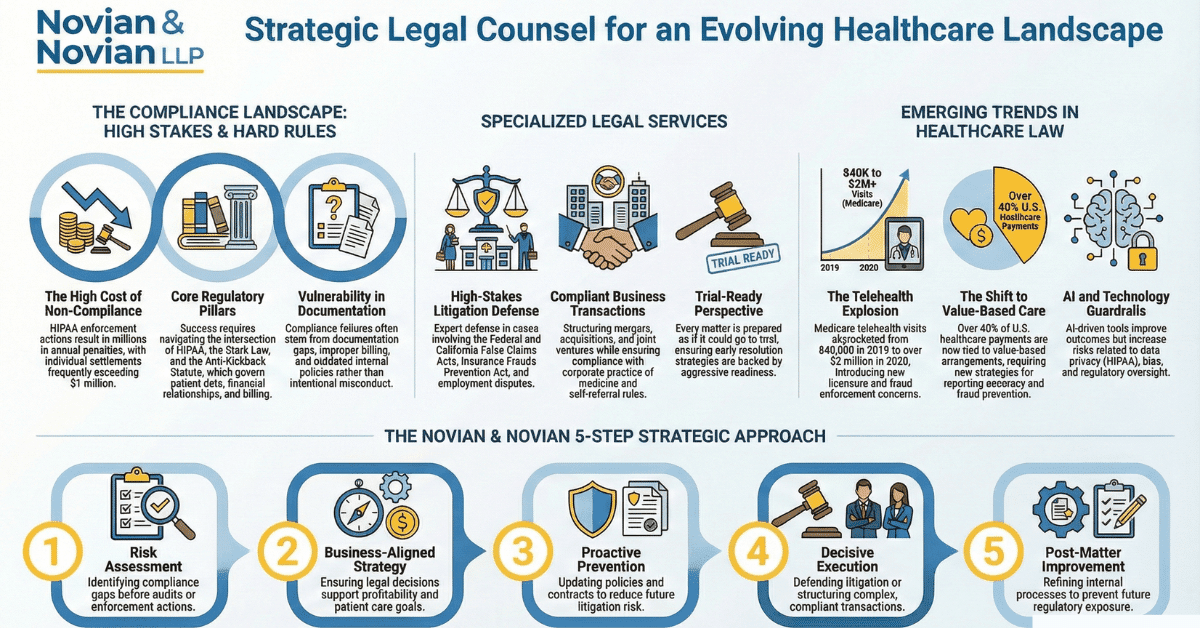
At the center of many compliance matters are core regulations such as HIPAA, the Stark Law, and the Anti-Kickback Statute. These rules govern how patient information is handled, how physicians and providers structure financial relationships, and how medical care is billed and reimbursed.
In practice, these laws rarely operate in isolation. For example, a referral arrangement that seems compliant from a business perspective may still violate Stark or Anti-Kickback rules once Medicare billing is involved. We recommend regularly reviewing contracts, billing practices, and supervision structures to ensure they generally work across different types of health plans and coverage models.
Common compliance challenges often arise from documentation gaps, improper billing, outdated internal policies, and misunderstandings about what services are covered under a particular health plan or Medicare program. We’ve worked with providers who believed their systems were compliant, only to discover during an audit that coding errors or improper use of medical devices triggered significant exposure. Smaller practices and organizations serving low-income populations or older adults are especially at risk, as limited resources can make it harder to monitor compliance across health care services, preventive care, and community care programs.
The consequences of non-compliance can be severe. According to data from the U.S. Department of Health and Human Services, HIPAA enforcement actions result in millions of dollars in penalties each year, with individual settlements frequently exceeding $1 million. These penalties are often accompanied by litigation costs, increased supervision, and, in some cases, exclusion from Medicare or other national health coverage programs, all of which directly affect a provider’s ability to deliver medical care and receive payment.
Legal counsel plays a vital role in helping healthcare organizations navigate this environment. In our work, we take a step-by-step approach: first evaluating risk areas, then aligning policies with regulatory requirements, and finally supporting providers through audits, investigations, or corrective action plans. By involving healthcare lawyers early, organizations can reduce costs, protect patient trust, and stay focused on delivering essential health services while maintaining long-term financial stability.
The healthcare industry is unlike any other. It is highly regulated, deeply interconnected, and constantly evolving.
In our experience, healthcare providers and healthcare businesses often feel pulled in multiple directions at once: delivering quality medical care, managing rising costs, navigating health insurance and Medicare requirements, and staying compliant within complex healthcare systems. This is where having the right legal partner becomes essential.
Here’s how we help healthcare businesses and why you should work with Novian & Novian:
Healthcare
As Novian & Novian, we stay one step ahead of regulatory and industry shifts so our clients don’t have to react after problems arise. We work with hospitals, physician groups, and healthcare organizations seeking to maximize profits while maintaining compliance across health coverage, billing, and operational structures. Our perspective is shaped by trial experience, practical business judgment, and forward-thinking legal strategy, always with an emphasis on cost-effective solutions.
“Healthcare law is not just about compliance, it’s about understanding how legal decisions affect patient care, reimbursement, and long-term sustainability,” says Farid Novian, Managing Partner at Novian & Novian.
We regularly help clients evaluate how new services, medical devices, or billing models will interact with existing health plans and regulatory obligations. For instance, if you’re expanding services or restructuring provider relationships, we recommend addressing compliance issues upfront before an audit or payment dispute threatens your ability to receive care reimbursements.
Litigation
Our team of attorneys seamlessly combines specialized knowledge of healthcare statutes, regulations, and case law with decades of experience in business litigation, employment law, and corporate transactions. We can just as easily handle smaller and medium-sized cases as we can sophisticated, high-stakes matters. We work closely and proactively with our clients to meet their goals in resolving each matter.
When healthcare disputes escalate, early legal strategy can mean the difference between a manageable resolution and years of costly litigation,” Farid Novian explains
Our interdisciplinary team defends individual and institutional clients in lawsuits arising under the California False Claims Act, Federal False Claims Act, and California Insurance Frauds Prevention Act. We represent employers in healthcare-related employment disputes, including, but not limited to: discrimination, harassment, wrongful termination, breach of employment contracts, and retaliation (e.g., under California Health & Safety Code section 1278.5). We also represent providers in a variety of business torts and medical billing disputes, which can range from negotiating settlements with billing companies and payors, to aggressively pursuing claims in state and federal court.
In all, the following non-exhaustive list includes the types of matters we litigate on behalf of our various clients in the healthcare industry:
- California False Claims Act (“CFCA”) (California Government Code sections 12650, et seq.)
- Federal False Claims Act (“FCA”) (31 U.S.C. sections 3729, et seq.)
- California Insurance Frauds Prevention Act (“IFPA”) (California Insurance Code sections 1871.7, et seq.)
- Contract disputes
- Partnership and corporate disputes
- Business torts
- Misappropriation of trade secrets
- Breach of fiduciary duty
- Intentional Interference with Prospective Economic Advantage
- Employment discrimination
- Harassment
- Wrongful termination
- Retaliation (e.g., California Health & Safety Code section 1278.5)
- Medical billing disputes
Transactions
Healthcare transactions demand careful planning and legal supervision due to strict state and federal limitations on ownership, referrals, and compensation structures. In our work, we help healthcare businesses navigate these challenges while still moving deals forward efficiently and compliantly. We often advise clients that what generally works in other industries may not apply in healthcare—and overlooking that distinction can be costly.
“A successful healthcare transaction is one that works on paper, in practice, and under regulatory scrutiny,” Farid Novian notes.
Our transactional services include entity formation, buy-sell agreements, mergers and acquisitions, joint ventures, securities matters, management services agreements, and business and employment agreements. We also counsel clients on safeguarding patient confidentiality, anti-kickback and self-referral rules, and corporate practice of medicine issues. For example, when structuring a joint venture, we help evaluate how compensation and referral arrangements could impact billing, coverage eligibility, and long-term financial outcomes.
Our transactional services include, but are not limited to:
- Entity formation
- Buy-sell agreements
- Mergers and acquisitions
- Joint ventures
- Securities
- Safeguarding patient confidentiality
- Counseling for anti-kickback, self-referral
- Corporate practice of medicine issues
- Business and employment agreements
- Management services agreements
Innovations and Emerging Trends in Healthcare Law
One of the most significant shifts we’ve seen is the expansion of telehealth under Medicare, Medicaid, and private health insurance plans. During and after the COVID-19 public health emergency, telehealth utilization increased dramatically, with Medicare telehealth visits rising from approximately 840,000 in 2019 to more than 52 million in 2020, according to the Centers for Medicare & Medicaid Services (CMS). While this expansion improved access, especially for older adults, low-income patients, and local community populations, it also introduced new compliance concerns around licensure, supervision, reimbursement eligibility, and fraud enforcement. We often advise providers to closely evaluate which services are covered, how documentation is handled, and whether telehealth offerings generally work under each applicable health plan.
Healthcare technology presents another fast-evolving legal landscape. The use of AI-driven tools in diagnostics, billing, and patient engagement raises complex questions around data privacy, medical devices regulation, and patient safety. A systematic review published in The Lancet Digital Health highlights that while AI can improve outcomes, insufficient regulatory oversight increases risks related to bias, transparency, and patient harm From our perspective, providers must evaluate not just what technology can do, but whether its use aligns with HIPAA, state privacy laws, and emerging federal guidance.
“Innovation in healthcare is essential, but innovation without legal guardrails puts providers, patients, and revenue at risk,” says Farid Novian, Managing Partner at Novian & Novian.
Reimbursement models are also evolving, with a continued shift away from traditional fee-for-service toward value-based care and alternative payment models. According to the Health Care Payment Learning & Action Network, over 40% of U.S. healthcare payments are now tied to value-based arrangements. While these models aim to improve patient outcomes and overall well-being, they also introduce new regulatory scrutiny tied to quality metrics, reporting accuracy, and fraud prevention. For instance, inaccurate reporting can trigger audits, repayment demands, or False Claims Act exposure.
“As reimbursement models change, compliance strategy must change with them. What worked five years ago may no longer be defensible today,” Farid Novian explains.
Our Approach to Healthcare Law
Here’s a step-by-by guide on how we approach healthcare law at Novian & Novian:
|
Step |
Our Focus |
What This Means for Your Healthcare Organization |
|
1. Risk Assessment & Compliance Evaluation |
We begin with a thorough review of your healthcare operations, health insurance participation, billing practices, and regulatory exposure across Medicare, Affordable Care Act programs, and private health plans. |
You gain clarity on where compliance gaps exist. it could be before audits, payment denials, or when enforcement actions arise. This clarity helps you control costs and protect revenue effectively. |
|
2. Business-Aligned Legal Strategy |
In our experience, legal advice only works when it supports business realities. We align legal strategy with your financial goals, growth plans, and patient care priorities. |
Your legal decisions support profitability, operational efficiency, and continued access to essential health care services. |
|
3. Proactive Prevention & Dispute Avoidance |
We recommend preventive measures such as policy updates, contract reviews, and internal supervision structures that generally work across different healthcare systems. |
This reduces litigation risk, minimizes disruptions to medical care, and helps your organization stay compliant while focusing on patient well-being. |
|
4. Litigation or Transaction Execution |
When disputes or transactions arise, we execute decisively. It could be defending against healthcare litigation, resolving billing disputes, or structuring compliant business transactions. |
You benefit from experienced advocacy and precise execution that protects your organization during high-stakes matters. |
|
5. Post-Matter Supervision & Improvement |
After resolution, we help evaluate outcomes, refine internal processes, and implement improvements to prevent future exposure. |
Your organization emerges stronger, better positioned to adapt, and more resilient within an evolving healthcare industry. |
Transactions
Business transactions in the healthcare industry present a unique set of challenges that our experienced attorneys skillfully navigate to meet our clients’ ultimate goals. State and federal laws place limitations on entity formation, ownership, sale, and operation issues that must be carefully monitored to avoid penalties. We counsel our individual and institutional clients in effectuating the transactions themselves, and ensure compliance with the applicable state and federal laws. Our transactional services include, but are not limited to:

Entity formation

Buy-sell agreements

Mergers and acquisitions

Joint ventures

Securities

Safeguarding patient confidentiality

Counseling for anti-kickback, self-referral

Corporate practice of medicine issues

Business and employment agreements

Management services agreements
Why Healthcare Organizations Choose Novian & Novian
In our experience representing healthcare providers and healthcare businesses, organizations don’t just need lawyers who understand statutes. Instead, they need legal partners who understand how the healthcare system actually works in practice. From health insurance reimbursement and Medicare compliance to employment disputes and high-stakes litigation, our clients come to us because they want clear guidance, fast responses, and strategies that protect both revenue and patient care.
One example that stands out involved a mid-sized healthcare organization facing a six-figure medical billing dispute after a payor retroactively denied coverage under multiple health plans. The organization had already exhausted internal appeals and was concerned about cash flow, payroll, and continued access to care for patients in its local community. We stepped in, conducted a targeted evaluation of billing records and contracts, and challenged the denial using both regulatory and contractual arguments. The matter resolved without litigation, preserving payment, reducing legal costs, and allowing the organization to continue providing essential health services without disruption.
What consistently sets us apart is responsiveness, cost control, and trial readiness. We know healthcare executives operate in real time—week to week, sometimes day to day—and delays can affect patient access, staff morale, and financial stability. We make it a priority to communicate clearly, manage legal spend responsibly, and prepare every matter as if it could go to trial, even when our goal is early resolution.
As our Managing Partner Farid Novian puts it:
“Healthcare organizations don’t come to us for theoretical advice. They come to us for answers that work in the real world, under real regulatory scrutiny.”
If your organization is navigating compliance pressure, a billing dispute, or a complex transaction, we recommend speaking with counsel early. The right legal strategy, when applied at the right time, can often prevent disputes, control costs, and protect your ability to deliver quality medical care. If you’re looking for a healthcare law firm that treats your goals as paramount, Novian & Novian is ready to help.
Other Practice Areas

Business Litigation & Dispute Resolution

Business Organization & Corporate Securities

Catastrophic Injury

Employment Law

Entertainment, Publicity & Privacy

Hospitality

Intellectual Property

Real Estate

Technology Law & Social Media
What Legal Regulations Must Healthcare Providers Comply With?
Healthcare providers must comply with laws such as HIPAA, the Stark Law, the Anti-Kickback Statute, Medicare and Medicaid regulations, and Affordable Care Act requirements, among others. These rules govern everything from patient privacy and billing to referrals, health insurance reimbursement, and participation in national health programs.
How Can Novian & Novian Help With Healthcare Business Transactions?
In our experience, healthcare transactions require careful planning to avoid regulatory violations tied to ownership, referrals, and compensation. Novian & Novian helps structure transactions that align with business goals while maintaining compliance across health plans, Medicare, and other health coverage systems.
What Are Common Risks Facing Healthcare Providers?
Common risks include billing and reimbursement disputes, employment claims, data privacy violations, and False Claims Act exposure. If left unaddressed, these issues can increase costs, disrupt medical care delivery, and threaten a provider’s ability to receive payment.
How Does Telehealth Affect Healthcare Law?
Telehealth expands access to care but introduces legal challenges related to licensure, reimbursement eligibility, supervision, and data privacy. We recommend evaluating telehealth services carefully to ensure they are covered under applicable health plans and comply with federal and state regulations.
What Should I Do If Facing Healthcare Litigation?
If litigation arises, make sure to preserve records, limit internal communications, and consult experienced healthcare counsel as early as possible. Early legal strategy can often reduce financial exposure, protect your organization, and improve long-term outcomes.
Disclaimer: This content is provided for general informational purposes only and does not constitute legal advice or attorney advertising. Viewing or reading this information does not create an attorney-client relationship, and legal outcomes may vary depending on individual circumstances.